 |
| Open Theism Discussion Board > Public Forums > General Chat > Is This Accurate? | Forum Quick Jump
|
| 
BBBCanada
Registered Member

Date Joined Jun 2001
Total Posts : 2763
| Posted 8/8/2010 9:43 PM (GMT -6) |   | I could sooooo relate to his wife in that movie in my most depressive states. Anyhoo...interestingly, the whole idea of supposedly acting self-referentially is kinda what that movie is based on. It kinda leaves you with the odd intuition as an AUDIENCE MEMBER that maybe you (and your "reality" ) are also a part of another state of consciousness. The joke is play on YOU.
Brandon
It is the purpose that makes strong the vow, but vows to every purpose must not hold.--A friend.
To love without love is slavery--Mother Teresa
| | Back to Top | | |
 |
One Love
Registered Member

Date Joined Jan 2003
Total Posts : 13888
| Posted 8/10/2010 8:32 AM (GMT -6) | | We Are: The Illusion of Separateness
We live alone within our personal shell. We relate to people as if appearances were real, as if the ultimate truth dictates that I am here and you are there and an impenetrable wall separates us.
When I look at another person I see the outside. I see a body clearly separate from mine. But when I look at myself, I see the inside, I see my awareness, my consciousness. I know, rationally, that you have awareness, consciousness in you just as I do, that you have hopes and dreams, knowledge and fears just I as I do. But when I look at you, I do not see all this. I know the whole glory and catastrophe of being a human resides there in you, but I don’t see it. And so I assume and act as if consciousness is mine alone, as if consciousness stops at my skin. My perception does not show me your consciousness. You remain hollow to me, just an animated body, not real in the way that I am. How can I bridge this gap between us? How can I operate from the reality that I know must be true despite the limitations of my perception? How can I see you to be as real as I am?
The source of this illusion of separateness lies in the illusion of the ego. Relaxing with friends or family we may lower our inner barriers. In the underlying context of awareness, in the silent pool of consciousness we discover spaciousness without limits. Beneath our thoughts, beneath our emotions, we let go into simple awareness, into consciousness, the field in which we live and experience, the very substance of experience. Consciousness knows no boundaries, does not end at our skin. Space embraces us all, as does consciousness. Space penetrates all and walls cannot limit it. Likewise, our bodies do not define the limits of consciousness.
To rest in awareness, in consciousness, we drop our shell of separation, our false identity and enter the larger world, the great present. As we drain this moat of egoism, we see others in a new way: just people, neither more nor less than ourselves. Sharing in consciousness, knowing that others experience a full inner world just as we do, we begin to bridge the gap. We become simultaneously an entire universe in ourselves and just “one of the guys.” The “guys” become one in consciousness, even though we continue to experience this peculiar fact of life: that we directly know only our own thoughts, emotions, sensations, and not anyone else’s.
The more we enter into the stillness of simple awareness, the more we drop our fences of separation and identity in the consciousness that we share. This brings us to the first level of unity among people: unity in consciousness. Prior to this level, we can speak of cooperation and relationship but not unity.
Will offers a field for another kind of unity: shared intention and common purpose. The levels of unity under commonality of will depend on the depth and breadth of the sharing: from family, to community, to nation, to all humanity, to all life, to the Great Purpose of the Universe. We all enter into shared purpose with others in many types of communities: the corporation, the school, the sports team, the orchestra, the worship community, the political party, the military unit, the construction crew, the city, state, or nation. In all such cases of associated intention, we act in a coordinated fashion as part of a unit larger than our individual self. The result can be true and deep fellowship along with a sense of fulfillment. Shared intention, at its most effective, does not entail loss of individuality, but rather our fully individualized and unique participation in a greater whole.
We know in our hearts that our aim for a meaningful life depends on becoming fully ourselves while transcending ourselves. Both unity in consciousness and unity in will enrich and transform us with a spirit that eventually approaches Love.
Lord Jesus Christ, Son of God, have mercy on me, a sinner. | | Back to Top | | |
|
One Love
Registered Member
Date Joined Jan 2003
Total Posts : 13888
| Posted 8/10/2010 10:06 AM (GMT -6) | | Tom:
Is that yours D? Nice
Nope. It's not mine. It's the from the Inner Frontier website.
********************************************************
Tom:
D: The source of this illusion of separateness lies in the illusion of the ego.
T: Are you equating "ego" with "false self," with construing our true identities with the changing fortunes of earthly existence? If so, then I agree.
Cool.
*****************************************************
D: Beneath our thoughts, beneath our emotions, we let go into simple awareness, into consciousness,
T: ...I don't think there is a form of existence that is "simple awareness" or "pure consciousness" that is also (as you describe) void of "thoughts and emotions." I can't conceive of consciousness that is not the thinking of thoughts and the feeling of value. To be conscious IS to think and feel.
Ah! This is good place to talk about this. It is the false self that believes that consciousness is synonomous with thought and emotion. Why? Because "my story" (the autobiographical self-referencing of the self-occupied self, the "individual" ) is IMPOSSIBLE TO MAINTAIN without the psychological and emotional activity of the mind/brain within consciousness. That's why silence and unknowing are PRIMARY hesychastic experiences. In practicing hesychasm, one LEARNS that there is a state of human consciousness where thoughts and feelings are absent, but where the self still exists.
Amit Goswami and Eckart Tolle (in "A New Earth" ) talk about this...and I think they are on the mark. Ever since Decartes, we have believed "I think, therefore I am" essentially linking the essence of personhood with psychological and emotional activity within the mind. But in the act of silent unknowing, we see that it's more true that "I choose, therefore I am." In stragetically directing our attention away from thought and emotive activity, and towards consciousness itself that grounds both, we experience a new dimension of our own consciousness that shows that the self is NOT thought. Moreover, we see that the "space" of self is NOT just merely limited to our bodies.
Lord Jesus Christ, Son of God, have mercy on me, a sinner. Post Edited (One Love) : 8/10/2010 10:16:02 AM (GMT-5) | | Back to Top | | |
|
One Love
Registered Member
Date Joined Jan 2003
Total Posts : 13888
| Posted 8/10/2010 10:18 AM (GMT -6) | | Case in point. I remember asking a friend of mine this question about a month ago:
"If you were to stop all your thoughts and emotions right now and just "be"...who would you be?"
They looked at me for a while...and said...
"Well, I wouldn't be anyone. I'd be nobody. I wouldn't exist. I don't exist without my thoughts and feelings."
I was like...wow. That's just standard Decartes stuff!! "I think, therefore I am."
But...that's what it means to be totally identified with certain "learned programs" and "individual experiences" of the mind/brain...seeing THAT amalgam as "me"...and everything else in my perception as "not-me" It would be like the sky exhaustively identifying itself totally with the cloud formations and their activities (snow, rain, etc) within itself...and NOT with the environment in which the clouds are sustained. Like the sky wouldn't exist without the clouds that make up so much weather within it.
Now, when you read this, really think to yourself: How many people that I know that actually LIVE this way? From the Autopilot page...
------------------------------------------------------------------------------------------------
We accept as a fundamental cultural norm for each of us to live a predominantly pseudo-conscious life: half-aware and dependent on stimuli, be they external sensory perceptions or internal thoughts, emotions, or physical sensations, to activate our inner life, to move us. And then our actions themselves consist of habitual responses, associative thoughts, reactive emotions, and bodily habits. We live enmeshed in our automatic thoughts and routine actions, a style of life that requires little real engagement. We cruise along, not necessarily blissfully, until something unpleasant intrudes, whereupon we engage just long enough to set a course toward ridding ourselves of the unpleasantness. Or if something unusually pleasant comes along, we might notice that and set a course toward it. Once our course is set, we promptly fall back into automatic patterns of action.
We live primarily, both inwardly and outwardly, by the patterns acquired over our lifetime, patterns that enable us to stay relatively unaware and unengaged. Our remarkably intricate brains and their complex networks mask the truth by making us appear, both to ourselves and others, to be fully living our life. However, the reality is that we spend the great bulk of our time in this semi-conscious world of programmed patterns, Autopilot.
We call the most familiar part of this fully-customized and highly-adaptable autopilot our personality. The patterns programmed into our brain circuits of memory, of likes and dislikes, of knowledge and skills, and of habits of thought, emotion, and action, form the conglomeration known as our personality. This personality of ours is so complex that it appears to be conscious and free. But the truth is that every aspect of our personality is programmed and runs on autopilot in response to stimuli. Though the programs can and do change over time, much of our personality remains fixed from early childhood. Even our perceptions are filtered by our personality. If our personality is concerned about being too fat, we see people only in terms of whether they are fat or not, and how they compare to us on that score.
Our personality substitutes for us, for our individuality. This automatic way of being stands in for us, occupying our center and running our life. This is the world that the Buddha, in his First Noble Truth, describes as being unsatisfying. Some of us enjoy a happy personality and others do not. Either way, it all runs by program automatically.
Now none of this implies that our personality is bad or that we should try to rid ourselves of it, even if we could. Indeed it is most necessary. Our personality is the repository of all our life skills, including those that earn us a living. We need it. Life would be dull without our likes and dislikes, our opinions and tastes, and our idiosyncratic manner of speaking and acting. The spiritual path, however, raises issues about personality, issues concerning the level of awareness and the direction of control.
Does our personality have us, or do we have our personality? Do our thoughts take us? Or are we aware of our thoughts as thoughts? Do our thoughts think us? Or do we think our thoughts? Do our emotions take us, with no choice on our part? Or do we feel our emotions, being aware of them as emotions.
Notice your thoughts. You may catch a glimpse of your thoughts thinking themselves: a whole train of them running on, each thought associatively responding to the one before it. And remarkably, these thought trains do not need any intention on your part. Without your intervention, your thoughts just carry on their own life. Occasionally you may tune in, notice your thoughts, and believe that it is you thinking them and that they embody your own actual opinions. But it all goes by rote, on previously formed patterns.
Now it is possible, for a limited time, to think and direct your thoughts intentionally, for example when considering some problem. Then your thoughts are not automatic and you have temporarily and partially raised yourself out of World 6, out of the Autopilot, and into the next higher world. But notice, this requires actual, in-the-moment contact with the meaning of your thoughts, with recognizing that your thoughts are thoughts, a state that is not as common for us as we might believe.
The Autopilot is good and useful in its place. For example, our body performs innumerable, crucial tasks automatically, from maintaining our cells, to digesting our food, to walking, to reading these words. We could not survive without all this automatic functioning of our body.
The problem comes when what should be our higher functions defer to the Autopilot. Do we taste the food we are eating, or do we just eat with little awareness of the food? Do we believe our stock opinions or do we intentionally ponder what is right and true and efficacious? Do we walk along lost in our automatic trains of thought or are we in contact with our body, mind, heart, and surroundings? Do we allow our automatic emotional reactions to dictate how we relate to the people in our life? Do we do our job by rote and habit, or do we give it enough attention to continually improve?
Functioning on autopilot is smooth but habitual. Robots will one day work at this level. Our being on autopilot operates on the automatic energy, with minimal awareness. Will on autopilot remains fragmented and subject to stimuli. We are not engaged, have little initiative, do not choose, and abdicate to habit.
------------------------------------------------------------------------------------------------
The state of humanity where consciousness is totally identified with our personality seems to be JUST WHAT Evdokimov describes with the "prospon" who merges with the "individual":
Every human being possesses a rudimentary person, a psychological center of integration which makes the whole gravitate around the metaphysical Self, and constitutes self-awareness; this is the prosopon, a natural element of the human substance.
...
The "individual" is a sociological and biological category that belongs entirely to nature. The individual is part of the natural whole, and is separate from it either by a contrast, by a demarcation, or through isolation. In the natural state, the prosopon merges with the individual; it is but a "potentiality" of the person. But once actualized, it demands maturing into a hypostasis, which is a spiritual category. It is not a part, but contains the whole, which explains its ability to be enhypostasized.
The individual to whom one ascribes "a strong personality" merely presents a particular mixture of natural elements, with certain prominent traits. Despite these salient traits, such a person ultimately creates only the impression of deja vu. A saint is striking because of a countenance unique in the world, because of a light that is always ultimately person. He or she has never seen before.
Lord Jesus Christ, Son of God, have mercy on me, a sinner. Post Edited (One Love) : 8/10/2010 10:53:18 AM (GMT-5) | | Back to Top | | |
|
Tom
Registered Member

Date Joined Jul 2001
Total Posts : 10353
| Posted 8/10/2010 1:25 PM (GMT -6) | | D: Ah! This is good place to talk about this. It is the false self that believes that consciousness is synonomous with thought and emotion. Why? Because "my story" (the autobiographical self-referencing of the self-occupied self, the "individual" ) is IMPOSSIBLE TO MAINTAIN without the psychological and emotional activity of the mind/brain within consciousness. That's why silence and unknowing are PRIMARY hesychastic experiences. In practicing hesychasm, one LEARNS that there is a state of human consciousness where thoughts and feelings are absent, but where the self still exists.
T: I can't argue against mystical experience. That kinda ends the conversation. But with the permission of all the mystics out there, I'll humbly disagree with you that conscious experience can manifest/instantiate itself apart from all thought and feeling.
D: Amit Goswami and Eckart Tolle (in "A New Earth" ) talk about this...and I think they are on the mark. Ever since Decartes, we have believed "I think, therefore I am" essentially linking the essence of personhood with psychological and emotional activity within the mind.
T: They ARE "linked," even if they are not strictly speaking "synonymous." I'm not saying that consciousness is synonymous with the CONTENT or OBJECT of one's thought. I'm saying that conscious experience is by definition thinking/feeling experience.
You'll have a hard time denying this, D, unless you want to deny that God is essentially a thinking/feeling being, and you can't do that without denying that God is essentially unsurpassable aesthetic satisfaction.
D: But in the act of silent unknowing, we see that it's more true that "I choose, therefore I am."
T: All choice is valuation, all valuation is by definition a "feeling unto" aesthetic satisfaction.
Tom
KIXYTΘEMTA | | Back to Top | | |
|
One Love
Registered Member
Date Joined Jan 2003
Total Posts : 13888
| Posted 8/10/2010 2:53 PM (GMT -6) | | Tom:
I really think you're misunderstanding 'consciousness' (not that any of us has the last word, mind ya; I don't think anybody ), but I think Goswami and Tolle are missing something. It may be due to their belief in the nature of ultimately/necessary reality (i.e., God), though I'm not sure of their beliefs on this matter. But if we believe God is necessary unsurpassable aesthetic satisfaction, then it follows that THIS always necessarily qualifies consciousness or rather, I'd prefer to say that: consciousness is the MODE of aesthetic satisfaction, and that's irreducibly rational and feeling.
From what I've been understanding God's unsurpassable aesthetic satisfaction is basically uncreated consciousness reflecting upon itself, relating itself to itself, and experiencing unsurpassable aesthetic satisfaction from that self-relationship. Basically, this occurs when uncreated consciousness has ITSELF as the object of it's awareness/perception, such that observer, observed, and the process of observation all become one reality. Another way of saying this would be God knowing Godself, willing to be Godself, and in so doing, experiencing delight in Godself. This would be God's "spiritual" activity...but it is NOT thought or emotional drive, per se.
God can do this because God is Spirit. We can do this too (to some degree) as we are spirit.
Lord Jesus Christ, Son of God, have mercy on me, a sinner. Post Edited (One Love) : 8/10/2010 2:58:25 PM (GMT-5) | | Back to Top | | |
|
One Love
Registered Member
Date Joined Jan 2003
Total Posts : 13888
| Posted 8/10/2010 3:08 PM (GMT -6) | | Tom:
I can't conceive of consciousness that is not the thinking of thoughts and the feeling of value. To be conscious IS to think and feel.
and...
You'll have a hard time denying this, D, unless you want to deny that God is essentially a thinking/feeling being...
All I'm saying is that uncreated consciousness TRANSCENDS any thoughts or feelings of value within the Divine Mind...and is not exhaustively identified with said thoughts or feelings of value. Uncreated Consciousness directly experiencing this transcendence, I believe, grounds the unsurpassable aesthetic satisfaction of God.
Scripturally, it's the Spirit of God (inseparable from uncreated consciousness) that is the MEANS and GROUNDS for God's "thoughts" and how they are discerned, yes? God's Spirit is transcedent to God's thoughts and feelings as such. We wouldn't say that God's personal nature is SOLELY found in his thoughts and feelings, now would we?
Lord Jesus Christ, Son of God, have mercy on me, a sinner. Post Edited (One Love) : 8/10/2010 3:17:41 PM (GMT-5) | | Back to Top | | |
|
Tom
Registered Member
Date Joined Jul 2001
Total Posts : 10353
| Posted 8/10/2010 4:06 PM (GMT -6) | | D: All I'm saying is that uncreated consciousness TRANSCENDS any thoughts or feelings of value within the Divine Mind...
T: How can you possibly know that?
It sure looks to me like you've posited a reality (transcendent consciousness) definitive of divinity that is MORE FUNDAMENTAL than God as experiencing SUBJECT and the unsurpassable aesthetic satisfaction definitive of his subjectivity. That's a big abandonment of Greg's work Bro.
Why do you think it needs to be the case that God is most fundamentally a consciousness that transcends even God's own thoughts and experience of himself?
D: Uncreated Consciousness directly experiencing this transcendence, I believe, grounds the unsurpassable aesthetic satisfaction of God.
T: That seems impossible given Greg's metaphysic. Think through it. You're saying the pure divine consciousness (void of all thought and feeling) "experiences" its own transcendence of God's thoughts and feelings and that this grounds God's experience/enjoyment of Godself. You're positing a contentless experience--void of all thoughtful and felt content, and that's a denial of process categories. You've got the experience of consciousness GROUNDING God's own felt experience of his beauty. That makes what is necessary a consequence of some greater MORE fundamental reality. In other words, if pure consciousness is both a) the ground of God's perception and enjoyment of his own beauty AND b) void of all thought and valuation, then c) you've essentially denied fundamental process categories and so the very core of Greg's process metaphysic, and d) why should a pure contentless consciousness which neither thinks nor feels/evaluates nor chooses ground an experience of beauty and enjoyment as opposed to horror or suffering? Why should such consciousness be essentially love and goodness as opposed to anything else? Why should that which neither thinks/perceives/feels ground loving and beautiful thoughts and feelings? A consciousness that neither thinks nor evaluates? It's a contradiction of terms.
What's meaningless to me is the notion of "consciousness" per se "having an experience" of itself, an experience that is void of all thought and feeling, and that this "experience" grounds the further experience of aesthetic satisfaction. Makes no sense.
D: We wouldn't say that God's personal nature is SOLELY found in his thoughts and feelings, now would we?
T: If by solely you mean thoughts and feelings void of all consciousness (they way you're imagining a consciousness void of all thought and feeling), then no. Thought/feeling are inseparable from consciousness, consciousness being simply the MODE of aesthetic satisfaction. So to my mind there is no such thing as "thought and feeling void of all consciousness" (i.e., "SOLELY thought and feeling" ). But if we mean "conscious thought and feeling" (consciousness being the mode of thought and feeling), then yes, God's thoughts and feelings (as far as the terms apply to God at all) constitute God's interpersonal nature.
Caveat: We are WAAAAAAY into speculation, so who cares? BUT, unless you can show me what's being gained here by your positing a reality (pure consciousness void of thought and feeling) that is itself the GROUNDS of God's own thoughts and feelings. a) I don't see how you could possibly know this? and b) I don't see what it explains?
Tom
KIXYTΘEMTAPost Edited (Tom) : 8/10/2010 5:02:54 PM (GMT-5) | | Back to Top | | |
|
One Love
Registered Member
Date Joined Jan 2003
Total Posts : 13888
| Posted 8/10/2010 5:19 PM (GMT -6) | | Tom:
It sure looks to me like you've posited a reality (transcendent consciousness) definitive of divinity that is MORE FUNDAMENTAL than God as experiencing SUBJECT and the unsurpassable aesthetic satisfaction definitive of his subjectivity. That's a big abandonment of Greg's work Bro.
I have done no such thing. What I have articulated is this: God as experiencing subject, which experiences unsurpassable aesthetic satisfaction definitive of his subjectivity...is IMPOSSIBLE without God having a faculty by which he could know Godself and know God's "thoughts": God being Spirit. the Transcendental Reality I've described is another way of saying "God IS Spirit." And God AS Spirit is what grounds his personal being, an experiencing subject who can experience unsurpassable aesthetic satisfaction.
Ask Greg this: Can the Father "know his own thoughts" and self-communicate himself to an "other" without the Holy Spirit? SCRIPTURALLY speaking...but also metaphysically speaking?
Better yet...ask this: When the Father reflects upon his own existence, is the Holy Spirit, in any way, involved in that?
In my mind, the faculty of conscious being that can ground the generation of various thoughts and feeings that can distingish and choose various thoughts and feelings to actualize and express MUST transcend the possible thoughts and feelings that are generated (and eliminated) by the one who transcends them...and can "take them on" and live them. This is "spirit." The "nous." Whatever.
All we're saying is that God has a Spirit, too.
Lord Jesus Christ, Son of God, have mercy on me, a sinner. Post Edited (One Love) : 8/10/2010 5:22:26 PM (GMT-5) | | Back to Top | | |
|
One Love
Registered Member
Date Joined Jan 2003
Total Posts : 13888
| Posted 8/10/2010 5:31 PM (GMT -6) | | Tom:
You're saying the pure divine consciousness (void of all thought and feeling) "experiences" its own transcendence of God's thoughts and feelings and that this grounds God's experience/enjoyment of Godself. You're positing a contentless experience--void of all thoughtful and felt content, and that's a denial of process categories. You've got the experience of consciousness GROUNDING God's own felt experience of his beauty. That makes what is necessary a consequence of some greater MORE fundamental reality. In other words, if pure consciousness is both a) the ground of God's perception and enjoyment of his own beauty AND b) void of all thought and valuation, then c) you've essentially denied fundamental process categories and so the very core of Greg's process metaphysic, and d) why should a pure contentless consciousness which neither thinks nor feels/evaluates nor chooses ground an experience of beauty and enjoyment as opposed to horror or suffering? Why should such consciousness be essentially love and goodness as opposed to anything else? Why should that which neither thinks/perceives/feels ground loving and beautiful thoughts and feelings? A consciousness that neither thinks nor evaluates? It's a contradiction of terms.
I'm basically saying that God, in self-relationship, continually experiences the "joy of being God" in an unsurpassably intense manner, such that God is aesthetically satisfied...and that this entire process is GROUNDED in the activity of God as Spirit. God the Spirit is the Uncreated Consciousness that grounds God's self-referential and self-expressive processes...the Trinity AND Creation. Is this not true?
"You've got the experience of consciousness GROUNDING God's own felt experience of his beauty."
For who knows a person’s thoughts except the spirit of that person, which is in him? So also no one comprehends the thoughts of God except the Spirit of God.
Lord Jesus Christ, Son of God, have mercy on me, a sinner. | | Back to Top | | |
|
Tom
Registered Member
Date Joined Jul 2001
Total Posts : 10353
| Posted 8/10/2010 7:15 PM (GMT -6) | | D: What I have articulated is this: God as experiencing subject, which experiences unsurpassable aesthetic satisfaction definitive of his subjectivity...is IMPOSSIBLE without God having a faculty by which he could know Godself and know God's "thoughts": God being Spirit.
Tom: I'm hearing: God could not be a thinking/feeling/willing personal subject without being conscious.
Who would disagree?
Now, what I'M saying is that God could not be conscious without thinking/feeling/willing. I'm saying neither consciousness nor thinking/feeling/willing is instantiated without the other. There is no consciousness (conscious experience) that is not and experience of sentient feeling and there is no experience of sentience and feeling that is not conscious experience. Consciousness is the mode of aesthetic satisfaction: i.e., God is Spirit. There's no such satisfaction apart from consciousness, and no consciousness that is not sentiently evaluative.
What I hear YOU saying is that there is a consciousness (a conscious experience) which is in no way a thinking/feeling experience, a consciousness that can be instantiated apart from any thought or feeling whatsoever. That would mean thought, feeling, and volition are CONTINGENT properties of God, properties apart from which God would remain a conscious experiencer. If that's what you're saying, then I'm disagreeing. Is that what you're saying?
Again, I'm not saying consciousness = thought/feeling. They're not strictly speaking synonymous. But they are--what's the word I want? Concomitant? Perhaps something stronger. The instantiation of either by definition requires the other. So there's no discarding thought/feeling to enter an experience of pure consciousness void of all thought and feeling. What would make it DESIRABLE on any account? Indeed, what could be DESIRABLE about an experience void of desire/feeling/desire? Is it an experience one would recommend to others? On what basis? What would it be about the absence of all thought/feeling (See Yanneras on eros as definitive of God and the goal of human being) that could RECOMMEND itself to others? A recommendation is a valuation.
Tom
KIXYTΘEMTAPost Edited (Tom) : 8/10/2010 10:01:17 PM (GMT-5) | | Back to Top | | |
|
One Love
Registered Member
Date Joined Jan 2003
Total Posts : 13888
| Posted 8/11/2010 7:51 AM (GMT -6) | | Tom:
Again, I'm not saying consciousness = thought/feeling. They're not strictly speaking synonymous. But they are--what's the word I want? Concomitant? Perhaps something stronger. The instantiation of either by definition requires the other. So there's no discarding thought/feeling to enter an experience of pure consciousness void of all thought and feeling.
I hear what you are saying. I'm thinking that consciousness (as the field of subjectivity that grounds and sustains thought/feeling/will) IN conscious experience is in a bi-polar ASSYMETRICAL relational unity with thought/feeling/will...such that they are NOT equivalent, though always together. Just like the mind of a thinker who is actively thinking will be in a bi-polar assymetrical relational unity with the actively sustained thought. There is such a thing as unconscious perception in human beings (consciousness active without awareness), but sense we are talking about God, we're assuming that Uncreated Consciosuness is always aware of whatever is perceived...and doesn't have a nervous system, such that there is any time gap between perception and awareness.
I think what I'm trying to get at is 1) the real distinction between generated thoughts/feelings and the consciousness of the subject wherein the thoughts/feelings are generated and 2)the experience of consciousness being self-reflexive...basically an observing consciousness observing only itself and relating itself to that experience, and not any particular thoughts or feelings generated within the consciousness. The closest approximation to this experience for humans that I can think of would be silent, unknowing in meditation where all secondary-awareness processes (like introspective reflection like "I-am-this") are shifted from the foreground to the background of awareness.
When a human being experiences that who they are is not simply amalgams of thought and feeling, including personalized memories of choice...but the field of subjectivity within which these things occur. The human subject is NOT JUST the human mind/brain or it's activities.
Lord Jesus Christ, Son of God, have mercy on me, a sinner. Post Edited (One Love) : 8/11/2010 8:22:10 AM (GMT-5) | | Back to Top | | |
|
Tom
Registered Member
Date Joined Jul 2001
Total Posts : 10353
| Posted 8/11/2010 9:28 AM (GMT -6) | | D: I hear what you are saying. I'm thinking that consciousness (as the field of subjectivity that grounds and sustains thought/feeling/will)…
T: Even “field of subjectivity” creates problems for me. As I think about what that might be or mean, I just come up empty handed. Subjectivity is an abstract term we use to describe the activity of a subject. Apart from that activity, what can it possibly be? Pure subjectivity void of all thought and feeling? It just doesn’t compute. We could mean the scope of a conscious person’s perception or something like that, but that’s not what you mean. You want to say that ‘consciousness’ is a thing, and entity, or some kind of thoughtless/feelingless soup of sentience that is FIRST required to BE before thought and feeling and choices can occur.
D: …in a bi-polar ASSYMETRICAL relational unity with thought/feeling/will...such that they are NOT equivalent, though always together. Just like the mind of a thinker who is actively thinking will be in a bi-polar assymetrical relational unity with the actively sustained thought.
T: Not equivalent and always together can just as well describe a perfect symmetry too. But I want to agree that there’s a) a certain difference between consciousness and thought/feeling and b) there’s a certain dependency OF thought/feeling UPON consciousness that isn’t the case when you consider the relationship in the other direction.
D: I think what I'm trying to get at is 1) the real distinction between generated thoughts/feelings and the consciousness of the subject wherein the thoughts/feelings are generated and 2) the experience of consciousness being self-reflexive...basically an observing consciousness observing only itself and relating itself to that experience, and not any particular thoughts or feelings generated within the consciousness.
T: Maybe it would help to distinguish in the content of a conscious subject’s thought/feeling between necessary and contingent thoughts/feelings (or between definitional and constitutive activities of conscious disposition). On your (1) what we want to say that consciousness isn’t synonymous with all the generated thoughts that clutter our minds (what we’re wearing, what our job is, thoughts of our body, environment, etc.). Thoughts don’t DEFINE us. But that doesn’t mean NO conscious thought or feeling defines us, and that looks to me to be what your (2) is. Self-perception isn’t a no-thought/no-feeling act of perception, a content-less perception, because there’s nothing beautiful about zero-content. So, let’s just say that there is a certain core-content definitive of the self-perceiving act which is God’s self-defining conscious act. And what would that content be? It’s the Logos. The Son IS the thoughtful content of the Father’s own self-perceiving act.
I think you would like to posit the Spirit logically prior to all this and say that the Spirit just is ‘divine consciousness’ or that ‘field of subjectivity’ by which the Father perceives his own self and ‘generates’ (we were talking about distinguishing between generating necessary vs contingent thoughts) the Logos. I appreciate the role of the Spirit. My problem is that this makes the Spirit rather than the Father the fountainhead of deity. It places the Spirit logically prior to both Father and Son as GROUND of each. I’m not sure I wanna say that.
Another problem is that it makes impossible a view on the relations that you and I like very much (discussed by Zizzy actually, who discusses Augustine’s agreement on it]. Remember you and I thought we had found the answer to the filioque, something that satisfied both east and west? We said that in a sense it is true that the Spirit and Son are both generated by the Father, but that this only occurs as the Son is generated by the Father’s self-perceiving act and THEN—since the Son is the EXACT representation of the Father—and since the Father spirates the Spirit (with the East), we say the Son also, as complete imagine of the Father, also spirates the Spirit, so that the Spirit is spirated by both Father and Son, but only by the Son in virtue of his being a derived/generated complete image of the Father.
Fine. But this is all out the widow IF you place the Spirit’s actualized personhood prior to both Father and Son as the required field of subjectivity needed before the Father can even self-perceive. See?
D: The closest approximation to this experience for humans that I can think of would be silent, unknowing in meditation where all secondary-awareness processes (like introspective reflection like "I-am-this") are shifted from the foreground to the background of awareness.
T: I can get with the possibility of a self-perceiving act that doesn’t require any extraneous thoughts or feelings which are not definitive of the ‘self’ (I don’t use ‘self’ just to denote false selves, like you do). But that doesn’t mean the self-perceiving act doesn’t generate some thoughtful and emotional content. I think it must, otherwise you don’t get a necessary generation of the Son as the Father’s Logos by mean’s of the Father’s simply act of self-contemplation.
Tom
KIXYTΘEMTA | | Back to Top | | |
|
One Love
Registered Member
Date Joined Jan 2003
Total Posts : 13888
| Posted 8/11/2010 10:17 AM (GMT -6) | | Tom:
I want to agree that there’s a) a certain difference between consciousness and thought/feeling and b) there’s a certain dependency OF thought/feeling UPON consciousness that isn’t the case when you consider the relationship in the other direction.
This is it. Especially the bolded part.
**************************************************
Tom:
Maybe it would help to distinguish in the content of a conscious subject’s thought/feeling between necessary and contingent thoughts/feelings (or between definitional and constitutive activities of conscious disposition). On your (1) what we want to say that consciousness isn’t synonymous with all the generated thoughts that clutter our minds (what we’re wearing, what our job is, thoughts of our body, environment, etc.). Thoughts don’t DEFINE us. But that doesn’t mean NO conscious thought or feeling defines us, and that looks to me to be what your (2) is. Self-perception isn’t a no-thought/no-feeling act of perception, a content-less perception, because there’s nothing beautiful about zero-content. So, let’s just say that there is a certain core-content definitive of the self-perceiving act which is God’s self-defining conscious act. And what would that content be? It’s the Logos. The Son IS the thoughtful content of the Father’s own self-perceiving act.
Ok. What I hear you saying is this: The apprehension and aesthetic evaluation of one's self-perceiving act (where the observer's object of observation is only the observer) is it's own content that is distinct and distinguishable from thoughts/feelings that are NOT essentially of the self-perceiving act, like activity of imagination. What this means is that their is necessary aesthetic evaluation, but ONLY that of the self-perceiving act itself. I can go with this. It better encapsulates what I'm getting at, I think.
*************************************************
Tom:
I think you would like to posit the Spirit logically prior to all this and say that the Spirit just is ‘divine consciousness’ or that ‘field of subjectivity’ by which the Father perceives his own self and ‘generates’ (we were talking about distinguishing between generating necessary vs contingent thoughts) the Logos. I appreciate the role of the Spirit. My problem is that this makes the Spirit rather than the Father the fountainhead of deity. It places the Spirit logically prior to both Father and Son as GROUND of each. I’m not sure I wanna say that.
Another problem is that it makes impossible a view on the relations that you and I like very much (discussed by Zizzy actually, who discusses Augustine’s agreement on it]. Remember you and I thought we had found the answer to the filioque, something that satisfied both east and west? We said that in a sense it is true that the Spirit and Son are both generated by the Father, but that this only occurs as the Son is generated by the Father’s self-perceiving act and THEN—since the Son is the EXACT representation of the Father—and since the Father spirates the Spirit (with the East), we say the Son also, as complete imagine of the Father, also spirates the Spirit, so that the Spirit is spirated by both Father and Son, but only by the Son in virtue of his being a derived/generated complete image of the Father.
Fine. But this is all out the widow IF you place the Spirit’s actualized personhood prior to both Father and Son as the required field of subjectivity needed before the Father can even self-perceive. See?
Here's the thing: The Father IS the fountainhead of deity. At the same time, logically speaking, the Father would not have the ability for and exercise of self-perceive and self-communicate without his disposition to do so, which IS the Holy Spirit. (Remember that talk I had with Greg?) The Son, as perfect self-reflection of the Father, naturally possesses the Spirit because the Father naturally possesses the Spirit, right?
It's not saying that the Spirit is logically prior to the Father, more than saying this: The Holy Spirit is the Father's "availability" for self-perception, self-knowledge, and self-communication.
**************************************************** D: The closest approximation to this experience for humans that I can think of would be silent, unknowing in meditation where all secondary-awareness processes (like introspective reflection like "I-am-this" are shifted from the foreground to the background of awareness.
T: I can get with the possibility of a self-perceiving act that doesn’t require any extraneous thoughts or feelings which are not definitive of the ‘self’ (I don’t use ‘self’ just to denote false selves, like you do). But that doesn’t mean the self-perceiving act doesn’t generate some thoughtful and emotional content. I think it must, otherwise you don’t get a necessary generation of the Son as the Father’s Logos by mean’s of the Father’s simply act of self-contemplation.You're right. Taking it to God, God gets aesthetic satisfaction via unsurpassably intense experience in his self-perceiving activity sans any non-divine reality. Humanly speaking, it's getting aesthetic satisfaction in self-percieving activity without referencing any "images" in the human mind/brain. (Images that are grounded in human neurology in the realmo of time, space, matter, and energy) **************************************************** Tom: D: As I see it, it FREES one to not have their identities bound up in categories created by the mind, but in the "suchness" of one's own direct experience of oneself as conscious being.
T: I take it this FREEDOM is a desirable thing, something which is ENJOYED when its experienced. I take it that silent unknowing is a good thing, a desirable thing. But that makes it an experience of FEELING and you're saying it's VOID of all thought and feeling. I'm wondering what makes it a good thing at all then.Point taken. Again, we can say that for the "spiritual" being, the self-perceiving act has itself as it's necessary aesthetic content...though this is DISTINCT from aesthetic evaluation based upon IMAGES (thought/feelings using the imagination).
Lord Jesus Christ, Son of God, have mercy on me, a sinner. Post Edited (One Love) : 8/11/2010 10:25:52 AM (GMT-5) | | Back to Top | | |
|
One Love
Registered Member
Date Joined Jan 2003
Total Posts : 13888
| Posted 8/11/2010 10:27 AM (GMT -6) | | You said something interesting, Tom...
I can get with the possibility of a self-perceiving act that doesn’t require any extraneous thoughts or feelings which are not definitive of the ‘self’ .
And that's just it. Once you eliminate all the things that are NOT the "self", what are you left with?
From an Inner Frontier website...
Our belief in our ego, or separate self, is to a large extent learned from society. All the people around us labor under a self-centered perspective on life, which naturally devolves to impressionable children. Repeatedly shining the light of awareness directly on this sense of separateness gradually disperses it. But i f we look carefully for our ego, for this separate self that we think we are, we shall not find it.
Am I my body? I can control my body, I can be aware of my body, and my awareness is greater than my body. So I am probably not my body.
Am I my feelings? I can be aware of my feelings and have some rudimentary influence on them, so I am probably not my feelings.
Am I my thoughts? My thoughts claim the title of I, thinking “I think,” “I am hungry.” But that “I” is just a thought, having no more substance than any other thought. It fools me though, this thought “I.” I believe in it. I believe it refers to something real and substantial, to the real me. But if I look at it clearly, I see it as only a thought with no real referent. At best, I may have a vague idea that I am some combination of my thoughts, feelings, and body. Again it proves empty to the insightful observer.
Am I my knowledge and experience, my habits and desires, my style - in short, my personality? But I can see all this at work in myself. And clearly, the one who sees seems closer to me than this whole complex of acquired patterns and inherited predispositions that I call my personality. So no, I am not my personality. I need my personality because only through it can I function in life, but I also need to remember that this personality is not who I am.
How about my awareness? Am I my awareness? Two problems here. First, I have some control over what I am aware of. So there must be something deeper. Second, the deeper I go into awareness, the less it is centered in me, so how can that be me as a separate entity, as an ego?
How about my attention? How about that in me that decides, my will? This is the subtlest of all. Yet again, the deeper I look into my will, the less it is centered in me, and the more it opens beyond me.
So wherever we look, we do not find this self, this separate person that takes our name, this self-important actor on the stage of our life. The more we engage in spiritual inner work, the more carefully and persistently we are able look into ourselves, and the more this once-compelling ego, this self disappears. Or perhaps we see that it never existed to begin with. Gradually, our belief in our ego assumes a porous quality, which rather than cutting us off from others, merely clouds our relationships intermittently. This separate self never was. Our devotion to it shrivels and we are left to truly be ourselves, to play our unique role in the larger story of our common life. When moments come in which we fall back into that trance of selfness, we feel uncomfortable, like in a shoe that no longer fits, and we let it go.
-------------------------------------------------------------------
If I am not my body (including my brain), my personality, or my ability to strategically direct my attention, then who am I?
Lord Jesus Christ, Son of God, have mercy on me, a sinner. Post Edited (One Love) : 8/11/2010 10:49:27 AM (GMT-5) | | Back to Top | | |
|
One Love
Registered Member
Date Joined Jan 2003
Total Posts : 13888
| Posted 8/11/2010 10:31 AM (GMT -6) | | | This is the same type of "no-self" conclusion that the Buddha came to long ago.
Speaking more specifically...it's like this...from THIS website

There are Four Functions of Mind:
Manas = sensory, processing mind
Chitta = storage of impressions
Ahamkara = "I-maker"
Buddhi = knows, decides, judges, and discriminates
Chitta is basically where all of our "programs" and "individual experiences" are stored in the mind/brain relational unity. What happens in most people is that the "I-maker" function of the mind (which provides for self-reference unto individual self-perception) becomes COMPLETELY IDENTIFIED with some of the impressions in Chitta to be directly acted upon by the Manas function. Whatever impression pop up most strongly in the Citta are what are ASSUMED to be the ground of the self by the Ahamkara and acted out in Manas. Buddhi awakens whenever stillness and unknowing in the mind to reveal that identity and freedom do NOT lie at the level of the programs and individual experiences in the neurologically bound Chitta, but with the nonlocal "chooser" that is distinct from those Mana, Ahamkara, and Citta. This realization makes it possible for the human to FREELY CHOOSE among the Chitta what to actualize or not actualize...
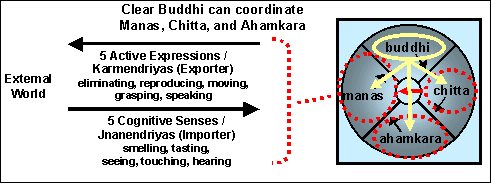
But it also opens up the human consciousness to experience ITSELF without reference to any of the "images" in the Citta or any activity of Ahamkara or Manas, wherein one experiences the non-local subject directly.

Just giving an example. Tom, all of your "personality-of-Tom" is in your Chitta, which is directly related to the neurological wiring in your brain. Let's say you have an accident that causes retrograde amnesia and thereby drastic changes in your personality. Manas, Ahamkara, and Buddhi would still work fine. But your Ahamkara would be associating with DIFFERENT content such that you wouldn't be "acting like Tom" anymore. For all intents and purposes, you wouldn't be "Tom" anymore. You could take the name "Bob" and live a whole different life, if you chose. However, this shows clearly that the material in your Chitta CANNOT be the essence of who you are. At the same time, in the act of silence and unknowing, it wouldn't matter if you were "Tom" or "Bob" at that point, you would come to the SAME realization of non-local conscious being that grounds the activities of world composition and identity formation.
Feel me?
Lord Jesus Christ, Son of God, have mercy on me, a sinner. Post Edited (One Love) : 8/11/2010 11:10:01 AM (GMT-5) | | Back to Top | | |
|
One Love
Registered Member
Date Joined Jan 2003
Total Posts : 13888
| Posted 8/11/2010 11:12 AM (GMT -6) | | Good example: The movie "Regarding Henry"
Basically, Henry's being shot in the head, and the subsequent brain damage, lead to him not being able to associate his identity with some of the previous programs and individual experiences in his Chitta (that of his narcissistic, womanizing, lawyer "self" ) This, in turn, put him in the interesting position of looking at his "old self" from an outside perspective such that he didn't like who he once was...and he wanted to live a different way. This was ONLY possible because the Buddhi within him grounded the Ahamkara's ability to construct a new personality with NEW experiences and NEW reinterpretations of old experiences...to be acted out in the world by the Manas.
In all this transformation, the Buddhi of the "old" Henry would be NO DIFFERENT from the Buddhi of the "new" Henry.
Hoping this illumines more of what I'm saying.
Lord Jesus Christ, Son of God, have mercy on me, a sinner. Post Edited (One Love) : 8/11/2010 12:10:24 PM (GMT-5) | | Back to Top | | |
|
One Love
Registered Member
Date Joined Jan 2003
Total Posts : 13888
| Posted 8/11/2010 11:34 AM (GMT -6) | | Hey, Tom...do you remember this from Edward Moore?
"So, in response to your question: My view is that the memory of our earthly existence will provide us with the continuity of personality necessary for creative expression in the eskhaton. In my book, especially in the passage you quoted, I was taking a stance against Maximus' view that our ego will be replaced by the divine presence, as he states explicitly in Chapters on Knowledge 2.88. If our ego becomes overwhelmed by the absolute presence of God (as Lars Thunberg has put it) then I see no possibility for creative expression, nor even celebration; for we have become, as I write in my book (and elsewhere), 'functions of the Godhead.' We must retain our freedom as persons, which means we must retain memory of the historical development that led us to the eskhaton."
Please note that he directly identifies the self-referential autobiographical memory composed of "programs" and "individual experiences" as the locus of personal individuality and freedom. But isn't the autobiographical memory simply MATERIAL in the Citta that is NOT essential to fundamental human experience of I am-ness?
Furthermore...what I think Maximus as our ego being replaced by the divine presence is analogous to when the human consciousness DISIDENTIFIES with autobiographical memory and personality structure in the Citta and exists primarily as Buddhi, the non-local subject that is inseparable from Divine Presence. This doesn't mean that the autobiographical memory and personality structure are annihilated...not at all. It means that identity is NOT FOUND in those things and self-transcendence exists, such that Buddhi can use memory and the personality structure for transcendent purposes.
Lord Jesus Christ, Son of God, have mercy on me, a sinner. Post Edited (One Love) : 8/11/2010 12:07:03 PM (GMT-5) | | Back to Top | | |
| 108 posts in this thread.
Viewing Page : 1 2 3 4 5 |
| Forum Information | Currently it is Monday, November 09, 2026 9:26 PM (GMT -6)
There are a total of 97,718 posts in 6,040 threads.
In the last 3 days there were 0 new threads and 0 reply posts. View Active Threads
|
Forum powered by dotNetBB v2.42EC SP3
dotNetBB © 2000-2026 |
|
|