 |
Open Theism Discussion Board > Public Forums > General Chat > (No Subject)
| Forum Quick Jump
|
| 
One Love
Registered Member

Date Joined Jan 2003
Total Posts : 13888
| Posted 11/3/2010 11:01 AM (GMT -6) |   | | Okaaaaay....go!

Lord Jesus Christ, Son of God, have mercy on me, a sinner. Post Edited (One Love) : 11/3/2010 4:14:51 PM (GMT-5) | | Back to Top | | |
 |
One Love
Registered Member
Date Joined Jan 2003
Total Posts : 13888
| Posted 11/3/2010 2:57 PM (GMT -6) | | Sorry for the confusion.
How are the human freedom to choose (freedom) and the human sense of conscience and empathy (responsibility) related? Do they mutually engender one another? If so, how? Do they mutually condition one another? If so, how?
Lord Jesus Christ, Son of God, have mercy on me, a sinner. Post Edited (One Love) : 11/3/2010 3:01:37 PM (GMT-5) | | Back to Top | | |
|
One Love
Registered Member
Date Joined Jan 2003
Total Posts : 13888
| Posted 11/3/2010 3:20 PM (GMT -6) | | It's like this: some people feel that the only way to maximize freedom is to free one's freedom to choose from any obligation/duty to anyone or anything and letting one's choices be unrestrained from moral and empathetic sensibilities. Actually, this would be the moral nihilist, will-to-power kind of person. Other's find a sense of freedom in merely resisting or willfully ignoring any obligation/duty. Others still would say that maximize freedom is, paradoxically, to bind one's freedom to choose to doing one's obligation/duty, such that all of one's choices are bounded by moral and empathetic sensibilities. This may well be the deontological Happy Human.
But something's missing.
I'm thinking about these things...
1) The idea of a person's thoughts, intentions, and actions being "constrained" or "compelled" by the love of Christ. (2 Corinthians 5:14)
2) Inter-personal relationship as the ultimate ground of the whole thing (Not merely individual and social promotion, gratification, and expansion of human existence ala extended enculturation)
3) The idea of "trust" (specifically the idea of being entrusted with something or entrusting something to another) as meeting place for freedom, responsibility, and "compulsion" (enforced constraints/boundaries) in the context of interpersonal relationship between the Creator and the created person.
Lord Jesus Christ, Son of God, have mercy on me, a sinner. Post Edited (One Love) : 11/3/2010 3:26:36 PM (GMT-5) | | Back to Top | | |
|
One Love
Registered Member
Date Joined Jan 2003
Total Posts : 13888
| Posted 11/3/2010 3:48 PM (GMT -6) | | I saw this:
We can give up freedom in two ways: because we choose to (responsibility), or because we have to (compulsion). There is an axis of compulsion that runs orthogonal to both freedom and responsibility; we can lose our freedom and gain nothing in responsibility if our actions are compelled by fear of punishment or loss. We must realize at once that compulsion is not responsibility (either unenforced or enforced); a large portion of the world today speaks glibly of social responsibility, but what they really mean is social compulsion. They may indicate that such compulsion is only a temporary necessity, on the way to true responsibility, but historical examples of getting past this step are hardly common.
We have for this case again some biblical analogies. When we restrict our freedoms solely out of fear of the law, we lose both freedom and responsibility. So Paul speaks of the law: "Now before faith came, we were confined under the law, kept under restraint until faith should be revealed. So that the law was our custodian (schoolmaster, KJV) until Christ came, that we might be justified by faith. But now that faith has come, we are no longer under a custodian; for in Christ Jesus you are all sons of God, through faith." (Gal. 3:23-26) Therefore the Christian is called to do responsibly out of love for God what under the law was a matter of compulsion: by entering into the new relationship in Christ compulsion is transformed into responsibility. The same issues constantly arise again; every resort to legalism rather than to responsible discipleship is an attempt to substitute compulsion for responsibility. Such a substitution seems quite appealing: certainly it is both safer and easier to have a strict legal code that can be followed without thought or choice rather than leaving individual choices to the personal responsibility; this is not, however, the kind of Christian maturity to which Christ has called us. Note that this framework avoids extremes: we cannot live responsibly without the law, for it shows us what living responsibly means; but if we attempt to settle all the issues of living by construction of a legalistic code, we have destroyed the opportunity for responsibility.
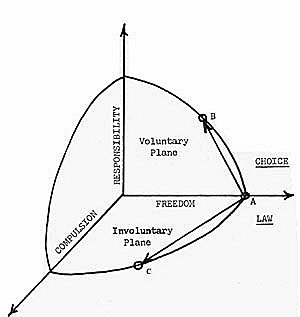
Here he said...
Therefore the Christian is called to do responsibly out of love for God what under the law was a matter of compulsion: by entering into the new relationship in Christ compulsion is transformed into responsibility.
I'd say is like this: the Christian, out of love for God, is now 1) internally "compelled" by the Royal Law of God's Love (ie. the Great Commandments) that has now defined his being and 2) internally "free" to choose for the God continually "entrusting" him with the freedom to choose and a domain of influence. Yes, the Christian freely responds to God's love with loving service. But the Christian always has a conscience "constrained" by the Great Commandments and a sincere desire not "grieve" the Holy Spirit of God. The internal conviction about to love one's neighbors as oneself conditions all of one's intentions, motivations, actions. You might say that there is a "gravitational pull" towards loving one's neighbors as themselves generated by the "weight" of their abiding in love of God.
Christian freedom, as I see it, is when the range of possibilities of moral intention, motivation, and action is optimized, given the potentials and constraints of one's total human "self", provided that one's freedom to choose to "be themselves" as "entrusted" beings before God has been liberated by (and paradoxically , constrained/controlled by) one's abiding in God's Love. God's love empowers people love others more than they fear death. God's love compels people to love others more than they fear the "enemy" or the "stranger."
Lord Jesus Christ, Son of God, have mercy on me, a sinner. Post Edited (One Love) : 11/3/2010 4:24:26 PM (GMT-5) | | Back to Top | | |
|
One Love
Registered Member
Date Joined Jan 2003
Total Posts : 13888
| Posted 11/3/2010 4:14 PM (GMT -6) | | How does this work? Like this...
"Not my will but Your Will be done."
Jesus's choice in Gethsemane was free, but it was also HARD. I believe that Jesus was so "compelled" by his love for his Father (who was also his God), that it gave him the power to make a choice OVER AND AGAINST what his limbic brain and human genetic heritage would be screaming at him--namely "I don't want to die." No, in the face of death, the power of human freedom to choose ALONE didn't allow him to take the level and degree of responsibility he did being the Messiah in the midst of being "sorrowful unto death." It was his being totally "contrained" by his interpersonal love relationship with the Father and the Holy Spirit.
Jesus' being "compelled" by his love for his God actually FREED HIM to make a decision not possible or empowerable by human freedom to choose alone.
Lord Jesus Christ, Son of God, have mercy on me, a sinner. Post Edited (One Love) : 11/3/2010 4:24:42 PM (GMT-5) | | Back to Top | | |
|
Tom
Registered Member

Date Joined Jul 2001
Total Posts : 10353
| Posted 11/3/2010 9:04 PM (GMT -6) | | I think talk of 'responsibility' functions within the limits of one's epistemic distance (the space to misperceive and misrelate). It (viz., talk of responsibility) is necessary (as a description of what love does) for those whose perceptions and convictions are susceptible to misrelation and who need to be motivated by considerations other than the satisfaction of love. 'Responsibility' names the tree and its fruit and so describes the space that character development and personal becoming require. But what 'responsibility' names for those who labor under a sense of duty, love does for its own sake without thought of duty. Not disregard for duty--just without any thought of it. For love there is no duty per se, no relating to responsibility as such. There is only truly willing good for the other AS the other and not as a means to fulfill some duty that watches from the sidelines. Duty/responsibility still has a tinge of 'objectifying' poison in it, for one can love BECAUSE it is the right thing to do is, which is a form of misrelation. It's better than not doing the good. But to love ultimately is to be free of all thought of duty and responsibility. One BECOMES naturally what language of duty names. Training wheels serve a purpose, but the mature don't require them and they ride straight without them.
Tom
KIXYTΘEMTAPost Edited (Tom) : 11/4/2010 7:00:33 AM (GMT-5) | | Back to Top | | |
|
One Love
Registered Member
Date Joined Jan 2003
Total Posts : 13888
| Posted 11/4/2010 4:03 PM (GMT -6) | | Tom:
'Responsibility' names the tree and its fruit and so describes the space that character development and personal becoming require. But what 'responsibility' names for those who labor under a sense of duty, love does for its own sake without thought of duty. Not disregard for duty--just without any thought of it. For love there is no duty per se, no relating to responsibility as such. There is only truly willing good for the other AS the other and not as a means to fulfill some duty that watches from the sidelines. Duty/responsibility still has a tinge of 'objectifying' poison in it, for one can love BECAUSE it is the right thing to do is, which is a form of misrelation. It's better than not doing the good. But to love ultimately is to be free of all thought of duty and responsibility. One BECOMES naturally what language of duty names.
Through the coinherence of eternity and existence in love, the ethical significance of relationality emerges. Without an extended examination of Kiekegaard's position on love (especially set forth in Works of Love), it is possible to describe the irreducibly relational nature of love. In the Great Commandment, there are no external standards to go by. After first loving God with our whole being so that "the God relationship [becomes] our conscience," then we are told to love our neighbors as ourselves. The command begins and ends in relationality, and it works because "if one must love his neighbor as himself, then the command, like a pick, wrenches open the lock of self-love and thereby wrests it away." In other words, since the eternal and the existential coinhere in love, there can be no other external criteria to justify love or to explain its duties which are not ipso facto less or lower than the relational reality of love itself. The very familiarity of the Great Commandment tends to obscure its radical ethical nature, but its basic power lies in the claim that relationality--not empirical fact, nor moral principle, not rational argument--is the irreducible nature not only of love's ethic but of human beings in themselves.
James Loder
The Knight's Move
Page 107-108
Lord Jesus Christ, Son of God, have mercy on me, a sinner. Post Edited (One Love) : 11/4/2010 4:18:20 PM (GMT-5) | | Back to Top | | |
|
Tom
Registered Member
Date Joined Jul 2001
Total Posts : 10353
| Posted 11/4/2010 7:13 PM (GMT -6) | | | | |
|
One Love
Registered Member
Date Joined Jan 2003
Total Posts : 13888
| Posted 11/4/2010 10:52 PM (GMT -6) | | Tom:
So I'm not crazy?
If you are, then I am...and James Loder was...and LeRon Shultz (who was influenced by Loder's work)...and...
***********************************************
Tom:
So I thought something on my own that agrees with Loder. Hmmm.
You'd be surprised how much you've been agreeing with Loder...for a WHILE now. 
PS: Do you know that James Loder was one of Greg's favorite professors at Princeton? Yeah. For real.
Lord Jesus Christ, Son of God, have mercy on me, a sinner. Post Edited (One Love) : 11/4/2010 10:55:13 PM (GMT-5) | | Back to Top | | |
|
Tom
Registered Member
Date Joined Jul 2001
Total Posts : 10353
| Posted 11/5/2010 6:43 AM (GMT -6) | | | L: In other words, since the eternal and the existential coinhere in love, there can be no other external criteria to justify love or to explain its duties which are not ipso facto less or lower than the relational reality of love itself.
T: This is what I mean when I say (to Daniel) that God's acts of love do not conform to an objective standard other than the act itself. Our acts of love can be said to conform to God. We are God-like. God is God-like (a tautology). But God is not standard-like or _____-like (and fill in the blank with whatever you think defines that by which God's goodness is measured).
Tom
KIXYTΘEMTAPost Edited (Tom) : 11/5/2010 4:10:27 PM (GMT-5) | | Back to Top | | |
|
Similitude
Registered Member
Date Joined Apr 2004
Total Posts : 4968
| Posted 11/6/2010 10:59 AM (GMT -6) | | |
To me, it's like the link I recently provided for the article where a philosopher recently decided there was no such thing as morality. What did he mean by that? He basically means that there is no morality/duty in the sense that the average person believes there is. And what is that? That what we call the world is not only
1) an ordered system whose natural causal sequence corresponds to human inference-making capacity,
but that it is also a moral order because of 2 additional facts:
2) Humans are volitional
3) One's highest possible natural good attainable by one's volition is such that that very choice is consistent with and conducive to the highest possible natural good attainable for every other volitional being at the point in time when that choice is made.
But many atheists are (and have been all along) realizing that 2) is only non-arbitrary on the grounds that the world is intuitively known to be the product of a volitional creation of a benevolent person. But what few of them remember is that 1) is ALSO only non-arbitrary on that same ground.
How then do we make sense of duty in terms of the above? First of all, just because we're volitional doesn't imply that we are duty-bound. After all, God is volitional, but He isn't duty bound.
To be duty-bound, one must see that 3) above includes God, the Creator of the world, as ONE of the volitional members of the volitional community that has a natural good to be attained from CERTAIN of the volitional choices of other volitional beings (which, in this case, would be all created beings, whereas He, alone, is NOT created). In other words, God is the ultimate stake-holder of human volitional choice in the sense that He is the one who actually ENDOWED humans with volitional capacity in the first place.
And as it turns out, this is precisely part of what it means for the creation to exist FOR God. IOW, not only do natural aspects of creation (like aesthetic ones) give God pleasure, given His sentient nature, but so do some volitional choices. Those volitions that give Him pleasure, we call "right," "proper," or some other normative term indicating that which is preferred by some sentient, teleological being that is a stake-holder of the volition.
What is "right" is inferred in terms of analogical extraplolation from our own sympathetic sensibilities and corresponding impulses. Thus, my own interest is ultimately the interest of the ultimate stake-holder of human volition, God, since He is not only teleological, but SYMPATHETIC (otherwise, we couldn't conceive of Him as benevolent and, therefore, interested in our ability to apprehend or anything else that we believe involves sentient pleasure and displeasure).
Thus, acting in my own self-interest is also a DUTY because I also OWE ("owe" being derived from a natural impulse/sensibility of sympathetic, volitional beings) that to God, even when it involves short-range suffering that I might otherwise selfishlessly wish to avoid. And here, I think, is the pertinent difference between God and us, in this respect: We can be deceived by suffering or the anticipation of suffering because of how it affects our MINDS--God can not be so deceived by His own suffering or anticipation of suffering. So we have to GIRD UP THE LOINS OF OUR MINDS volitionally in a way that God doesn't. But the comprehensiveness and objectivity of God's mental processes are not diminshed by His sentient states.
We, then, extrapolate our own sympathetic nature to others as analogically as the data allows, including God. These analogical inferences are used, in turn, to infer which, if any, putative divinely-inspired texts are the TRUE ones. These texts can, then, serve as spring boards, like our own sentient nature, from which to inductively extrapolate even further to even higher and/or more specific ideals and ends of creation.
So back to the atheist. He doesn't owe anything to God. And he's not so oblivious to the implications of natural evil as to think that it will always be the case that choosing unto his actual highest natural good will always be consistent with and conducive to the actual highest natural good of other members of the volitional community. Thus, the golden rule can never be a bona-fide RULE of behavior for him. It would be IRRATIONAL for him.
The problem for the atheist is this: EVERYTHING about atheism is irrational since their very belief in "apprehension" is a pure, blind faith belief, whereas for those holding to benevolent-theism, that belief is INTUITIVE and, therefore, a SPECIES of KNOWLEDGE! Porter, Lewis, Plantinga etal have demonstrated this in various ways. And though they may sometimes misword their deductive arguments to that effect. It is easy to see why they are right about their conclusions in this regard.
Post Edited (Similitude) : 11/6/2010 11:13:30 AM (GMT-5) | | Back to Top | | |
|
Similitude
Registered Member
Date Joined Apr 2004
Total Posts : 4968
| Posted 11/6/2010 12:13 PM (GMT -6) | | From what I said above, it can be inferred that normativity and, hence, duty only requires that there be degrees of pleasure attainment in choosing aright. But we also know from experience that DISpleasure often results from choosing wrongly. IOW, choosing wrongly doesn't MERELY diminish pleasure. It also results in positive DISpleasure. Thus, that fact ALSO has to be included in our analogical extrapolations. To ignore it is to be less than maximally rational in the inductive sense of that term.
Post Edited (Similitude) : 11/6/2010 12:16:58 PM (GMT-5) | | Back to Top | | |
|
Tom
Registered Member
Date Joined Jul 2001
Total Posts : 10353
| Posted 11/6/2010 12:43 PM (GMT -6) | | Isn't it the case that choosing wrongly (misrelating) provides SOME meausure of perceived pleasure and that this motivates wrongdoing in the first place? This is so even if there are ultimately (or even immediately but not perceived) adverse painful consequences to poor choices. So, don't disagreements over morality exist at all because some people perceive and value the immediate pleasure that sin provides and don't perceve the ultimate damage that it's doing and this in turn grounds their reasons for feeling 'this' is wrong and 'that' is not wrong? Sin, after all, is pleaurable for a season. So I don't think we can always ground morality in the immediate pleasure or pain experienced from choice. Sometimes what's good and lovng to do is immediately painful (though immediatley pleasurable in another sense to those who perceive the loving nature of the choice) while what's unloving or evil to do can be immediately pleasurable (even if eventually painful in another sense that is not perceived by the chooser or immediately damaging in ways the chooser can't perceive because of the seasonal pleasure).
Is that germane to what you're describing Jeff?
In other words, differences of opinion over what's right and wrong exist because of a) our ability to experience immediate pleasure on some level from evil, and b) the distance/delay in experiencing the bottom-line consequences of our choices (good and evil). If the ultimate, bottom-line consequences of choice were always immediately experienced, we would hardly be capable of 'misperceiving' the true nature of good and evil and hence would not misrelate. Thus, to misrelate is to misperceive or misconstrue the immediate vs ultimate consequences of choice.
My larger point is that there's a certain quality of experience (an unsurpassable aesthetic satisfaction) that IS God's necessary existence--ontologically speaking. God IS the immediate perception and experience of the highest possible value (i.e., love), and thus God shouldn't be thought of as achieving this quality of experience by conforming to some objective standard of goodness. Ultimately (metaphysically speaking), love is its own justification.
Jeff, what do you think about Loder's statement ("Since the eternal and the existential [in God] coinhere in love, there can be no other external criteria to justify love or to explain its duties which are not ipso facto less or lower than the relational reality of love itself") and the idea that God is amoral in the sense that his actions are not measured by some non-God standard? What/Who God is IS the standard--without this making God capricious or arbitrary since God is not what/who God is arbitrarily, for what exists/is 'necessarily' cannot, by definition, exist 'artibtrarily'.
Tom
KIXYTΘEMTA Post Edited (Tom) : 11/6/2010 1:24:19 PM (GMT-5) | | Back to Top | | |
|
Similitude
Registered Member
Date Joined Apr 2004
Total Posts : 4968
| Posted 11/6/2010 3:39 PM (GMT -6) | | | T: Is that germane to what you're describing Jeff?
J: Yes it is. And what also happens is that people harden their hearts against their more plausible inferences as to what is right when they find it impossible to do what seemed right to them on purely inductive grounds. It takes a long time for people to get as far as that philosopher I was talking about. Most people just resort to arbitrariness, superstition, contradictions, etc, but hold on to "a form of" benevolent theism.
But where that philosopher is, intellectually, is a very precarious place to be. Because he's having to admit that notions of "respect," etc are void of the kind of meaning they intelligibly have in our metaphysic. And that would have profound effects on social civility if most people embraced his view. He can exist in relative peace and safety precisely because he's in a very small minority.
T: Jeff, what do you think about Loder's statement ("Since the eternal and the existential [in God] coinhere in love, there can be no other external criteria to justify love or to explain its duties which are not ipso facto less or lower than the relational reality of love itself") and the idea that God is amoral in the sense that his actions are not measured by some non-God standard? What/Who God is IS the standard--without this making God capricious or arbitrary since God is not what/who God is arbitrarily, for what exists/is 'necessarily' cannot, by definition, exist 'artibtrarily'
J: Yes, but I would tend to think of "love" as always being volitional in the sense that we mean by that term. The only thing that I can really truly see as volitional, in that sense, with God is the act of creation itself. That act is an act of KNOWN risk-taking that was not necessary in any sense of the word. Nothing else done by the persons of the godhead, sans creation, is conceivable to me as a risk in any sense of the word. IOW, there is no risk of suffering, sans creation.
With creation, there is bona-fide risk of suffering for the persons of the godhead. This is why I can't get on board with the idea that God is essentially characterized by unsurpassable satisfaction.
I say He IS that sans creation. But I think creation changes that. After creation, God has to work strategically to maximize pleasure/minimize suffering just as we do. Because He is essentially sympathetic, and created volitional beings cause Him suffering. And any experience of suffering seems to NECESSARILY mean that God is not UNsurpassably satisfied.
On the other hand, there is no risk that creation will not ULTIMATELY be WORTH it to God. And because He IS essentially sympathetic, that will probably involve UR.
I suppose we could say that God is always unsurpassably AESTHETICALLY satisfied, so long as that is meant in a specific sense. Because it is true that God is quite aesthetically pleased with His own amazing teleological strategical work with the creation, even with all His sympathetic suffering going on all the while.
Post Edited (Similitude) : 11/6/2010 3:47:13 PM (GMT-5) | | Back to Top | | |
|
Tom
Registered Member
Date Joined Jul 2001
Total Posts : 10353
| Posted 11/7/2010 9:02 AM (GMT -6) | | J: Yes, but I would tend to think of "love" as always being volitional in the sense that we mean by that term. The only thing that I can really truly see as volitional, in that sense, with God is the act of creation itself.
T: So how does the Father love the Son sans creation and independently of any intent to create if creation is the first instance of God ‘loving’? (Did I misunderstand you?) Or do you link the ‘intention to creation’ with the ‘begetting of the Son’? Doesn’t sound like you do.
J: That act is an act of KNOWN risk-taking that was not necessary in any sense of the word. Nothing else done by the persons of the godhead, sans creation, is conceivable to me as a risk in any sense of the word. IOW, there is no risk of suffering, sans creation.
T: Totally agree.
J: With creation, there is bona-fide risk of suffering for the persons of the godhead. This is why I can't get on board with the idea that God is essentially characterized by unsurpassable satisfaction.
T: There may be a way…
J: I suppose we could say that God is always unsurpassably AESTHETICALLY satisfied, so long as that is meant in a specific sense. Because it is true that God is quite aesthetically pleased with His own amazing teleological strategical work with the creation, even with all His sympathetic suffering going on all the while.
T: Well, God would certainly be unsurpassably satisfied in that sense, i.e., with his own behavior respecting creation. But for those of us who think God’s necessary existence is (among other things) a particular ‘quality’ of experience that’s generated by the triune relations themselves, nothing that happens in creation can affect the God-defining quality of those relations—i.e., affect what the Son means to the Father as Son, and the Spirit, etc. These ‘relations’ (what they are, how they’re experienced, and the pleasure they generate/provide) are what’s necessary (among other things) about the necessary God. But if necessary, then creation can’t generate a moment of negation in that experience, so to speak. It remains constant whatever else is going on between God and creation. So when I say God is “unsurpassable aesthetic satisfaction” I don’t mean “as happy as can be given the loss of joy he suffers over creation” nor do I mean God is "unable to suffer in any sense or mode of being." I mean to say the satisfaction and beauty that F, S, and SP are and give to each other, because it DEFINES God as God, can’t be risked; so whatever God feels for creation, and via the Son's incarnation, it is taken in, experienced, and overcome by the infinite unrelenting pleasure that God is. HOW to make sense of that (suffering that is experienced and overcome by infinite beauty) is my life’s theological goal. I think it can be done, but I gotta run to church right now!
Tom
KIXYTΘEMTA | | Back to Top | | |
|
Similitude
Registered Member
Date Joined Apr 2004
Total Posts : 4968
| Posted 11/7/2010 10:38 AM (GMT -6) | |
T: So how does the Father love the Son sans creation and independently of any intent to create if creation is the first instance of God ‘loving’? (Did I misunderstand you?) Or do you link the ‘intention to creation’ with the ‘begetting of the Son’? Doesn’t sound like you do.
J: I guess I'm trying to keep in mind what we claim about persons of the godhead--namely, that they can not POSSIBLY not love in some sense of that word. But that is the equivalent of saying that love, for the persons of the godhead, is not volitional for them in the sense that it can be for us. So how do we articulate that with our language without being verbose? Don't we have to distinguish between a voluntary sense of love and a non-voluntary sense of love? That's what I'm trying to do.
T: I mean to say the satisfaction and beauty that F, S, and SP are and give to each other, because it DEFINES God as God, can’t be risked;
J: I totally agree with that. That seems hard to doubt.
T: ... so whatever God feels for creation, and via the Son's incarnation, it is taken in, experienced, and overcome by the infinite unrelenting pleasure that God is. HOW to make sense of that (suffering that is experienced and overcome by infinite beauty) is my life’s theological goal.
J: I would think the adjective "infinite" might create the problem. But it could still be the case that the Trinity's satisfaction with their own relationship is sufficient to render any suffering they can possibly experience "unworthy to compare" to it, even if we have to conceive of it as finite. And knowing that such a relationship can never allow suffering to be anything but momentary, relatively speaking, Christ could say, even while moving headlong unto profound suffering, that:
"Behold, the hour cometh, yea, is now come, that ye shall be scattered, every man to his own, and shall leave me alone: and yet I am not alone, because the Father is with me. These things I have spoken unto you, that in me ye might have peace." John 16:32-33
Post Edited (Similitude) : 11/7/2010 9:41:05 AM (GMT-6) | | Back to Top | | |
|
One Love
Registered Member
Date Joined Jan 2003
Total Posts : 13888
| Posted 11/7/2010 12:03 PM (GMT -6) | | T: ... so whatever God feels for creation, and via the Son's incarnation, it is taken in, experienced, and overcome by the infinite unrelenting pleasure that God is. HOW to make sense of that (suffering that is experienced and overcome by infinite beauty) is my life’s theological goal.
J: I would think the adjective "infinite" might create the problem. But it could still be the case that the Trinity's satisfaction with their own relationship is sufficient to render any suffering they can possibly experience "unworthy to compare" to it, even if we have to conceive of it as finite.
Think of it this way. Greg argues in "Trinity and Process" (pace regular process theology/philosophy) that aesthetic satisfaction can be achieved through INTENSITY of beautiful experience rather than simply DIVERSITY of beautiful experience. For regular process thought, the God/Creation relationship is necessary because God actually requires Creation to provide the diversity of beautiful experience in order for God to be aesthetically satisfied; God needs Creation to "become" who God is. From Greg's standpoint, even though there are only 3 persons in the Godhead, the intensity of their loving relationship is "unsurpassable", such that the depth and extent of love shared by the divine persons CANNOT be improved upon by any means. It's as intense as relationships get. And it's this intensity that not only aesthetically satisfies God, but also defines God as God. And it's THIS point that makes the God-Creation relationship one of GRACIOUS freedom.
In short, the intensity of God's loving self-experience grounds God's equanimity / dispassion / apatheia such that no possible pleasure or pain that God gets from interaction with Creation can disrupt or nullify that love, peace, and joy ad intra.
Actually, I think humans are to approximate this. How? Well, supposedly, a human believer who is "one with the Lord in Spirit" can have such an intense experience of the Trinity's indwelling love that no possible pleasure or pain caused by any creaturely circumstance can disrupt or nullify 1) the love we cannot be separated from (Romans 8:31-39), 2) the peace that passes all understanding (Philippians 4:7), and 3) the joy found in the Holy Spirit (Romans 15:13; Galatians 5:22) Unlike God, even though, through the love of Christ mediated by the Holy Spirit, we are "filled with all the fullness of God" (Ephesians 4:14-19)...we NEVER reach the UNsurpassable intensity of beautiful experience that God does. We are always able to "surpass" whatever level of intensity of loving relationship we presently have with God at any given point in time. (Hence, epektasis) At the same time, neither do we feel a sense of LACK because of that. Constant growth in God, but no lack of God. This happens such that a Christian's soul-satisfying "rest" in abiding in God is "sufficient to render any suffering they can possibly experience 'unworthy to compare' to it..."
If unsurpassable intensity of beautiful experience achieving "1", then creatures are able to APPROACH, but not acheive, that ala "0.9999999..." and so on. With theosis, we are called to be like God as far as is possible for creatures.
Lord Jesus Christ, Son of God, have mercy on me, a sinner. Post Edited (One Love) : 11/7/2010 11:28:53 AM (GMT-6) | | Back to Top | | |
|
Similitude
Registered Member
Date Joined Apr 2004
Total Posts : 4968
| Posted 11/7/2010 1:55 PM (GMT -6) | | | D: Actually, I think humans are to approximate this. How? Well, supposedly, a human believer who is "one with the Lord in Spirit" can have such an intense experience of the Trinity's indwelling love that no possible pleasure or pain caused by any creaturely circumstance can disrupt or nullify 1) the love we cannot be separated from (Romans 8:31-39), 2) the peace that passes all understanding (Philippians 4:7), and 3) the joy found in the Holy Spirit (Romans 15:13; Galatians 5:22)
J: Exactly. Which is why we should either call both infinite, or neither infinite. What does it mean to finitely "approximate" the infinite? See my point? I think we need to talk in terms that make sense to our HUMAN minds. I'm just saying that by eliminating the word "infinite," everything you and Tom are saying makes perfect sense. Adding "infinite" seems to create a paradox or a contradiction. But we don't need to do that. It's not as though something about benevolent theism becomes incoherent otherwise.
Post Edited (Similitude) : 11/7/2010 1:11:05 PM (GMT-6) | | Back to Top | | |
|
One Love
Registered Member
Date Joined Jan 2003
Total Posts : 13888
| Posted 11/7/2010 2:05 PM (GMT -6) | | D: Actually, I think humans are to approximate this. How? Well, supposedly, a human believer who is "one with the Lord in Spirit" can have such an intense experience of the Trinity's indwelling love that no possible pleasure or pain caused by any creaturely circumstance can disrupt or nullify 1) the love we cannot be separated from (Romans 8:31-39), 2) the peace that passes all understanding (Philippians 4:7), and 3) the joy found in the Holy Spirit (Romans 15:13; Galatians 5:22)
J: Exactly. Which is why we should either call both infinite, or neither infinite. What does it mean to finitely "approximate" the infinite? See my point? I think we need to talk in terms that make sense to our HUMAN minds. That must suffice for philosophy.
Maybe that's why "infinite" experience is not the helpful term here. "Unsurpassability" actually helps here. God's experience of God is unsurpassably intense ( x = 1 ) , and therefore cannot be improved upon at any time. Creaturely experience of God, on the other hand, is surpassably intense (x < 1 ), and therefore can be eternally improved upon. (0.99999repeating, See "Epektasis: The Perpetual Ascent of the Soul" by Google search)
Lord Jesus Christ, Son of God, have mercy on me, a sinner. Post Edited (One Love) : 11/7/2010 1:09:18 PM (GMT-6) | | Back to Top | | |
| 34 posts in this thread.
Viewing Page : 1 2 |
| Forum Information | Currently it is Monday, November 09, 2026 5:29 PM (GMT -6)
There are a total of 97,718 posts in 6,040 threads.
In the last 3 days there were 0 new threads and 0 reply posts. View Active Threads
|
Forum powered by dotNetBB v2.42EC SP3
dotNetBB © 2000-2026 |
|
|