 |
Open Theism Discussion Board > Public Forums > General Chat > (No Subject)
| Forum Quick Jump
|
| 
One Love
Registered Member

Date Joined Jan 2003
Total Posts : 13888
| Posted 7/10/2011 7:44 AM (GMT -6) |   | | Why U.S. is not a Christian nation
By Kenneth C. Davis,
Special to CNN
July 4, 2011 9:10 a.m. EDT
"As the government of the United States of America is not in any sense founded on the Christian Religion, -- as it has in itself no character of enmity against the laws, religion or tranquility of Musselmen (Muslims) ..."
At the same time, it would have to be admitted that the foundational principles of rights and responsibilities of America is grounded on the belief in a Creator.
"We hold these truths to be self-evident, that all men are created equal, that they are endowed by their Creator with certain unalienable Rights, that among these are Life, Liberty and the pursuit of Happiness."
Being "created equal" is what UNDERGIRDS the fundamental belief of human worth and dignity and the corresponding rights and responsibilities. This cannot be replaced authentically naturalism/atheism. (In my opinion, the Humanist Manifesto belies the inherently nihilistic stance involved in its beliefs. Secular humanism CANNOT truly ground human--or animal--dignity...
[Secular] humanists ground values in human welfare shaped by human circumstances, interests, and concerns and extended to the global ecosystem and beyond. We are committed to treating each person as having inherent worth and dignity, and to making informed choices in a context of freedom consonant with responsibility.
Lord Jesus Christ, Son of God, have mercy on me, a sinner. Post Edited (One Love) : 7/10/2011 8:11:58 AM (GMT-5) | | Back to Top | | |
 |
One Love
Registered Member
Date Joined Jan 2003
Total Posts : 13888
| Posted 7/10/2011 8:12 AM (GMT -6) | | So...the U.S., per it's highest ideals and historical self-understanding, is definitely NOT a "Christian" nation...but it is AT LEAST a deistic one! I don't see how anyone could really argue otherwise. 
Modern definition of deism:
Deism is the recognition of a universal creative force greater than that demonstrated by mankind, supported by personal observation of laws and designs in nature and the universe, perpetuated and validated by the innate ability of human reason coupled with the rejection of claims made by individuals and organized religions of having received special divine revelation.
Theistic rationalism
Lord Jesus Christ, Son of God, have mercy on me, a sinner. Post Edited (One Love) : 7/10/2011 8:18:28 AM (GMT-5) | | Back to Top | | |
|
One Love
Registered Member
Date Joined Jan 2003
Total Posts : 13888
| Posted 7/10/2011 9:06 AM (GMT -6) | | | You oughta like this, Jeff.
Ok. From what I gather Francis Hutcheson deeply influenced the whole American idea of "inalienable rights"...
Norman Fiering, a specialist in the intellectual history of colonial New England, has described Francis Hutcheson as “probably the most influential and respected moral philosopher in America in the eighteenth century.” Hutcheson's early Inquiry into the Original of Our Ideas of Beauty and Virtue, introducing his perennial association of "unalienable rights" with the collective right to resist oppressive government, was used at Harvard College as a textbook as early as the 1730s. In 1761, Hutcheson was publicly endorsed in the annual semi-official Massachusetts Election Sermon as "an approved writer on ethics." Hutcheson's Short Introduction to Moral Philosophy was used as a textbook at the College of Philadelphia in the 1760s.Francis Alison, the professor of moral philosophy at the College of Philadelphia, was a former student of Hutcheson who closely followed Hutcheson’s thought.Alison's students included "a surprisingly large number of active, well-known patriots,” including three signers of the Declaration of Independence, who "learned their patriotic principles from Hutcheson and Alison.” Another signer of the Declaration of Independence, John Witherspoon of the College of New Jersey (now Princeton University), relied heavily on Hutcheson's views in his own lectures on moral philosophy. John Adams read Hutcheson's Short Introduction to Moral Philosophy shortly after graduating from Harvard. Garry Wills argued in 1978 that the phrasing of the Declaration of Independence was due largely to Hutcheson's influence, but Wills's work suffered a scathing rebuttal from Ronald Hamowy. Wills' view has been partially supported by Samuel Fleischacker, who agreed that it is "perfectly reasonable to see Hutcheson’s influence behind the appeals to sentiment that Jefferson put into his draft of the Declaration."
Check out this background article on Hutchenson's thought. Bottom line: it all assumes an intelligent, benevolent creator. He's pretty much an "Intelligent Design"-er.
As well as making this intelligent designer argument about the underpinning truth-value of mind-dependent aesthetic judgement, Hutcheson in Section V of the fist Treatise also attempts the more ambitious task of actually showing that there is a God, and that this God is benevolent. It is not necessary to examine or assess Hutcheson’s argument in detail, but in essence it is a species of what we might call “probabilistic argument from design”. Hutcheson claims that beauty (i.e. uniformity amidst variety) of even the most basic geometrical shapes is so improbable to have come into existence by chance that it strongly implies intelligent design. In turn, as we consider more and more complex forms of beauty, the probability of intelligent design grows ever greater until it becomes irrational to posit anything else (especially mere chance) as an explanation. Furthermore, given this immense and lasting beauty in the breadth of creation, it is reasonable to suppose that God made it so deliberately, and to our express advantage (a supposition aided by Hutcheson’s evident voluntarist theology). Hutcheson thus notes:
Now from the whole we conclude, “That supposing the Deity so kind as to connect sensible Pleasure with certain Actions or Contemplations, beside the rational Advantage perceivable in them; there is a great moral Necessity, from his Goodness, that the internal Sense of Men should be constituted as it is at present, so as to make Uniformity amidst Variety the Occasion of Pleasure.”
...
To recap: we possess a sense of beauty given to us by God, which perceives the “idea” of beauty, which is instantiated in the world by the same God, who ordered creation so as to be to our best advantage, bringing us pleasure in aesthetic appreciation. Yet Hutcheson has another very important point to make: that our sense of beauty cannot be reduced to self-interest. In part Hutcheson takes this to be an obvious truth flowing from proper appreciation of the role of God and the existence of a sense of beauty he believes himself to have established. But in addition Hutcheson is at pains to provide a barrage of examples aiming to demonstrate that aesthetic beauty cannot be reduced to self-interest, and these largely stand independent of his own particular sense of beauty theory.
With this schematic overview of Hutcheson’s Treatise I in place, we are able to see its argumentative payout as an intervention in significant part aimed squarely at Mandeville. Firstly, Hutcheson wants to establish that the pleasure we gain from aesthetic appreciation is instantaneous, unreflective, and original. With a foundation in our very constitution as ordered by a benevolent God – who as Hutcheson noted in his preface was “not left quite indifferent in the affair of Virtue” – the appreciation of beauty can be traced back to neither custom nor education, which at most have the power to refine or extend the sense of beauty, but which must always presuppose it. Pleasure in value-judgement, therefore, cannot be reduced to the artful manipulation of politicians: our aesthetic sense of beauty prefigures any socialisation. Secondly, because our sense of beauty is God-given, and the pleasure we receive in perceiving beauty is God-sanctioned , in both cases by a voluntarist God who is benevolent, it cannot be the case that our pleasure in beauty is the product of self-interest which finds expression in status-seeking and domination, nor that our standards of aesthetic value are artifices manufactured to establish social stability. Our psychological make-up with regards to even the most basic aesthetic judgements cannot be accounted for on Mandeville’s theory of competitive self-interest seeking and pride. Thirdly, because our sense of beauty is itself not just the product of, but the evidence for, a benevolent God who orders the world to our advantage and happiness, Mandeville’s Augustinian view of a God who has abandoned mere fallen man to a vale of tears comprehensively and systematically misconstrues the nature of God, the nature of man, and the relationship between the two.
Lord Jesus Christ, Son of God, have mercy on me, a sinner. Post Edited (One Love) : 7/10/2011 9:09:38 AM (GMT-5) | | Back to Top | | |
|
One Love
Registered Member
Date Joined Jan 2003
Total Posts : 13888
| Posted 7/10/2011 9:09 AM (GMT -6) | | Similtude:
If we use deist in the old sense, I would agree. In the past, it included the belief that God holds people accountable for "wrong-relating." Now, deism is frequently used to mean that God set creation in motion from the beginning but doesn't intervene AT ALL thereafter--not even to hold people accountable.
Yeah. Unfortunately, deism, it seems, is errant ontologically about the relationship between the Creator and Creation. Once you eliminate that ontological error, then the BENEVOLENCE and INTELLIGENCE of God becomes quite obvious!
Lord Jesus Christ, Son of God, have mercy on me, a sinner. Post Edited (One Love) : 7/10/2011 9:14:02 AM (GMT-5) | | Back to Top | | |
|
One Love
Registered Member
Date Joined Jan 2003
Total Posts : 13888
| Posted 7/10/2011 9:13 AM (GMT -6) | | I guess I'd seriously want to ask any philosophically astute atheist who is American how they can hold so dearly to the American view of "inalienable rights"...when they are so CLEARLY and HISTORICALLY based upon theistic claims! I'd want to know how they could philosophically ground "inalienable rights" while having completely naturalistic assumptions, thus REMOVING the chief assumption all parties involved seemed to have grounding those rights...yeah...
Lord Jesus Christ, Son of God, have mercy on me, a sinner. | | Back to Top | | |
|
One Love
Registered Member
Date Joined Jan 2003
Total Posts : 13888
| Posted 7/10/2011 9:26 AM (GMT -6) | | | One could argue that one of the ideals of America is to be a VIRTUOUS, BEAUTIFYING community in response to the antecedent BENEVOLENCE of the Creator that, via the "inalienable rights", gave all humans the DIGNITY, COMMONALITY, FREEDOM necessary for the RESPONSIBILITY and SERVICE involved in being a virtuous, beautifying "Union".
That would be accurate, I would think.
"Life, Liberty, and the Pursuit of Happiness"
"...promote the general welfare..."
Lord Jesus Christ, Son of God, have mercy on me, a sinner. Post Edited (One Love) : 7/10/2011 9:29:49 AM (GMT-5) | | Back to Top | | |
|
One Love
Registered Member
Date Joined Jan 2003
Total Posts : 13888
| Posted 7/10/2011 9:37 AM (GMT -6) | | | | |
|
Tom
Registered Member

Date Joined Jul 2001
Total Posts : 10353
| Posted 7/10/2011 11:51 AM (GMT -6) | | D’s Quote: “As the government of the United States of America is not in any sense founded on the Christian Religion, -- as it has in itself no character of enmity against the laws, religion or tranquility of Musselmen (Muslims)...”
Tom: I’d challenge this a bit. It doesn’t follow that since the US isn’t founded upon any particular religion (Christianity) that all religions (Islam in particular) are compatible with the values central to the worldview which is at the heart of the events and declarations that created America and which sustain its freedoms (however imperfectly we hold them). Islam, in particular, is not void of inherent political aspirations, whatever SOME Muslims might say about the possibility of a form of fulfilled Islamic living that doesn’t include political commitments and Shari’a law. There is to date NO Islamic state (or society) that has succeeded (or even approached a measure of significant success) in marrying the political freedoms (of speech, press, religion) and equalities (of gender, sex, etc.) definitive of Western style democracy with Islamic law. And I don’t believe it can be done. Shari’a law is fundamental to Islamic orthodoxy (I agree with the Mulahs; they’re right on) and that same way of life is incompatible with the freedoms and equalities at the heart of America’s national identity.
I agree that at the very least some form of theism/deism is needed to consistently maintain the inherent worth and value of human beings. Nevertheless, I’m sure atheism is a belief/freedom protected by the very worldview that shaped America.
Anybody familiar with Sam Harris’ or John Loftus’ arguments for grounding human value/dignity atheistically?
Tom
KIXYTΘEMTA | | Back to Top | | |
|
Tom
Registered Member
Date Joined Jul 2001
Total Posts : 10353
| Posted 7/10/2011 4:27 PM (GMT -6) | | http://www.helium.com/items/2074815-are-there-right-and-wrong-answers-to-moral-questions
Book Reviews: The Moral Landscape: How Science Can Determine Human Values, by Sam Harris.
Atheist neuroscientist Sam Harris's book The Moral Landscape: How Science Can Determine Human Values (2010) argues for a consequentialist and realist moral theory where the good is whatever promotes human well-being. Harris says that insofar as there are objective facts about what makes humans thrive, there are objective facts about how we ought to treat other people. In any one situation, there may be multiple relevant types of well-being to be considered, it may be difficult to gather data and assess risk, and there may be dissenting opinions, but this does not mean the moral question has no correct answer. Moral facts may exist even if we are untalented at perceiving them and tend to disagree about them.
There are facts about morality, he says, because there are facts about well-being. "If we were to discover a new tribe in the Amazon tomorrow, there is not a scientist alive who would assume a priori that these people must enjoy optimal physical health and material prosperity," Harris writes. Scientists would want to study the tribe's health and prosperity before passing judgment. On the other hand, he suspects that "news that these jolly people enjoy sacrificing their firstborn children to imaginary gods would prompt many (even most) anthropologists to say that this tribe was in possession of an alternate moral code every bit as valid and impervious to refutation as our own...The disparity between how we think about physical health and mental/societal health reveals a bizarre double standard: one that is predicated on our not knowing - or, rather, on our pretending not to know - anything at all about human well-being." (19) We do indeed know some things about individual and social well-being, Harris says, such as that killing children doesn't contribute to it. "But this notion of 'ought' is an artificial and needlessly confusing way to think about moral choice...For instance, to say that we ought to treat children with kindness seems identical to saying that everyone will tend to be better off if we do." (38)
He bravely acknowledges some of the problems with consequentialism. For example, he quotes philosopher Patricia Churchland who has pointed out that "no one has the slightest idea how to compare the mild headache of five million against the broken legs of two, or the needs of one's own two children against the needs of a hundred unrelated brain-damaged children in Serbia." (68)...
KIXYTΘEMTA | | Back to Top | | |
|
One Love
Registered Member
Date Joined Jan 2003
Total Posts : 13888
| Posted 7/10/2011 4:38 PM (GMT -6) | | | | |
|
Similitude
Registered Member
Date Joined Apr 2004
Total Posts : 4968
| Posted 7/10/2011 5:32 PM (GMT -6) | | Tom: He bravely acknowledges some of the problems with consequentialism. For example, he quotes philosopher Patricia Churchland who has pointed out that "no one has the slightest idea how to compare the mild headache of five million against the broken legs of two, or the needs of one's own two children against the needs of a hundred unrelated brain-damaged children in Serbia." (68)...
Jeff: I think it's not consequentialism that is the problem here. It's rank utilitarianism. The following, IMO, need to be true for morality to be intelligible and rational:
1) The means to the highest good of each member of the society must be consistent with and conducive to the highest good of every other member of the society. This is a species of consequentialism. I contend that apart from post-mortem, sentient states, this condition isn't even possible.
2) Humans must actually BE volitionally competent to CHOOSE those "means."
Take away God/teleology as intuitive, and you can't know either. Indeed, the brand of scientism many folks in Sam's atheistic camp embrace is one that views ALL beliefs as tentative. I.e., nothing is ever truly known by them except one's own existence, via self-consciousness, perhaps. They believe even our very intuitions/categories can be illusory. I've argued with some that insist that even the LNC should be accepted tentatively only--as if you could ever falsify it!! In that sense, Sam is in an arbitrary sub-camp of his own. There are plenty of atheists that don't even take Sam serious. His emotions over-ride his head frequently.
Those guys forget how much of what they take for granted in conversation is arbitrary, blind belief without a benevolent, competent Designer to ground their inferences about regularities, human nature, etc. Take most anything an atheist says. Then start asking him/her to explain how he/she knows it. You end up with nothing. Because they don't believe universally human categories exist, or they don't believe they are trustworthy if they do exist. E.g., many atheistic scientists make no qualms about the fact that they think our intuitive conceptions of time and space are just flat bogus. That's why they have no problem questioning free-will, etc. Once you take that epistemological step off the cliff, what difference does it make what else you doubt? None is worse than any other, epistemologically speaking.
| | Back to Top | | |
|
One Love
Registered Member
Date Joined Jan 2003
Total Posts : 13888
| Posted 7/12/2011 12:03 PM (GMT -6) | | Sam Harris is exactly right here...
It is possible to feel much better (in every sense of “better”) than one tends to feel. It is, in fact, possible to be utterly at ease in the world—and such ease is synonymous with relaxing, or fully transcending, the apparent boundaries of the “self.” Those who have never experienced such peace of mind will view the preceding sentences as yet another eruption of “mumbo jumbo” on my part. And yet it is phenomenologically true to say that such states of well-being are there to be discovered. I am not claiming to have experienced all relevant states of this kind. But there are people who appear to have experienced none of them—and many of these people are atheists.
This is not surprising. After all, experiences of self-transcendence are generally only sought and interpreted in a religious or “spiritual” context—and these are precisely the phenomena that tend to increase a person’s faith. How many Christians, having felt self-transcending love for their neighbors in church or body-dissolving bliss in prayer, decide to ditch Christianity? Not many, I would guess. How many people who never have experiences of this kind (no matter how hard they try) become atheists? I don’t know, but there is no question that these states of mind act as a kind of filter: they get counted in support of ancient dogma by the faithful; and their absence seems to give my fellow atheists yet another reason to reject religion.
...
There are several people there who have absolutely no idea what I’m talking about—and they take this to mean that I am not making sense. Of course, religious people often present the opposite problem: they tend to think they know exactly what I’m talking about, in so far as it can seem to support one religious doctrine or another. Both these orientations present impressive obstacles to understanding.
Think about a Christian in the highest state of hesychia and the "sacrament of the present moment." Would the Christian that experienced self-transcendence in that context DISBELIEVE Christianity? Probably not. Nor would the Muslim Sufi who had experienced "fanaa" and "baqaa" in Allah. Or the Hindu who had experienced the highest levels of "bhakti". But the atheists who are not even concerned about ANY FORM of transcendence will not do the work that it takes to have this experience.
Lord Jesus Christ, Son of God, have mercy on me, a sinner. Post Edited (One Love) : 7/12/2011 12:06:29 PM (GMT-5) | | Back to Top | | |
|
One Love
Registered Member
Date Joined Jan 2003
Total Posts : 13888
| Posted 7/12/2011 12:08 PM (GMT -6) | | Harris talks about an altered state of consciousness that he experienced during his LSD trip...but it's interesting...
Ingesting a powerful dose of a psychedelic drug is like strapping oneself to a rocket without a guidance system. One might wind up somewhere worth going—and, depending on the compound and one’s “set and setting,” certain trajectories are more likely than others. But however methodically one prepares for the voyage, one can still be hurled into states of mind so painful and confusing as to be indistinguishable from psychosis. Hence, the terms “psychotomimetic” and “psychotogenic” that are occasionally applied to these drugs.
I have visited both extremes on the psychedelic continuum. The positive experiences were more sublime than I could have ever imagined or than I can now faithfully recall. These chemicals disclose layers of beauty that art is powerless to capture and for which the beauty of Nature herself is a mere simulacrum. It is one thing to be awestruck by the sight of a giant redwood and to be amazed at the details of its history and underlying biology. It is quite another to spend an apparent eternity in egoless communion with it. Positive psychedelic experiences often reveal how wondrously at ease in the universe a human being can be—and for most of us, normal waking consciousness does not offer so much as a glimmer of these deeper possibilities.
People generally come away from such experiences with a sense that our conventional states of consciousness obscure and truncate insights and emotions that are sacred. If the patriarchs and matriarchs of the world’s religions experienced such states of mind, many of their claims about the nature of reality can make subjective sense. The beautific vision does not tell you anything about the birth of the cosmos—but it does reveal how utterly transfigured a mind can be by a full collision with the present moment.
Harris marvels at the human brain's ability to experience self-transcendence and "cosmic consciousness", but he believes that there was NO TELEOLOGY behind how and why the human brain works the way it works, because of his naturalistic assumptions about reality. Loder says this capacity is "latent in the human psyche" (Knight's Move) because of how human existence was created/designed to operate with Divine Presence.
Harris would say that the "transcendence of egoity" (as he calls it) has NO uncreated personal referent in it's exercise. [At most, it's referent exists in the actual oneness of the universe.] Loder, following SK, would say that it DOES : Christ the Logos, through whom all Creation is made. The whole "I, not I, but Christ" perspective that leads from being trapped in biological hypostasis to being liberated into ecclesial hypostasis.
Lord Jesus Christ, Son of God, have mercy on me, a sinner. Post Edited (One Love) : 7/12/2011 12:22:52 PM (GMT-5) | | Back to Top | | |
|
Tom
Registered Member
Date Joined Jul 2001
Total Posts : 10353
| Posted 7/12/2011 10:01 PM (GMT -6) | | | | |
|
One Love
Registered Member
Date Joined Jan 2003
Total Posts : 13888
| Posted 7/14/2011 8:21 AM (GMT -6) | | I'm thinking that the reason that anti-supernaturalistic atheists focus on attacking particular human religions RATHER than simple theism (ala an uncreated, intelligent, benevolent creator) is because they kinda know that it's much easier to dismiss the historical and moral claims of particular religious beliefs than it is to dismiss the claim that an "competent, benevolent Designer" actually makes MORE SENSE of our human pursuits of knowledge and meaning actually corresponding to reality and NOT just being an absolute absurdity before the "nothing" or "void."
Lord Jesus Christ, Son of God, have mercy on me, a sinner. Post Edited (One Love) : 7/14/2011 8:26:32 AM (GMT-5) | | Back to Top | | |
|
One Love
Registered Member
Date Joined Jan 2003
Total Posts : 13888
| Posted 7/14/2011 8:28 AM (GMT -6) | | I found this interesting, Tom...
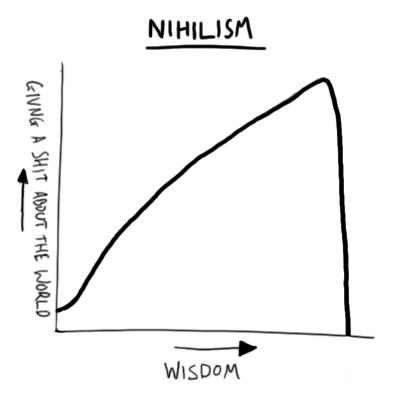
J. NIHILISM AND MEANING
The door closed. I was on the other side. I no longer believed in truth. I believed in nihilism. I knew nothing. I now realized that nihilism is not a world view one arrives at by reason. You are sort of dropped off there by a rational world view. Then you leave reason behind. I was excited to hold a position for which so many good arguments could be marshaled. However, I was disturbed by the fact that once the arguments brought me there I could make no arguments at all. I was also disturbed by the lack of values. I no longer had need to be concerned about being right or wrong. The problem was that, as a nihilist, I had nothing to be concerned about at all. As time went on, I found nihilism unsatisfying. It offered no meaning. No meaning at all. No meaning to life. No meaning to my actions. No meaning to words or thoughts. No reason. And worst of all no philosophy. I began philosophy as a quest. A quest for meaning. A quest for truth. But my journey had led me to a dead end. No, not a dead end, a dark hole. What I found is that there is nothing to find. My quest was over. Not because it was completed. Not even because I was distracted and side tracked. I didn’t even get lost. I died. I went looking for truth, but, ethically and intellectually I found nothing. I tried to get out but the hole was deep. Over and over again I would make a hypothetical leap back to reason and nature, but each time it brought me back to the same place, Nihilism. I sought to falsify nihilism itself, but as my mentor had made so clear, no argument can be made against positions on the other side of reason. Nihilism can not be falsified. Yet, an emptier truth can not be imagined. I had always assumed, perhaps naively, that when I found the truth it would be meaningful. If there was a world view that could be both true and meaningful it would certainly be worth investigating.
My thoughts:
This is a GREAT representation what a human experience of "Void" sounds like. As Loder said, the way that 1) creation is literally "no-thing" without God...and 2) the universe is consigned to empty silence, human existence--in and of itself--is nothing and comes to nothing. No amount of human achievement, conquest, or satisfaction will ever change that, nor ever transcend the ultimate meaninglessness and pointlessness of human existence itself. In the end, everything dies...so everything is "dead" already. Ecclesiastes, if you will.
This is the HUMAN condition, not just the atheists'! Anyone who knows enough about the universe--who was intellectually honest--would come to the same conclusion. According to SK (and Loder following), only the Incarnation, Resurrection, and Ascension give us historically grounded "reason to believe" that the universe is NOT utterly and ultimately empty or meaningless. Only the God-Man allows us to truly AFFIRM humanity and the universe IN LIGHT OF the no-thingness that Creation is.
Make sense?
Lord Jesus Christ, Son of God, have mercy on me, a sinner. Post Edited (One Love) : 7/14/2011 8:52:33 AM (GMT-5) | | Back to Top | | |
|
One Love
Registered Member
Date Joined Jan 2003
Total Posts : 13888
| Posted 7/14/2011 8:44 AM (GMT -6) | | And it may just be me, but this is what I "hear" when I read...
For the creation waits with eager longing for the revealing of the sons of God. For the creation was subjected to futility, not willingly, but because of him who subjected it, in hope that the creation itself will be set free from its bondage to corruption and obtain the freedom of the glory of the children of God. For we know that the whole creation has been groaning together in the pains of childbirth until now.
"Futility" and "corruption" are expressions of "Void". And the "Holy" is the God Himself who empowers the children of God and grounds even the "Void" via creatio continua/creatio ex nihilo.
Lord Jesus Christ, Son of God, have mercy on me, a sinner. Post Edited (One Love) : 7/14/2011 8:49:32 AM (GMT-5) | | Back to Top | | |
|
Tom
Registered Member
Date Joined Jul 2001
Total Posts : 10353
| Posted 7/14/2011 9:14 AM (GMT -6) | | | | |
| 84 posts in this thread.
Viewing Page : 1 2 3 4 |
| Forum Information | Currently it is Monday, November 09, 2026 5:54 PM (GMT -6)
There are a total of 97,718 posts in 6,040 threads.
In the last 3 days there were 0 new threads and 0 reply posts. View Active Threads
|
Forum powered by dotNetBB v2.42EC SP3
dotNetBB © 2000-2026 |
|
|