 |
| Open Theism Discussion Board > Public Forums > General Chat > Up With Authority: Why We Need Authority To Flourish As Human Beings | Forum Quick Jump
|
| 
BBBCanada
Registered Member

Date Joined Jun 2001
Total Posts : 2763
| Posted 11/23/2011 12:26 PM (GMT -6) |   | 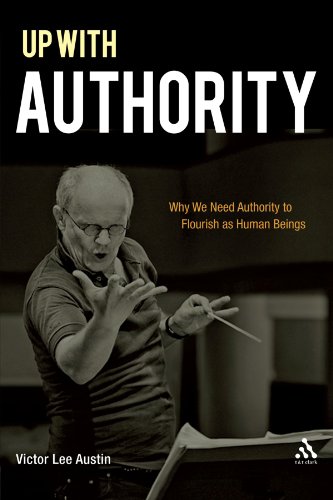
Best book EVA! Austin hones in on one of the assumptions that have played out in some of the discussions on this board and that is, because of sin, we need authority. Austin states that if we were "perfect" we would STILL require authority and as the pic on the front of the book shows, he uses the analogy of a symphony conductor to make his point. All this to say, that it is at this bottomline assumption that I've disagreed with Asher and continue to do so. I have not and still do not think that my prevailing assumptions about his brand of liberalism nor anarchism was off the mark. I think Greg should read this as well.
Dang, I knew I wasn't THAT off! 
Brandon
Since love grows within you, so beauty grows. For love is the beauty of the soul.--Saint Augustine
| | Back to Top | | |
 |
Asher
Registered Member
Date Joined Apr 2003
Total Posts : 477
| Posted 11/24/2011 4:37 PM (GMT -6) | | Who decides who has authority? The majority? What if someone doesn't recognize the authority, but in all basic moral areas (respect of life, property, etc) is without reproach? What are the criteria that determines legitimate authority? Was the Nazi apparatus that was legally voted into authority in Germany legitimate?
You don't have good answers to any of these questions, think what you will. | | Back to Top | | |
|
Asher
Registered Member
Date Joined Apr 2003
Total Posts : 477
| Posted 11/24/2011 7:07 PM (GMT -6) | | What do you do with people who do not recognize the authority of who is claiming authority over them?
What do you do when someone basically recognizes someone else's authority over them, but they disagree with where the authority wants them to go with regard to their own life?
Why does anyone WANT authority over anyone else?
Why do you Brandon want to be in authority over other people? Do you know better than them? Do you have their interests in mind moreso than they themselves? Again, we're assuming a normal-minded, peaceful, non-problem causing individual who does not recognize the legitimacy of such authority. Will you force such a one to submit to your authority or the authority of whoever you submit to?
I can totally understand why people submit themselves to someone else's authority...that's not the question here and never was...I respect voluntary submission to someone who you give authority over yourself to...what I don't respect is people who would FORCE others (again...peaceful, etc. others) to submit to an authority that person doesn't recognize.
That is the root cause of almost all human problems...forcing people to do what they don't want to do. | | Back to Top | | |
|
Asher
Registered Member
Date Joined Apr 2003
Total Posts : 477
| Posted 11/24/2011 7:17 PM (GMT -6) | | Dang, I knew I wasn't THAT off!
This book does absolutely nothing with regard to the base of our disagreement. He just reiterates your basic assumptions and so you feel justified. Notice who he engages throughout his book...none of them are libertarians. He hasn't engaged the basic disagreement, and neither have you.
Just about every libertarian writer directly engages philosophical opponents. This is not what is happening in this book. He assumes authority, and preaches a message of authority...he does not engage counter thought where it is strongest. | | Back to Top | | |
|
Asher
Registered Member
Date Joined Apr 2003
Total Posts : 477
| Posted 11/24/2011 11:12 PM (GMT -6) | | Let me repost this of mine:
I can totally understand why people submit themselves to someone else's authority...that's not the question here and never was...I respect voluntary submission to someone who you give authority over yourself to...what I don't respect is people who would FORCE others (again...peaceful, etc. others) to submit to an authority that person doesn't recognize.
That is the root cause of almost all human problems...forcing people to do what they don't want to do.
----------
Your questions to me assume that one is either for authority or against it. The real issue is ENFORCED authority. When someone has a natural authority and those around them recognize it and submit to it because they realize it is of benefit to them and to others to join together under this one's leadership...no one is against such interactions. When someone holds a gun...or a concealed gun, concealed under the cover of "legality" and "authority" ...on someone else and says "Submit to my authority or else"...that's what I have a problem with. And in the case of ALL established governments that's what it reduces to. Sure you can "pretty it up"...call it democratic, representative, "government of the people, by the people, for the people", equality, etc. But some pigs always end up being more equal than other pigs, as Orwell attested.
Authority that I can quit whenever I decide to is authority that has accountability. Forced authority is only accountable to itself, and all of human history belies your sincere belief in it's goodness. | | Back to Top | | |
|
Asher
Registered Member
Date Joined Apr 2003
Total Posts : 477
| Posted 11/25/2011 12:08 PM (GMT -6) | | "the essence of authority"
"What I understand you to be saying about it is that it is, IN ESSENCE, something negative--it is coercive."
"Can you possibly concieve of authority, aside from voluntary submission, as paradoxically interwined with freedom?"
------------
Brandon, you have defined me in a certain way, and interpret what I say to fit your interpretation. You can't even understand very plain language if it contradicts your interpretation. Let's try this again:
I do not hold the essence of authority to be something negative, or coercive. The fact that I have written POSITIVELY of free willed voluntary submission to authority..shows that I don't hold authority in it's essence as something NEGATIVE.
And it seems to me that YOU are the one that holds authority to be essentially coercive. Can I conceive of authority as paradoxically intertwined with freedom? This question alone shows our radically different understanding of authority and of freedom.
You can't wave a magic wand over something and mouth the magic word "Paradox" and make opposed ideas mesh together. Can I freely submit to authority and freely extract that submission to authority? If so, then we are getting to the essence of authority.
And I do value it. But when authority is conflated with the concept of coercion, you no longer have legitimate authority.
I understand that society is so skewed that conflation of ideas is written through it's warp and woof, and it is difficult to remove oneself from the matrix. But authority and coercion is one such conflation. Think about this: when a scientist speaks out in his area of expertise...we
say that he is an authority. We don't mean that you will now be required to follow his suggestions or else face societal repercussions. We mean, this scientist is better attuned to reality than ourselves in his area of expertise and if we don't follow his suggestions we will face repercussions from reality. We are now free to voluntarily submit to his suggestions, or not to and face the consequences of reality. Now let's look at coercive, political "authority"...it is an opposite of real, legitimate authority...whoever wields political authority speaks out an edict...we mean exactly that we will now be required to follow his policies or else face societal repercussions. We may in fact believe and even know to a great degree that we ourselves are better attuned to reality than the authority in his policy areas...we may know that if we follow his policy edicts we will face repercussions from reality. The king is wearing no clothes Brandon, and you're telling me how finely he's dressed. | | Back to Top | | |
|
Asher
Registered Member
Date Joined Apr 2003
Total Posts : 477
| Posted 11/25/2011 2:08 PM (GMT -6) | | "OK...all I'm saying is that outside of voluntarily submitting to authority, authority would be coercive."
Yes, we are all in agreement up to that point...that's the point at which I take the fork of voluntary submission to authority or no submission to authority...and you take the fork of coerced submission to authority.
"Even the expert. He is an authority but it is better that we submit voluntarily to his expertise."
Can you not see the difference in his kind of authority and that of political authority? The scientist...HAS...EXPERTISE. Political authority does not have anything comparable. The scientist doesn't hold a gun on you...those aren't the consequences you face if you disobey him...he's just telling you what's real and how to protect yourself. Political authority DOES hold a gun on you...the gun IS the consequence you face if you disobey political authority...oftentimes the policy edicts run contrary to what's real...that's why he holds the gun, because otherwise you wouldn't do what he said to do. (And again, so things don't get even more confusing...we're not talking about someone being in opposition to life, property, etc of others and the government holding a gun on them)
"The least good outside of that would be that authority corrects human deficiency."
Legitimate authority ameliorates human deficiency...political authority exacerbates human deficiency. Deficiency breeds cooperation. But coercive cooperation can also be had at the point of a gun, at the cost of greater human deficiency.
There is a fine line distinction I don't think you are getting. Imagine a society that has a natural authority structure, let's imagine something along the lines of an Amish community. Those with expertise and experience are deferred to because it is to everyone's benefit to do so. But let's imagine a hard-headed guy living among the Amish. He doesn't go help raise his neighbors barns. OK, I'm not saying that's the best option open to him. I'm saying is he free to do that without a gun being held on him? Are there ramifications? Sure! His neighbors won't help him raise his barn or get his crops in, etc....those are natural consequences of his choices, but a gun held on him is not. Now let's imagine a society with coercive authority structure. Not only is a gun held on you to force you to do all manner of things that are good for you...but a gun is held on you to force you to do all manner of things that aren't good for you...and there may even be a wall constructed to keep you from escaping. Your viewpoint tastes like tyranny to me. I know that's not your intention, but tyranny inevitably flows from that source. Throw down your gun, and don't subtly keep picking it back up after you have laid it down...and then if you have something to say coming from expertise or experience...I'll consider it. And if I still don't agree...don't start reaching for your gun. | | Back to Top | | |
|
BBBCanada
Registered Member
Date Joined Jun 2001
Total Posts : 2763
| Posted 11/25/2011 9:28 PM (GMT -6) | | |
Hmmm…I totally understand your position Asher and I think you think I don’t. I think you essentially are equating MY understanding of authority with this:
“ OK, I'm not saying that's the best option open to him. I'm saying is he free to do that without a gun being held on him? Are there ramifications? Sure! His neighbors won't help him raise his barn or get his crops in, etc....those are natural consequences of his choices, but a gun held on him is not. Now let's imagine a society with coercive authority structure. Not only is a gun held on you to force you to do all manner of things that are good for you...but a gun is held on you to force you to do all manner of things that aren't good for you...and there may even be a wall constructed to keep you from escaping. Your viewpoint tastes like tyranny to me.”
That’s coercion right? I’m not saying it is simply a matter of coercion. That’s you who is attributing to me what you think I think authority is about and I never once said that it is necessarily coercive. I never made judgments either way as to the problems you have with governmental authority which is really not a question I’m looking at at the moment. I may have come close to a judgment about parental authority dealing with human deficiency by saying that it may correct egoism and I said that in the context of what has basically been repeated on these boards. I’m simply saying in that context THAT seems to be the most positive thing that we are saying about parental authority. But I do understand that there is bad or illegitimate authority (in your thinking that would be coercive, legitimate authority is can be an expert in a particular field or when someone commands authority such that someone will submit to them voluntarily. I understand that Asher). I mean there are other authorities as well ie., reason. But you seem to be attributing to me that **I** understand coercion to be a legitimate form of authority. I would agree with Austin: “Yet authority is not, essentially, the power of coercive force. When coercion becomes necessary, authority is not able to be all that it could be.”
But there is an important question to me. I think this really needs to be grasped. I’ll say it again and let’s think about this. Austin is saying this:
“Even if we were perfect human beings we would still require authority.”
Think about that. What Austin is saying is that even if the character in the Amish example above (and there are authoritarian structures even in that community) were to voluntarily submit to his neighbours out of love and he did it perfectly all the time and if his Amish neighbours were to likewise love perfectly, he as an individual and they as a society would still require authority. Even if you got rid of coercion, we would still require authority (and not simply a expert or social authority of some sort). If everyone contracted or partnered (where authority is not felt) there would still be the need for authority and there is a reason for that. It goes back to his orchestra analogy.
Brandon
Since love grows within you, so beauty grows. For love is the beauty of the soul.--Saint Augustine
Post Edited (BBBCanada) : 11/25/2011 8:31:47 PM (GMT-6) | | Back to Top | | |
|
Asher
Registered Member
Date Joined Apr 2003
Total Posts : 477
| Posted 11/25/2011 9:50 PM (GMT -6) | | No Brandon, I don't miss your point, even if I am not totally in accord with it.
Let me ask...worst case scenario...if the kind of authority you say you are supporting is challenged and resisted and not obeyed...what then? Is force legitimate at that point? We throw a lot of questions back and forth to each other, and most of them go unanswered, but please answer this one, yes or no, and then do all the explaining you need to to place the gem in it's proper setting. Is force legitimately used against a person who is in all other respects peaceful and respectful of others with respect to their life and property, but who has denied the legitimacy of the "authority" and does not obey the edicts of the "authority"?
Was Peter in violation of authority when he said "We ought to obey God rather than men."?
Was Paul in violation of authority when he turned one set of authorities against another set of authorities who held different beliefs, so that he could do what he wanted to do instead of what those authorities wanted him to do?
Was a person who hid Jews from the Nazis, though they were legally the authorities, in violation of that authority?
Were African-Americans who purposefully broke laws in order to protest the injustice of such laws in violation of authority?
Was Gandhi violating authority in his resistance against the British?
What is the criteria for determining who has legitimate authority if that criteria is anything other than or anything added to voluntary submission?
How will I know the authority I am suppose to submit to, when there are multiple authorities demanding my submission? What if I disagree with you about who legitimate authorities are? Is it just a battle of force at that point? | | Back to Top | | |
|
BBBCanada
Registered Member
Date Joined Jun 2001
Total Posts : 2763
| Posted 11/26/2011 3:11 PM (GMT -6) | | |
Asher: Let me ask...worst case scenario...if the kind of authority you say you are supporting is challenged and resisted and not obeyed...what then?
Brandon: Which is why I don’t think you have totally grasped my viewpoint as well.  Austin makes the distinction between the NECESSITY of authority and the FORM of authority which he says has often been confused--and which I think you are confusing with your question(s). For an example, the authority that a society needs does not have to be a distinct body from the society itself. Austin says,
“Indeed, authority might take the form of a majority vote amongst all, and in a society without deficiencies, we would not need to worry about individuals then refusing their accession to the “rules binding for all” that authority provides. That is to say, Simon (Yves) account of this essential function defends authority without taking a position on any particular form of authority.”
And then in the next section he deals with the suppression of free agency of members of society which I’ll get to in the next post (running short on time). But let’s go back a step to this question asked earlier but ties into your question(s) above.
What is legitimate authority? Why obey this one and not that one? Let’s look at the orchestra analogy that Austin provides. He who has ears to hear and eyes to see. In an orchestra we have:
A. A mini society within a larger society.
B. It may have a corporate identity.
C. It may be a non-profit organization operating under given laws.
D. It has employees.
E. A public that is interested in hearing its music, benefactors, officers and the like.
In this mini society, the people associated with the symphony will be members also of other organizations, ie., families, employees of corporations, churches, etc. So what we want to say is that to be human is to be a member AT ONCE of a multiplicity of societies that are “nested and interrelated with each other in complex ways.”
Now, this society is not a political society and it therefore “lacks recourse to coercive force.” It CAN call the police or a judge but it doesn’t itself have a police officer or a judge. Also, a symphony is not a church so it doesn’t “press upon us questions of ultimate truth or putative divine authority.”
So how does authority work in the society that is a symphony orchestra? Well, let’s say that all of the musicians are mature players who are selfless and committed fully to the orchestra (the Amish character above). They don’t carry grudges or undercut one another nor seek more glamour for themselves than their part in the music warrants. As a matter of fact they don’t have to worry about any penalties because they give themselves to the practice and to the “common good” of the orchestra such that they are always at the top of their game. The question Austin asks is this:
“Would such a symphony, composed of mature musicians free from the weight of sin, need authority?”
Well, especially if we are not musically trained or acute to the nuances of symphonic music we might think they don’t but it is obvious, EVEN IN THIS STATE OF PERFECTION that they would need a conductor (who is btw, not simply an authority unto himself as he is accountable to others). Why? Because even as perfect as they are, “with any given piece of music, there is a RANGE OF LEGITIMATE INTERPRETATIONS. Decisions must be made with regard to phrasing, tempo, volume, and blend of various instruments. And guess what?
On each of these questions THERE ARE MANY WRONG ANSWERS; BUT THERE IS SELDOM JUST ONE RIGHT ANSWER. So decisions must be made and they must be made among alternatives which have equal reason.
Which is why a conductor is needed. I suppose many folk think we can do without the “conductor” today. But we can’t. And why can’t we? Because if we don’t submit to the authority of the conductor and accept the conductor’s “determinations” no music will be played (this is related below to human creativity. Next, Austin asks,
“Does a musician lose his freedom when he plays as his conductor directs?
Well, he does lose the ability to play ANY WHICH WAY HE WANTS but then it is asked, “Is that a true loss of freedom?” But that’s the thing. Even if say a violinist or trombonist played any number of solos and play them well without an authority outside of himself, he could NEVER play:
“Beethoven’s Eroica symphony by himself. Without the authority of the conductor that symphony never could be heard.”
As a matter of fact, (and here is where the paradox of authority and freedom come in. Which is not “dressed- up”)
“by acknowledging the conductor’s authority, a GREATER EXPRESSION OF FREEDOM IS POSSIBLE. There is more music that the trombonist is now free to play.”
That is, as the piece of music becomes more complex the more authority is needed even if the authority is “shared authority” or “democratically shared” amongst all its members through long hours of practice:
“With such complexity and complex multi-movement symphonies require greater coordination and set forth exponentially greater possibilities of legitimate interpretation. But it is the “complexities of social organization, with their attendant localizations and focusings of authority, THAT MAKE POSSIBLE LARGE-SCALE COORDINATED ACTIONS OF HUMAN CREATIVITY.
So it seems that a legitimate authority is one where those who are the musicians recognize the conductor to be so. A trombonist may be happy to work for such an authority because he recognizes that he would not always “play/perform the music that way.” She has authority and he acknowledges that she has it.
Now the conductor could lose their authority because he:
“makes bad judgments in music and a pattern of them would lead to dissension among the players.”
Thus if they failed to maintain the good quality of performance intelligently interpreted. Or perhaps through a selection of music that never used trombones except in trivial spots, a particular trombonist might start to wonder if the conductor had their good in mind. A conductor could lose their authority by not intending the good of the musicians.
In the end, the question has not to do with how authority is related to human inadequacies (immaturity, egoism, sin, etc) but with human excellences.
True (legitimate?) authority is exercised within reasonable bounds yet make “determinations that go beyond what is given by reason (a conductor can choose a wrong musical interpretation, yet there is no single right interpretation). But what the analogy of the symphony shows is that authority ENHANCES the freedom to participate in corporate action, as it also enhances freedom of individual fulfillment within corporate action.
I'll get to the the question of the suppression of free agency within society tmw.
Brandon
Since love grows within you, so beauty grows. For love is the beauty of the soul.--Saint Augustine
Post Edited (BBBCanada) : 11/26/2011 2:16:37 PM (GMT-6) | | Back to Top | | |
|
Asher
Registered Member
Date Joined Apr 2003
Total Posts : 477
| Posted 11/26/2011 5:39 PM (GMT -6) | | There's nothing in your latest post Brandon that I essentially disagree with. Our arguments in the past have been primarily about political authority, because that's where coercion primarily comes in and that is the crux of our disagreements.
Some thoughts on Tom's additions:
"All authority other than God’s own authority (i.e., all human authority) is derived"
It's not necessary, so in that sense there is some source prior to itself, so definitely derived.
"All human authority is as fallible as human being is (that is, humans can misinterpret and misapply derived authority)."
Well apart from sin, the fact that human's aren't omniscient means that their authority is inherently fallible.
"Human authority cannot command the violation of divine authority."
This is where it starts getting tricky. How many people directly know divine authority? Very few indeed, and we only have their word to that effect. Divine authority is almost always channeled through humans. And we have already established that humans are fallible. And hence that humans are fallible also about their interpretation of divine authority. So the question arises again of what are the criteria for determining legitimate authority? Which human authority is legitimate in it's parlance of divine authority? What if there is disagreement about which authority is the true authority? Is force ever legitimate in deciding this fundamental question?
"Humans have the authority to defy authorities in violation of God’s authority (but not without being willing to bear the consequences of doing so in a fallen world)."
Same problems here. Also, with regard to bearing consequences...which do you mean...1) someone hides Jews from the Nazis, and when the Nazis find out, the person is put in jail, thus bearing the consequences of their actions against the Nazis...or 2) someone hides Jews from Nazis, the Nazis find out, but the person escapes without bearing the consequence of jail...should someone try to escape the consequences if they can?
"So…all human authority is legit in so far as it fulfills its God-given (derived) capacity to command."
Problematic because there are so many interpretations of what that means. If you mean something different than me, is force legitimately used by either of us at that point?
"Authority to command in the absence of consequence for disobedience is no authority at all."
Depends on what we mean. What are the consequences for me not helping build my neighbors barn in the Amish community...not being helped in return, which is a consequence...or being forced at gunpoint to help build my neighbors barn, which is a consequences as well, but one I am wholeheartedly opposed to. The first type consequence is natural and direct and still supports authority. The second type consequence is illegitimate and actually unmasks a lack of authority, even when the gun-holder is masquerading in authority garb.
"The authorized one can violently compel conformity (by, say, removing trespassers from private property) AND/OR enforce consequences for disobedience (by fines or imprisonment, etc.)."
First instance I would agree with, second instance is still too vague...what are the fines and imprisonment for? If we are still trying to parse legitimacy. Pragmatically, the whole statement is true without any further explanation. | | Back to Top | | |
|
BBBCanada
Registered Member
Date Joined Jun 2001
Total Posts : 2763
| Posted 11/27/2011 8:25 PM (GMT -6) | | |
Hmmm…but this post gets starts getting into the political and so the implications of what I’m saying are probably where you and I (and Austin) would disagree. (And Tom. There is no such thing as stupid questions. Just stupid people.)
So what does this mean for individual? Even in the orchestra analogy there will be those who disagree with conductors interpretation after all there is a rich diversity not only within the orchestra but also within society.
Austin relies on Yves Simon for a response and makes a distinction between “form” and “matter” of the common good.
Form: is essentially the idea of the common good.
Matter: is the actual particular character of the common good.
Austin says that Simon argues that a society needs each person in it to will the common good. To not do so, one is in “turning themselves against the attainment of the human goods that the society makes possible. However, it:
“…is not necessary, and would in fact be harmful to the society, if each person also willed the particular matter of the common good. For if every person willed the matter of the common good, then society would become flat and dull, lacking the multitude of goods that its various members bring about.”
The WAY he says this is confusing (I think) but he does give an example of what he is talking about in terms of willing the common good both “materially” and “formally.” What he means is something like this:
Say you have some parents who live along a dirt road. The common good of the community would require the road to be paved. At the same time though, this would increase traffic and would impose greater risk to the safety of the children of these parents. The parents should accede to the common good and be willing to abide by, and not obstruct, whatever determinations authority may make regarding the means to the common good. Unless the parents are the actual authority or constituents, they are not obligated to “will the matter of the common good.” That is, getting the road paved on their own initiative prior to or apart from any authoritative determination.
Simon says that it would be harmful to society if particular goods were not materially willed PRECISELY AS PARTICULARS. In other words, when an authority carries out its:
“essential function of willing the matter of the common good, SPACE IS OPENED UP FOR A FREER AND RICHER SOCIETY IN WHICH THE MATTER OF PARTICULAR GOODS IS WILLED BY PARTICULAR AGENTS who nonetheless continue formally to will the common good.”
That is, the common good is really served by individuals consciously and strongly dedicated to the promotion of particular goods. Which is to say that
“authority exists in order that human persons may flourish as self-governed members of society who somehow contain their societies (they are total universes) in themselves. The achievement of authority is for society to be taken into the individual, not vice versa."
There are three objections that Austin bring up concerning this, but it is the second and third one that interest me most. The second objection basically asks what problem there is to everyone in society willing the common good both materially and formally at the same time. Let’s say you had a Latinist (the example he uses) who argues for the inclusion of Latin in the curriculum while at the same time weighing and understanding the arguments for proportion and balance in the curriculum as a whole.
The third one asks about authority from “top-down.” We don’t really need to formalize the determinations when they could be spontaneously organized from by the people below and who in fact would do so much better without the burden of authority watching over them (Asher has made this point many times).
His response to the first one above, is where Austin reminds us that we would do well to remember our finitude. We can always do more as in terms of expanding our imaginations and thus “we need each other willing materially the particular goods that we see and know and care about.” We need the Latinist to argue passionately and reasonably for the goods of Latin in OUR school at THIS time while acceding to the determinations of the curricular authorities once made.
As for the “top down” objection, Austin says that it seems to postulate an antithesis of freedom and authority. Even if we believed that authority increases freedom there is still no necessity for every decision to be made from the top authority. To this, Austin asks, “What might a non-top-down authoritative action look like?” Even though a violinist might help someone freely and it is accepted, that authority is then recognized. But the best part of the response is when Austin says:
“…the requirement that individuals need to will the common good formally, while continuing to will more particular goods materially, means that no “top” authority is mandating with specific detail how those particular goods are to be pursued. Authority fosters a rich texture in society, not a flattening of initiative and purpose.”
In other words:
“…because freedom results in the multiplication of what is possible in action and what is conceivable in thought, authority has an essential function in making determinations concerning the multiplicity of means by which the common good of a society might be achieved. And because the common good of a society is not one isolated goal, but rather encompasses within itself the harmonious pursuit by many persons of a multiplicity of particular goods, the most essential function of authority is to will the matter of the common good, so that various agents and associations within society can will the matter of particular goods.”
That is, “we need authority because it is desirable that particular goods should be taken care of by particular agencies. If all persons of mature talents and good will were to turn their attention to the matter of the common good, the many non-common particular goods of society would suffer and society would be, overall, less rich, less varied, less advanced.”
And this it seems to me is not only where sphere sovereignty comes in but what would describe, politically speaking a legitmate authority. We haven't merely disagree over coercion, but over the matter of why government should be involved when the individuals could do it just as well/better. What is said just above is what I've always maintained.
Brandon
Since love grows within you, so beauty grows. For love is the beauty of the soul.--Saint Augustine
Post Edited (BBBCanada) : 11/27/2011 8:03:36 PM (GMT-6) | | Back to Top | | |
|
Asher
Registered Member
Date Joined Apr 2003
Total Posts : 477
| Posted 11/27/2011 10:55 PM (GMT -6) | | | It's not that I disagree with everything you're saying, it's that I find it hard to hear you, or even believe you, with the gun in your hand. But see that's just the issue, I have to think you on some level know that your version of a good society, like so many others, just will not work without a gun to keep everyone on their government/maestro appointed cue. Yep, that's right, your maestro is holding a gun, not a baton. The question I asked myself long ago on the beginning of my road to libertarianism is: are there any societies wherein force is not the bottommost layer of it's foundation? And there are so many ways to confuse that question with others, for example: given the fact that there will likely always be a segment of people that are willing to violate other people's right to life and property it is inevitable that all societies have a response to that problem, and the only adequate working answer to THAT question is force, because the question ITSELF is force. But force is so easy an answer, that people in positions of power easily start answering other questions with the same answer - force. When force is the answer to problems that do not include violations of life and property, any government has lost legitimacy. You can have your orchestra in a free society without everyone being forced to take part in it. It's your need for total control that is at the heart of my revulsion for your system. And sphere sovereignty just does not address these concerns...WHO defines the spheres? We know that at some point in every society that has ever existed that government takes more and more authority to itself, makes inroads to every other sphere, and then redefines the spheres, in an ever widening spiral. There is nothing inherent in the other spheres that enables them to withstand government. We know that empirically because that has happened in EVERY human society. We can also know it apriorily given the laws of economics that apply to everyone. I understand why you like your government concept including sphere sovereignty. I also understand why Marxists like their government concept. Unfortunately they are both alike enchanting dreams, with no basis in reality. | | Back to Top | | |
|
BBBCanada
Registered Member
Date Joined Jun 2001
Total Posts : 2763
| Posted 12/2/2011 7:39 PM (GMT -6) | | |
Sorry, I had some things going on and was pretty stressed out about it. Got some great council and need to make some changes and hopefully things will work out in the end.
OK…I think we need to differeniate something here. Would you disagree with the paragraphs below? I don’t think you would.
“…the requirement that individuals need to will the common good formally, while continuing to will more particular goods materially, means that no “top” authority is mandating with specific detail how those particular goods are to be pursued. Authority fosters a rich texture in society, not a flattening of initiative and purpose.”
In other words:
“…because freedom results in the multiplication of what is possible in action and what is conceivable in thought, authority has an **essential function** in making determinations concerning the multiplicity of means by which the common good of a society might be achieved. And because the common good of a society is not one isolated goal, but rather encompasses within itself the harmonious pursuit by many persons of a multiplicity of particular goods, the most essential function of authority is to will the matter of the common good, so that various agents and associations within society can will the matter of particular goods.”
That is, “we need authority because it is desirable that particular goods should be taken care of by particular agencies. If all persons of mature talents and good will were to turn their attention to the matter of the common good, the many non-common particular goods of society would suffer and society would be, overall, less rich, less varied, less advanced.”
And if you don’t, then you don’t really have a problem with sphere sovereignty or principled pluralism. Principled pluralism or sphere sovereignty allows for the individual but realizes that we are MORE than individuals. We exist in a diversity of ways. This is why I essentially don’t agree with Jeff’s last post. Governing authority and particularly political authority’s ESSENTIAL FUNCTION is not about usurping. It is judicial. Even if we say that it usurps we say that it is overstepping its proper role. And I think you guys would TOTALLY agree with that. I’m rather realistic about government usurpation when you folk think I’m not. And then I get all these questions that say, “Well, what happens if someone doesn’t agree with your view of government?” or “WHO defines the spheres?” when we are in basic agreement on that.
So now, what we are left with is that you can’t conceive of political authority without coercion (force). As I understand your position, your position on force is TOTALLY negative outside of someone taking someone’s life and their possessions. In other words, if someone took someone’s life or their possessions then force would be legitimate. OK. Let me put it this way.
I think a distinction has to be made between political authority per se and political authority in the historical period between Christ’s ascension and his return to establish his kingdom. Authority per se has three elements: power, judgment and the perpetuation of tradition all of which are held together in one agency. However, in the period following Christ’s resurrection and ascension a secular political authority has come into existence whose chastened and limited purpose is simply to protect the right. This is social authority (the members of orchestra, authority that is for society as a whole) at their most extensive. It is where power must be accounted for. In other words, there is nothing beyond what political authority can resort to other than recourse to coercive force in order to deal with violence, recalcitrance and other affects of sin.
Other authorities (which you essentially a priori recognize in your argument) can only exclude. If there is coercion then these social authorities appeal for it namely from beyond themselves which is primarily political authority. If there were no sin, political authority would still exist but wouldn’t need in any way to coerce the support and cooperation of citizens. Which is to say that finitude, while it calls for authority does not call for coercion. And political authority, while it must have power, need not have coercive force at its disposal. And that’s the thing. Austin says:
“And even in the presence of sin, for most of its ongoing, everyday exercise political authority does not function by compulsion but by assent--always however, with the threat that compulsion may be brought upon those who defy it.”
How I understand that statement is that there is a lot of human activity that occurs freely. One is not forced or compelled on a daily basis to adhere to the “rules” but freely assent to follow them. However, if one doesn’t follow the rules there is a the threat of compulsion in which case “Do this or face the consequences.”
So the question has to be asked, “What is political authority for?” (unless of course you really don’t think it has any reason for existence outside of usurpation of its God-given limits). Again, folk like Skillen would say it is judicial such that humans can live together in FREE communications/associations/individuals (which is the human good).
Now how does this relate to coercion and force? Because even if we speak of authority we cannot speak of it apart from politics (though politics is not necessarily the first we speak of). So this works out like this (the example that Austin uses).
Say someone is wronged. The court needs to assure itself of the facts and then apply punishment. But as with political judgments of this sort, there are complexities having to do with both the person wronged and the person who did the wrong. Was the taxi driver who ran into the pedestrian wrong because he was speeding, ran a red light, accelerate when he saw the pedestrian in his way? What about the pedestrian? Does it matter that she was a violist who was just laid off and now faces an uncertain future because now she has a fractured shoulder from the taxi driver?
All of this assumes that we humans exercise epistemic authority in order to apprehend the truth of the matter which is to say that it is this that we speak of first. Not politics but epistemic authority that precedes it. Everything needs to be clear because EVERYONE, that is, all parties, including the public at large, are interested and deserve to have the truth told.
As a part of this, we will (or should) be concerned for the punishment due to the person who did the wrong. Mitigating factors may be at play for both the wrong doer and the person wronged. The driver’s need for livelihood, the violist’s need for the same as well (and one I think most forget) the consequences for the city of a sentence that is perceived as excessively harsh or so light as to be unserious (many folk don’t think that is all that important and I think I see some of that in Asher’s response when it comes metaphorically ameliorating deficiencies in children). All of these come into play, but none is determinative.
In both parts of judgment, the statement of wrong and the execution of punishment, the court is required to look in two directions--both backwards and forwards. It looks backwards to the past to not only to make a verdict on wrong, but to put an end to the wrong that happened and bring closure to an unhappy event and to foreclose possible future revenge. So both the verdict and the sentence of punishment have a backward looking aspect. But they also have a forward looking aspect, to the future which they now help to establish. That is to say, that in this society in the future it will now be known, by the authoritative political judgment that has been issued, that the action in question was indeed wrong. Austin says:
“Political judgment articulates the order of a society even as it buttresses and shapes that order, carrying it into the future.”
And it is into the future that the injured party now must live. She cannot ask for further compensation or revenge, but needs to accept the judgement as the gift of closure that it is. The wrong-doer must accept the wrong he has done, and pay the penalty imposed as a necessary yet also sufficient condition of his continuance in his political society.
Surely, this is more than mere coercion for coercion’s sake. To simply point out that the baton is a gun and that bothers you really only speaks to me about your feelings and not about the broader scope of things. It really does not believe in justice. Or it is without teeth. Can we not honestly say that all justice is accountable via mere persuasion and not brute force? Can we honestly say that in SOME WAY the future life of the pedestrian is NOT strangely liberated from the fault committed against her?
Huh. 
Brandon
Since love grows within you, so beauty grows. For love is the beauty of the soul.--Saint Augustine
Post Edited (BBBCanada) : 12/2/2011 6:49:01 PM (GMT-6) | | Back to Top | | |
|
Similitude
Registered Member
Date Joined Apr 2004
Total Posts : 4968
| Posted 12/3/2011 9:41 AM (GMT -6) | | Brandon: Governing authority and particularly political authority’s ESSENTIAL FUNCTION is not about usurping.
Jeff: No doubt. I was just agreeing with Asher on what actually DOES happen as opposed to what OUGHT to happen. It's kind of like what God warned Israel about when he warned them what would happen if they got a king like ALL THE OTHER nations.
So to me, the more practical question is not what kind of government should we have (we have little to no influence on that), it's how ought we to relate to the governments we do have? And why?
And the reason why we, as individuals, have little to no influence on what kind of government we have is the same reason why people tend to agree we need authority in the first place--i.e., people are VERY diverse in their goals, proclivities, etc. On the one hand, they know our radical diversity requires MANAGING to maintain a modicum of order. On the other hand, they want government to do mutually exclusive things because of their unwillingness and/or inability to agree upon a criteria for determining what is and how best to attain the highest common good.
In short, because of our diversity, we have what we have and always will have til the great King rules with a rod of iron in justice to the glory of God.
Post Edited (Similitude) : 12/3/2011 10:07:20 AM (GMT-6) | | Back to Top | | |
|
Asher
Registered Member
Date Joined Apr 2003
Total Posts : 477
| Posted 12/3/2011 7:51 PM (GMT -6) | | And this exactly is where Jeff and I part company, though we greatly agree up to that point:
Jeff: So to me, the more practical question is not what kind of government should we have (we have little to no influence on that),
We have exactly the amount of influence we in fact do have...and not to exert whatever modicum of influence we DO have to the issue of what kind of government we should have, is to tacitly give our allowance to what is, even when we know what is...is wrong. I also maintain, that unless we have formulated a clear idea of what kind of government (giving ground to you guys construction of this word so as to avoid confusion...I will use the word government, but know that I only endorse private government functions; not established, force-maintained, monopoly of government) we should have...we have no ground from which to call for anything different out of the existing lawless government that exercises hegemony over us all. In a rare occurrence, and only for this specific idea, I agree with David Hume...it's always the case that the few rule the many, and if the many withdraw their consent, slowly or revolutionarily, at some point the government will fall. The fault in most revolutions is that upon ousting one set of "few" they enthrone a new set of "few" and hence history is replete with this circularity, sometimes resetting to an earlier stage of de-evolution in government, and sometimes just changing faces...but with a continual downward spiral of loss of liberty. With a few rare occurrences of enfusing of libertarian life into a government structure.
Jeff: So to me, the more practical question is not what kind of government should we have, it's how ought we to relate to the governments we do have?
Government either has legitimacy or it doesn't. If it does (which means it's gonna be somewhere on the libertarian map...) and we acknowledge it's legitimacy; then we will likely be already doing from our own nature what we ought to be doing with reference to that government. If the government has legitimacy and we deny the legitimacy, then we are exactly the ones against which government functions are the bulwark. If the government doesn't have legitimacy then we owe nothing directly to that government, except what we owe to a gang of armed robbers. Which means pragmatic giving in to their tyranny as long as they hold superior force, or taking a stand and most likely being killed; and it means revolution if we can muster superior force. Other than that, we still do owe to any given individual within that government what we owe to all men...love one another...as much as is possible live peacefully...which also means that sometimes peace cannot be maintained (that's a whole other topic...and incidentally it's another instance in which I agree on a particular point with someone who I mostly disagree with...John Howard Yoder...I don't remember the title, but it's an interesting little book giving example after example of instances of being threatened by force and tactics one might try so as to avoid both using force, and having force used against yourself or others present)
Jeff: And the reason why we, as individuals, have little to no influence on what kind of government we have is the same reason why people tend to agree we need authority in the first place--i.e., people are VERY diverse in their goals, proclivities, etc. On the one hand, they know our radical diversity requires MANAGING to maintain a modicum of order. On the other hand, they want government to do mutually exclusive things because of their unwillingness and/or inability to agree upon a criteria for determining what is and how best to attain the highest common good.
And this is just another reason that gives weight to the libertarian position. Libertarian government is extremely slim (in comparison to any other government), but maintains exactly the correct criteria for governing that is sufficient to allow the fullest possible diversity while also maintaining order. In short, life liberty and property are protected...anything you want to do that does not violate these is allowed. So, nearly every position (as long as it submits to the criterion of life, liberty and property) can function under the umbrella of a libertarian society.
Jeff: In short, because of our diversity, we have what we have and always will have til the great King rules with a rod of iron in justice to the glory of God.
Because there is a majority of people that CURRENTLY agree with Jeff, (even if they disagree with him about his ideas and religion)...we have what we have, and most likely will continue having, for awhile...but economics forestalls that we will have the current configuration of government indefinitely, even before the eschaton. It's all gonna crumble, and who knows what we'll have then. So, fundamentally I disagree with Jeff in his pseudo-fatalism with regards to this topic. | | Back to Top | | |
|
Similitude
Registered Member
Date Joined Apr 2004
Total Posts : 4968
| Posted 12/4/2011 1:27 PM (GMT -6) | | | Asher: If the government doesn't have legitimacy then we owe nothing directly to that government, except what we owe to a gang of armed robbers.
Jeff: Here's where we disagree. We disagree as to how government non-self-defense force can ever be legitimate. My view is that the Hebrew scriptures give us an accurate account of history. That being the case, God truly delegated, after the Flood, the right and duty to humans to apply vengeance as a deterent to those would violate God-given rights of their fellowmen. Since that delegation, per Hebrew scripture, occurred well after the existence of human society and the advent of human violence, governmental force (in the form of just vengeance; see Rom. 13), as a means to deter, is a contingent right of man--it is not inherent in his nature. But this means usurpation can occur in at least two different ways:
1) Humans (via constitutions, etc) can delegate to governments powers God never authorized,
and
2) Governments can usurp powers never delegated to them by their constituents.
If governments did not usurp, they would look very much like the kind of libertarianism advocated and promoted by, e.g., Ron Paul. I suspect you might think Ron Paul is not libertarian enough. I'm not sure. But the kind of non-usurping government I advocate is WAY more libertarian than most people approve of.
The point is, the apostle Paul could only argue that we owe government taxes on the grounds that the authorities ARE authorized by God. The fact that they usurp and, therefore, should be challenged by all honorable and loving means by the rest of us does not, per se, imply that their actions result in a greater evil than would result from insubordination to them--just as the ubiquitousness of poor parenting does not prove, per se, that parenting is either an invalid form of authority or worse than no adult authority over children at all.
Asher: Because there is a majority of people that CURRENTLY agree with Jeff, (even if they disagree with him about his ideas and religion)...we have what we have, and most likely will continue having, for awhile...
Jeff: Most people disagree with me. First, because they don't agree with me that governmenal deterrant force (when not an instance of self-defense) is ONLY a contingently-authorized species of deterrence. Second, many people are willing to support usurpation to advance their own agenda. If most people agreed with me, government would be WAY more libertarian.
Asher: ... but economics forestalls that we will have the current configuration of government indefinitely, even before the eschaton. It's all gonna crumble, and who knows what we'll have then. So, fundamentally I disagree with Jeff in his pseudo-fatalism with regards to this topic.
Jeff: I don't rule out rare exceptions in relatively small societies, like Iceland. But they are not the rule--I don't know much about them. In the meanwhile, it is our duty to figure out how best to relate to the governments we have--my less-than-postmillenial-optimism notwithstanding.
Post Edited (Similitude) : 12/4/2011 2:20:46 PM (GMT-6) | | Back to Top | | |
| Forum Information | Currently it is Monday, November 09, 2026 5:46 PM (GMT -6)
There are a total of 97,718 posts in 6,040 threads.
In the last 3 days there were 0 new threads and 0 reply posts. View Active Threads
|
Forum powered by dotNetBB v2.42EC SP3
dotNetBB © 2000-2026 |
|
|