 |
| Open Theism Discussion Board > Public Forums > General Chat > Beautiful Math | Forum Quick Jump
|
| 
One Love
Registered Member

Date Joined Jan 2003
Total Posts : 13888
| Posted 5/22/2007 12:44 PM (GMT -6) |   | http://ioannis.virtualcomposer2000.com/math/Naturals.html
"My prayer is not for them alone. I pray also for those who will believe in me through their message, that all of them may be One, Father, just as you are in me and I am in you. May they also be in us so that the world may believe that you have sent me. I have given them the glory that you gave me, that they may be One as we are One— I in them and you in me—so that they may be brought to complete UNIty. Then the world will know that you sent me and have loved them even as you have loved me."
For those who are led by the Spirit of God are the children of God. The Spirit you received does not make you slaves, so that you live in fear again; rather, the Spirit you received brought about your adoption to SONship. And by him we cry, "Abba, Father." The Spirit himself testifies with our spirit that we are God's children. Now if we are children, then we are heirs—heirs of God and co-heirs with Christ, if indeed we share in his sufferings in order that we may also share in his glory. | | Back to Top | | |
 |
Corey
Five with a Four-wing

Date Joined Feb 2003
Total Posts : 1893
| Posted 5/23/2007 10:52 AM (GMT -6) | | Interesting.
I'd like somebody smarter than me help me understand how this relates to Godel's Incompleteness Theorem.
It seems (as if I know what I'm talking about!) that they're saying the same thing: any set is a subset of a higher set; there is no ultimate set.
--------------
- Void: Æ=0
- God: "I recognize that Void exists" ({Æ}=1).
- God: "Therefore, all that exists (for now) is Void and Me" ({Æ,{Æ}}=2).
It doesn't sit right with me to start with Void, as if that exists.
--------------
Isn't this dualistic? God and Void? Post Edited (Corey) : 5/23/2007 11:00:31 AM (GMT-5) | | Back to Top | | |
|
One Love
Registered Member
Date Joined Jan 2003
Total Posts : 13888
| Posted 5/23/2007 2:15 PM (GMT -6) | | Corey:
I'd like somebody smarter than me help me understand how this relates to Godel's Incompleteness Theorem.
It seems (as if I know what I'm talking about!) that they're saying the same thing: any set is a subset of a higher set; there is no ultimate set.
Better find someone smarter than me. But I would agree with your thought, as I'm understanding what you say.
**********************
--------------
Void: Æ=0
God: "I recognize that Void exists" ({Æ}=1).
God: "Therefore, all that exists (for now) is Void and Me" ({Æ,{Æ}}=2).
Corey:
It doesn't sit right with me to start with Void, as if that exists. Isn't this dualistic? God and Void?
In my mind, I change "Void" to "Potentiality-in-Dispostion"
In my mind, the "Void" spoken about is actually the dispositional range of existence that is INSEPARABLE from the Primordial Hypostasis (Father). The Fount of Aseity is "dispositional actuality", which means that we cannot separate God's "firstness" from the potentiality involved with that "firstness". That which forms the essential existence of God is God's eternal activity of divine self-relationship within that range of existence that brings unsurpassabe aesthetic satisfaction to God. The Procession of the Father's Spirit and the "Begetting" of the Firstborn are personal activities within the framework of self-relationship BECAUSE of the potential for self-reflexivity that is latent in the Primordial Hypostasis.
So, to me, the Void is not "nothing"...more than it is potentiality that's inseparable from the dispositional actuality of the Primordial Hypostasis.
Could be wrong on that...but that's what I think.
Does that make sense?
"My prayer is not for them alone. I pray also for those who will believe in me through their message, that all of them may be One, Father, just as you are in me and I am in you. May they also be in us so that the world may believe that you have sent me. I have given them the glory that you gave me, that they may be One as we are One— I in them and you in me—so that they may be brought to complete UNIty. Then the world will know that you sent me and have loved them even as you have loved me."
For those who are led by the Spirit of God are the children of God. The Spirit you received does not make you slaves, so that you live in fear again; rather, the Spirit you received brought about your adoption to SONship. And by him we cry, "Abba, Father." The Spirit himself testifies with our spirit that we are God's children. Now if we are children, then we are heirs—heirs of God and co-heirs with Christ, if indeed we share in his sufferings in order that we may also share in his glory.Post Edited (UNISON) : 5/23/2007 2:19:26 PM (GMT-5) | | Back to Top | | |
|
Tom
Registered Member

Date Joined Jul 2001
Total Posts : 10353
| Posted 5/23/2007 11:04 PM (GMT -6) | | Uni-
That's one reason why I think God cannot be atemporal. An atemporal being, so far as I see, cannot be "dispositional" ("potentially this" or "potentially that"), which God has to be if we want to say the choice to create is free and creation contingent. To be "potentially X or -X" is to be that which "might/might not become X," and to be that which might/might not become X is to face alternative futures, and to face alternative futures is to be temporal.
Tom
Post Edited (MANY) : 5/24/2007 6:03:38 AM (GMT-5) | | Back to Top | | |
|
Corey
Five with a Four-wing
Date Joined Feb 2003
Total Posts : 1893
| Posted 5/24/2007 6:44 AM (GMT -6) | | |
Uni: Better find someone smarter than me. But I would agree with your thought, as I'm understanding what you say.
Corey: I was sensing a possible tension between Von Neumann and Gödel, in that VN "defines the natural numbers in terms of sets." Defining an Infinite in terms of Finite things? Clearly no set is ultimate; no set holds all natural numbers. VN's definition only works by infinite regression.
Tom: That's one reason why I think God cannot be atemporal.
Corey: I still have to disagree with you on this point, Tom. Just as VN's model starts with Æ=0, so also it's quite possible for there to be a beginning to all sequence. Having "dispositional potential" does not necessarily entail the presence of sequence, only the potential for it. The intuition that atemporality precludes the potential for sequence hasn't been established, in my mind. | | Back to Top | | |
|
One Love
Registered Member
Date Joined Jan 2003
Total Posts : 13888
| Posted 5/25/2007 9:02 PM (GMT -6) | | Indra's Net
ioannis.virtualcomposer2000.com/optics/indra.html
"My prayer is not for them alone. I pray also for those who will believe in me through their message, that all of them may be One, Father, just as you are in me and I am in you. May they also be in us so that the world may believe that you have sent me. I have given them the glory that you gave me, that they may be One as we are One— I in them and you in me—so that they may be brought to complete UNIty. Then the world will know that you sent me and have loved them even as you have loved me."
For those who are led by the Spirit of God are the children of God. The Spirit you received does not make you slaves, so that you live in fear again; rather, the Spirit you received brought about your adoption to SONship. And by him we cry, "Abba, Father." The Spirit himself testifies with our spirit that we are God's children. Now if we are children, then we are heirs—heirs of God and co-heirs with Christ, if indeed we share in his sufferings in order that we may also share in his glory. | | Back to Top | | |
|
One Love
Registered Member
Date Joined Jan 2003
Total Posts : 13888
| Posted 5/25/2007 9:07 PM (GMT -6) | |
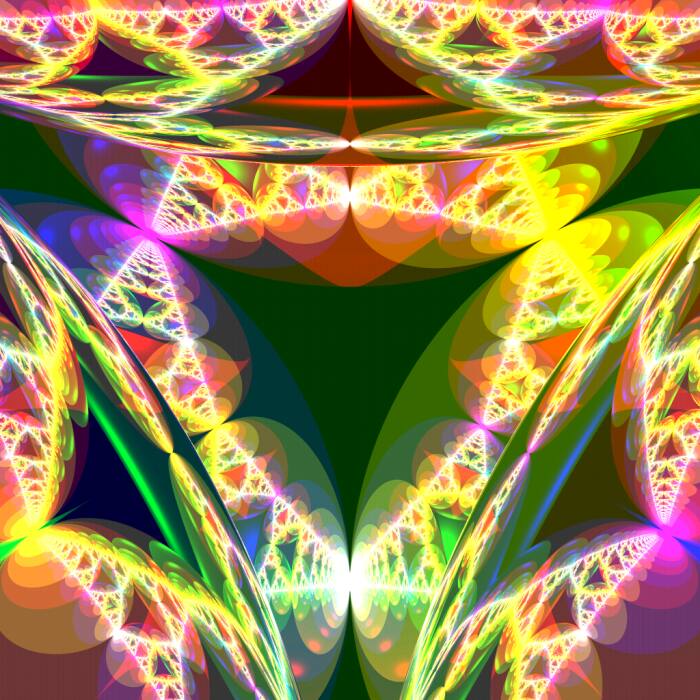
Does anyone notice the Sierpinski Triangles (another fractal) that are NATURALLY being formed? Yeah... 3s everywhere.
"My prayer is not for them alone. I pray also for those who will believe in me through their message, that all of them may be One, Father, just as you are in me and I am in you. May they also be in us so that the world may believe that you have sent me. I have given them the glory that you gave me, that they may be One as we are One— I in them and you in me—so that they may be brought to complete UNIty. Then the world will know that you sent me and have loved them even as you have loved me."
For those who are led by the Spirit of God are the children of God. The Spirit you received does not make you slaves, so that you live in fear again; rather, the Spirit you received brought about your adoption to SONship. And by him we cry, "Abba, Father." The Spirit himself testifies with our spirit that we are God's children. Now if we are children, then we are heirs—heirs of God and co-heirs with Christ, if indeed we share in his sufferings in order that we may also share in his glory.Post Edited (UNISON) : 5/25/2007 9:10:17 PM (GMT-5) | | Back to Top | | |
|
Tom
Registered Member
Date Joined Jul 2001
Total Posts : 10353
| Posted 5/26/2007 12:38 AM (GMT -6) | | I'm finding geometric shapes less and less important. What metaphysical truth am I suppose to "get" from a "shape"? They're pretty, I'll give you that!
Corey, Alan's got a nice post on his blog to the tune of "Can an atemporal God freely create?" (something like that). Pretty tight. It's not an intuition so far as I can see. It's just straight up reasoning from given premises to a conclusion. Oh, it's here: http://prosblogion.ektopos.com/archives/2006/08/can_a_timeless.html and here:
Tom
Post Edited (MANY) : 5/26/2007 12:41:48 AM (GMT-5) | | Back to Top | | |
|
Similitude
Registered Member
Date Joined Apr 2004
Total Posts : 4968
| Posted 5/27/2007 11:41 AM (GMT -6) | | | Alan posted the following about his view of God's temporality:
Jeff, I'm glad you liked my post "Can a Timeless God Freely Create?" I'm not sure what you mean by asking whether I've "converted", though. What I've basically endorsing is the idea that there must be at least one temporal moment to God's existence. Hence, God is necessarily not atemporal. However, I do not want to commit myself to the view that God must have an infinitely extended past or anything like that. As far as I can see, there could have been one and only one temporal moment.
Below is part of Alan's post on "the Prosblogion." Assuming that time is a being that has to be created, try to imagine how Alan's logic below would work if what God is creating is time itself:
Alan: In other words could we say that God's contemplation of possibilities and his deciding to actualize one of them occur simultaneously, as it were, with the "change" in God's intentional stance reflecting a mere logical sequence and not a temporal one? I don't think this will work because the relation between (1) God's contemplation of a set of creative possibilities and (2) his selecting one of those is not a logical sequence. In other words, no purely logical relation is going to get you from a proposition describing a set of possibilities ("Either A or B or C ...") to a proposition affirming just one of those possibilities ("A"). The latter just doesn't follow from the former. What we need is not a logical rule, but something substantive, namely, the exclusion of the other possibilities ("Neither B nor C ..."). It seems that this exclusion has to be due to a volitional act on God's part, an act that effects a transition from volitional indeterminacy ("Either A or B or C ...") to volitional determinacy ("A"). And it is simply incoherent to suppose that God (or anyone else) could be in both states at once. There are two distinct intentional stances here, and they are incompatible. Hence a free decision to create involves a qualitative change in God's mental life. And qualitative changes are temporal, not logical.
For the sake of clarity, lets just throw the word "time" in that conclusion to see how it sounds:
Hence a free decision to create TIME involves a qualitative change in God's mental life. And qualitative changes are temporal, not logical.
See the problem? How can there be temporal sequence leading up to the creation of time? Hence, time can not be created if Alan's logic is valid. My way around this dilemma is to say that time and space are not beings. They are only frames of reference from which we can abstract particular relationships. And in this sense, they are categories distinct from the category of being.
| | Back to Top | | |
|
PotOnWheel
Registered Member

Date Joined Jul 2001
Total Posts : 9890
| Posted 5/27/2007 2:18 PM (GMT -6) | | | D., T., "essence and energies..."?
It has this: footnote 31 -- "the eastern view recorded by Gregory of Nyssa, On the Beatitudes VII, P.G. 44, 1280C.D.: Man escapes from his own nature, becoming an immortal from a mortal that he is, and from one who has a price on his head to a priceless one, and from a temporal creature to an eternal one, being man becoming wholly god ... For if that which God is by nature, His property, is given by grace to man, then what else but a certain equality of honor is professed by virtue of the relation? "
Another site has this:
10-Explaining the theology of Gregory Palamas, he [Ives Congar] stresses that God’ energies must be available for us to share in, and they must be uncreated or else we could never be deified. This last point is important in Eastern theology. Orthodoxy differentiates between God’s essence and his activities, his self-manifestation to the world. It is axiomatic in Orthodoxy that we can not know God in his essence, for to know fully the nature of God is to be God. God in his essence is complete mystery; we can only know God in his activities, his love, his mercy, and so forth. Yet even God’s activities are mysterious: “How unsearchable are His judgements and His ways past finding out.” Essence without energy is inconceivable. As Basil the Great says: “There is no natural essence without energy, nor energy without essence. Rather, we recognize the essence by virtue of the energy, this energy manifesting and testifying to the essence. For no one has ever seen God’s essence; but we come to believe in the essence by virtue of the energy.”
http://energeticprocession.wordpress.com/2005/06/
(o)Post Edited (PotOnWheel) : 5/27/2007 2:38:56 PM (GMT-5) | | Back to Top | | |
|
Corey
Five with a Four-wing
Date Joined Feb 2003
Total Posts : 1893
| Posted 5/28/2007 8:55 AM (GMT -6) | | Alan's argument (which incidentally I did follow at the time), as I understand it, address the question of immutability, not the question as to whether God could have ever existed atemporally.
I agree with all of Alan's "therefores"
Therefore, God made a free decision to create from among several mutually exclusive possibilities. (2,3)
Therefore, in freely created God undergoes a change in his intentional stance. (4,5)
Therefore, God has changed in some respect. (6)
Therefore, God is not absolutely immutable. (7)
but don't agree that this argument shows that God cannot exist timelessly sans creation, or more precisely, sans the intentional stance to create.
Neither would I agree that "Time was 'created' and belongs to 'this' world and doesn't impinge upon God." Once God has experienced sequence, there's no way to un-experience that. There will forever be a before and an after. God is fully impinged.
AFAIK, I'm pretty much in the William Lane Craig camp on this one.
---------
What I'm balking at in the "eternally temporal" view is the problem of actual infinite regress. To simply dismiss it as "a numbers game" is a dodge.
For now, it probably comes down to a matter of preference. Tom finds the notion of God transitioning from atemporal to temporal more repugnant, and I happen to find the problem infinite regress more repugnant. Either way we have to swallow hard.
----------
Reflecting on the "off the dime" problem... does positing infinite past temporality really do much to remedy this? What changed between the moment of deciding to create and the literally infinite moments that preceded it? What new state of affairs obtained that motivated God to suddenly radically change the status quo? Could there really be anything "new" to occur? etc. Post Edited (Corey) : 5/28/2007 9:39:12 AM (GMT-5) | | Back to Top | | |
|
PotOnWheel
Registered Member
Date Joined Jul 2001
Total Posts : 9890
| Posted 5/28/2007 12:51 PM (GMT -6) | | | I hope this post does not frustrate anyone. I read what Jeff and Corey wrote, and then went out to mow and weed-N-feed the lawn. This is what occured to me while doing those things.
I was following Corry when he said that Alan's arguement addressed immutability. No surprise. But both the four therefores and Alan and Corey's embrace of them surprised me--at first. (I'd like to knwo what D. thinks.)
Then while mowing it occured to me that this might ALSO be about predestination. And THEN the pieces start coming together.
By analogy I mused at how Reformed looking at Orthodox can think that the four passages in the Bible about Christ preaching to the captives in hell -- and some of them getting saved, but not all -- could (did) prompt someone to ask, do "Orthodox believe people can accept Christ after they have died and be saved by good works outside of faith." Problem is both one of varying terms and varying categories. (Yes, scripture does present Christ preaching to those in hades who do not know Him but still--some of them but not all--recognize and believe on him then based on the formation already present in them. No, "works" in this case IS belief/faith, and not law or meritorious carnal activity, so we need not worry about Judaizing or Romanizing this. Scripture speaks for itself.)
The terms here, of which one is immutability, have structures and contexts that they are used to carrying around with them. (Like passible does, in common contexts.)
But so does predestination. And I think that is the train-station one might well get down to if you go further in your path. So, while mowing, it occured to me that common missteps with predestination might be being made here. (And, also, that boing down the "therefores" path might lead one to predestinations that are un-hoped for too.)
Rather, back up in historical context to recognize and implement the distinctions between "essence and energies." That should do the trick.
What I see working in Alan's four "therefores" is a lockstop between energy and essence that GOES TO FAR by not handling the necessary relationship characteristics that surely does exist between them. They are not disjunct, or separate -- like later views of "created grace" (which Thomas might not recongnize, but became widespread). But key is that What God can do in his Creation does not surge back up some heavenly-plumbing and spill all over the floor of the trinity.
Simply put: God is totally other in his essence while being totally present in his energies, allowing us who are totally ceatures by nature to be totally deified by grace.
The four "therefores" are built on presumed requirements that do fit some things, but do not fit God.
Thank you.
And, D., take care...
 btw, Corey, what is a "freely creat ed God?" Do you mean "freely creat ing..."
(o) Post Edited (PotOnWheel) : 5/28/2007 12:54:05 PM (GMT-5) | | Back to Top | | |
|
Similitude
Registered Member
Date Joined Apr 2004
Total Posts : 4968
| Posted 5/28/2007 4:44 PM (GMT -6) | | | Corey, if you agree that time is not a being that is created, I may actually be agreeing with you after all. But I'm not sure what you mean by the problem of "infinite regress." What is that problem, exactly?
| | Back to Top | | |
|
PotOnWheel
Registered Member
Date Joined Jul 2001
Total Posts : 9890
| Posted 5/28/2007 7:50 PM (GMT -6) | |
jefscott said...
If time is not a being, B., what is it? The difficulty of defining time and space is at the heart of our disagreements about them, IMO. Maybe its just me, but for me a "being" is alive. E.g., Water is a creature and a mineral, but not a being.
Time is a creature; and my wife suspects that the falling-apart-ness of time is due to sin.
I'm guessing that the eternally-growing-ness of time is a good thing.
(o) | | Back to Top | | |
|
Corey
Five with a Four-wing
Date Joined Feb 2003
Total Posts : 1893
| Posted 5/29/2007 9:45 AM (GMT -6) | | | Jeff: I'm not sure what you mean by the problem of "infinite regress." What is that problem, exactly?
Corey: No matter how high you count, you can always count one more number higher. You will never arrive at “infinity”, by counting up. Similarly, no one could count down from infinity to zero. Imagine you run into a man on the street who is counting outloud: “4 … 3 … 2 … 1 … 0!” You ask, “What are you doing?” and he replies, “Counting down from infinity; I just finished.” There’s no way he could do this. Even barring problems with his mortality, counting down from infinity isn’t possible.
Positing an infinite past is the mirror of this. If time extends infinitely into the past, then in order to reach this current moment, an actual infinite would have to have been traversed by successive additions of events, one causing the next. We'd never arrive at "0", but clearly we have! See the problem?
------
No, I don't think time is a "being" or a "creature" or whatever. In fact, I'm wondering to myself if it's even a noun; rather I suspect thinking of it as an adjective might be more appropriate: it describes the state of affairs where there is procession of befores and afters. Post Edited (Corey) : 5/29/2007 9:58:38 AM (GMT-5) | | Back to Top | | |
|
Tom
Registered Member
Date Joined Jul 2001
Total Posts : 10353
| Posted 5/29/2007 12:03 PM (GMT -6) | | To be repugnant a notion has first to be meaningful!  And I don't find atemporal personhood, or atemporal loving relationality, at all meaningful. I honestly don't know what sense to make of it.
Tom
Post Edited (MANY) : 5/29/2007 12:08:23 PM (GMT-5) | | Back to Top | | |
|
Corey
Five with a Four-wing
Date Joined Feb 2003
Total Posts : 1893
| Posted 5/29/2007 8:43 PM (GMT -6) | | | Jeff: I guess I don't see the problem if the traversal had no beginning. [...] Oh well, we're all agreed that time is not a created being. That's good enough for now!
Corey: Don't hang up the phone just yet! Didn't my example show that the problem still is present even if one assumes no beginning to the sequence? There is still an infinite interval to be traversed.
Do you also see that positing an infinite past REQUIRES positing an infinite set of true propositions, since time is discrete? Post Edited (Corey) : 5/29/2007 8:50:33 PM (GMT-5) | | Back to Top | | |
| 79 posts in this thread.
Viewing Page : 1 2 3 4 |
| Forum Information | Currently it is Monday, November 09, 2026 11:05 AM (GMT -6)
There are a total of 97,718 posts in 6,040 threads.
In the last 3 days there were 0 new threads and 0 reply posts. View Active Threads
|
Forum powered by dotNetBB v2.42EC SP3
dotNetBB © 2000-2026 |
|
|