 |
| Open Theism Discussion Board > Public Forums > General Chat > Christ is the Telos. | Forum Quick Jump
|
 | 
Tom
Registered Member

Date Joined Jul 2001
Total Posts : 10353
| Posted 2/10/2008 11:39 AM (GMT -6) |   | D-
I see four aspects of human nature instantiated by Jesus that you pointed out:
1) The capacity to relate to God in our own self-relationship.
2) The capacity to have our personhood rooted in the God and not in created relationships.
3) The capacity to hear God’s voice in us.
4) The capacity to become a compatibilistic doer of the Good.
I’m fine with 2 through 4. To have our identity grounded in the relationship to God and not grounded in any other relationship, to hear God’s voice, and to be compatibilistically free to do God’s will at all times. Sounds wonderful. I’ve never suggested anything else.
But on (1), I have to say I don’t know what it means. If you mean the capacity to relate to God ‘within’ ourselves, then yes. If you mean the capacity to see ourselves as God, to equate self-perception with God-perception, then no.
But you’ll say, “That’s how Christ saw himself, and Christ is exactly what God wants us to be.” And I’ll say, “I don’t think that’s the sense in which Christ is our example.” E. L. Mascall, “God…is not ‘who’ we become.”
But you already know all this.
--------------------------------
D: If God the Son is “hypostatically unified” to Christ's ‘flesh’...and Christ's ‘flesh’ is ACTUALLY and TRULY inseparable from the rest of the Universe, the CONTEXT for Christ's flesh...then what matter/energy arrangement in Creation is NOT affected by Christ's bodily resurrection at all times?
Tom: Why only suppose such intimacy begins with the resurrection? How is God not intimately related to matter by creation? In him we live and move and have our being? In Christ “all things hold together.” God is always, everywhere, at/with/by all things. I don’t think this begins with the resurrection. I’m not saying the resurrection isn’t a unique presence of God in the world, I just don’t see how it gets you the particular psychology of personal identity that you want.
D: What matter/energy arrangement in Creation is Christ NOT ‘hypostatically unified’ to...if indeed the Word truly took on all aspects of flesh, just without sin?
Tom: I don’t see how Christ’s implicating all creation in his saving act by virtue of the incarnation/resurrection precludes our being persons-in-relation to God. Sorry. You think that because all creation is connected to/inseparable from the hypostasis of the Son that human beings can’t perceive themselves as thinking/choosing/feeling embodied centers of experience in relationship to God.
So, what of the quotes I posted?
T
| | Back to Top | | |
|
One Love
Registered Member

Date Joined Jan 2003
Total Posts : 13888
| Posted 2/10/2008 12:41 PM (GMT -6) | | Let's start with your quotes, Tom. Just bring back Ware. He summarized what you are wanting to say...
Palamas envisages, then, three levels of union. First, there is union “according to essence,” such as exists between the three persons of the Holy Trinity, Father, Son, and Holy Spirit. But the mystical union between God and human beings cannot be on this level. On Palamas’s presuppositions, if we were to participate in God’s essence, then we should become God in a literal sense, in the same way the three divine persons are God. But theosis (deification) is not to be understood in such a crude and unqualified way; for, although united to God, the saints do not become additional members of the Trinity.
Second, there is union “according to hypostasis,” such as occurred at the incarnation, when Godhead and manhood were united in the single person of Jesus Christ the Theanthropos. Once more, the mystical union cannot be of this kind, since the hypostatic union brought about at the incarnation is altogether unique. It is indeed our vocation to become “sons in the Son,” to use a phrase of Eckhart. But this does not mean that we and God constitute a single person, as in Christ’s hypostatic union; for in the mystical vision, face-to-face, the saints still preserve each their own individual identity.
There remains, then, the third possibility: the mystical union is a union “according to energy.” The human person in such a union is made one with God, yet is not absorbed or annihilated. Each of the saints, although “deified” or “divinized”—filled, that is to say, with the life, glory, and power of God—nonetheless continues to be a distinct personal subject. God is “all in all” (1Cor 15.28); yet, in the words of the Macarian homilies (fourth century), “Peter is Peter, Paul is Paul, Philip is Philip. Each one retains his own nature and personal integrity, but there are all filled with the Holy Spirit.” In the “I and Thou” relationship between God and the saints, the “I” still remains an “I” and the “Thou” still remains a “Thou,” however close the two approach in mutual love.
Basically what I hear all of these people saying is the following:
1) For every individual human being, there will be an creaturely "I" sense there. A sense of creaturely (limited perspective, surpassable in beauty) self-differentiation and self-consciousness that is the source of human meaning-making and choice.
2) This creaturely "I" sense can see itself as personally distinct from the ground of it's being, God.
3) This creaturely "I" sense can have an ego identity associated with it (Paul, Peter, Tom, Dwayne, Hillary, Rush, etc) that will be part of their individual becoming as a "thou." (Of course, ego identities can CHANGE...but the creaturely "I" sense would remain consistent throughout.)
4) Neither the creaturely "I" sense itself nor the capacity for ego identification are obliterated by mystical union between God and the human soul. The creaturely "I" doesn't see itself as UNlimited and UNcreated subjectivity...so we never see ourselves as God sees Godself. "I" participate in the DIVINE ENERGIES of the Father via the Father's Spirit and Father's Word...but never in the self-experience of God's utter transcendence. As a result, there is union without fusion or confusion.
I think this is what was being said pretty much, right, Tom?
I just want to make sure.
In the Spirit of Christ, BE Christ to every "Christ" you see when you look at yourself and other human beings. "Insofar as you've done to the least of these..." Post Edited (Imago Dei) : 2/10/2008 12:31:46 PM (GMT-6) | | Back to Top | | |
|
One Love
Registered Member
Date Joined Jan 2003
Total Posts : 13888
| Posted 2/10/2008 1:25 PM (GMT -6) | | Tom:
I’m fine with 2 through 4. To have our identity grounded in the relationship to God and not grounded in any other relationship, to hear God’s voice, and to be compatibilistically free to do God’s will at all times. Sounds wonderful. I’ve never suggested anything else.
Fine.
************************************
Tom:
But on (1), I have to say I don’t know what it means. If you mean the capacity to relate to God ‘within’ ourselves, then yes. If you mean the capacity to see ourselves as God, to equate self-perception with God-perception, then no.
I mean the Kierkegaardian sense of the human capacity to be a "relation that relates itself to itself" and in that self-relationship, relate to a transcendent GROUND of it's relating to sustain the self-relationship without despair.
It is part of our makeup to always have to ability to relate to God in our own self-relationality as creaturely "I"s.
****************************************
D: What matter/energy arrangement in Creation is Christ NOT ‘hypostatically unified’ to...if indeed the Word truly took on all aspects of flesh, just without sin?
Tom: I don’t see how Christ’s implicating all creation in his saving act by virtue of the incarnation/resurrection precludes our being persons-in-relation to God. Sorry. You think that because all creation is connected to/inseparable from the hypostasis of the Son that human beings can’t perceive themselves as thinking/choosing/feeling embodied centers of experience in relationship to God.
Ok...this may seem random, but whatever...
Let's say that I have a skeptical view of the idea of epiklesis. Let's say that I think that idea of bread and wine somehow being "transformed" into (or being "shown/revealed" to be) the Real...ACTUAL...Presence of Christ. Let's say you think that it's simply "superstitious magic."
Ok. Let's say I've been blessed to know about modern scientific discoveries and ideas about cosmogony and cosmology. Long story short, let's say that from this, I believe that human flesh is actually being (more or less) vibrations of energy that are inseparable from the sea of energy throughout the universe. (We could talk about zero-point energy, Casmir effect, and all that...but I think you get the point)
Now, I think about what it means that every "quantum" of energy in the Universe related to the PRESENT production and sustenance of Christ's glorified human flesh...is "hypostatically unified" to God the Son.
Hmmm...that would mean that there's no energy in the Universe that is uninvolved with Christ's hypostatic union...BECAUSE of Jesus' present physical nature. Christ the Logos is sanctifying all of Creation with his glorified, risen human body. Christ, both in divine nature and human nature, REALLY IS present in all Creation in a real way. We just don't have the eyes to see it.
I carry the thought. If Christ the Logos is hypostatically unified to all energy in the universe through his "flesh", this would include the energy that exists in ordinary BREAD and WINE that goes into Divine Liturgy. Even THAT energy isn't uninvolved with Christ's risen human body. And since bread and wine just look to us like...well...bread and wine, we DEFINITELY don't usually think of bread and wine as forms of energy manifestation. But it is. Perhaps, in epiclesis by God's grace, I have the "heart posture" (POVERTY-OF-SPIRIT) necessary to more fully PARTICIPATE in this reality through the "ordinary" bread and wine...as I believe that I, in community, am ACTUALLY participating in the REAL "Body and Blood" Presence of Christ. Given what I believe about the world (No 3-tiered worldview), things make sense. It's not obscure to me to say that Christ's TANGIBLE PRESENCE can be in bread or wine...or anything else for that matter.
Wow...
But...another thought occurs. My very own FLESH and BLOOD in my body is of this energy. It's made out of the same "ashes of dead stars" the the bread and the wine is. Can it be possible, by grace through epicletic faith, for the "showing" reality seen in Divine Liturgy to be experienced in the energy of my own flesh...which is a "living sacrifice" to God. (Rom 12) As I live in "mundane ecstasy" in the World, can it be possible for the Real Presence of Christ to indwell my human becoming at every Present Moment as I live in the heart posture of the Orans: "Holy Spirit, Come!"
Well...yes. That's exactly what Fr. Proctor confirmed for me, over and over again. It IS possible and IN LINE with the teachings of the Fathers, Saints and the Church.
So, I would no longer think that epiklesis was just some "superstitious magic", but participation in a LIVED, LIVABLE reality.
Superstitious magic...ha! 
In the Spirit of Christ, BE Christ to every "Christ" you see when you look at yourself and other human beings. "Insofar as you've done to the least of these..." Post Edited (Imago Dei) : 2/10/2008 12:29:44 PM (GMT-6) | | Back to Top | | |
|
Tom
Registered Member
Date Joined Jul 2001
Total Posts : 10353
| Posted 2/10/2008 3:55 PM (GMT -6) | | Ware: Each of the saints, although “deified” or “divinized”—filled, that is to say, with the life, glory, and power of God—nonetheless continues to be a distinct personal subject. God is “all in all” (1Cor 15.28); yet, in the words of the Macarian homilies (fourth century), “Peter is Peter, Paul is Paul, Philip is Philip. Each one retains his own nature and personal integrity, but there are all filled with the Holy Spirit.” In the “I and Thou” relationship between God and the saints, the “I” still remains an “I” and the “Thou” still remains a “Thou,” however close the two approach in mutual love.
Tom: If Ware (who knows the Fathers better than all us put together, feels this is a view compatible with Orthodoxy, then...well, then am I still a heretic? I've gotten the distinct sense from you and POW that there is ZERO room in Orthodoxy for Ware's third way.
I'll try to get to your stuff asap. It's midnight, I've been translating for several hours and am beat. Plus I got a big brief to interpret in the AM.
Wars and rumors of wars. When will it end?
Love all,
T
| | Back to Top | | |
|
One Love
Registered Member
Date Joined Jan 2003
Total Posts : 13888
| Posted 2/10/2008 8:26 PM (GMT -6) | | Tom:
If Ware (who knows the Fathers better than all us put together, feels this is a view compatible with Orthodoxy, then...well, then am I still a heretic? I've gotten the distinct sense from you and POW that there is ZERO room in Orthodoxy for Ware's third way.
Let's think about something. Yes, Ware says what he says about personal distinction from God. Cool. At the same time, We must take Ware's statements, putting them into the context of his knowledge of epiklesis, essence/energies distinction, hesychasm, "Christ-in-me", etc. Ware's theological position ASSUMES orthodox beliefs about epiklesis (and other things) that you straight up deny, Tom. That's an issue. You went so far as to say this...
I don’t see the elements substantially transformed into Christ in any manner of speaking. Sorry. They’re just a reenactment, a memorializing of history, a point of contact wherein my faith and perception connect to the historical act of Christ on my behalf. There’s nothing magical about the elements. I think to make the elements anything more than this is superstitious magic.
I'm not trying to run this statement of yours into the ground, Tom. What I am trying to show you is that, with respect to some of the things that GROUND Ware's views on union with God...you're very theological predispositions not only actively deny...but simply just don't take into account. You said so yourself.
So, it seems to me that you can't just take Ware's position on personal differentiation from God in deification WITHOUT taking all the other integral ideas...including Ware's idea of our telos.
Let's look at some more quotes...all Ware. All Orthodox Way.
*******************************************************************
“On the walls of the catacombs in Rome there is sometimes painted the figure of a woman praying, the Orans. She is gazing towards heaven, her open hands raised with the palms upwards. This is one of the most ancient of Christian ikons. Whom does she represent—the Blessed Virgin Mary, the Church, or the soul at prayer? Or perhaps all three at once? However, it is interpreted, this ikon depicts a basic Christian attitude: that of invocation or epiclesis, of calling down or waiting upon the Holy Spirit.
There are three main positions that we can assume with our hands, and each has its own symbolic meaning. Our hands may be closed, our fists clenched, as a gesture of defiance or in an effort to grasp and to hold fast, thus expressing aggression or fear. At the other extreme our hands may hang listlessly by our sides, neither defiant nor receptive. Or else, as a third possibility, our hands may be lifted up like those of the Orans, no longer clenched by open, no longer listless but ready to receive the gifts of the Spirit. An all-important lesson upon the spiritual Way is understanding how to unclench our fists and to open our hands.
Each hour and minute we are to make our own the action of the Orans: invisibly we are to lift our opened hands to heaven, saying to the Spirit, Come.
The whole aim of the Christian life is to be a Spirit-bearer, to live in the Spirit of God, to breathe the Spirit of God.”
----------------------
Only a few Christians in each generation become elders, and still fewer become fools in Christ. But all the baptized without exception are Spirit-bearers. "Do you know realize or understand your own nobility?" ask The Homilies of St. Macarius. "...Each of you has been anointed with the heavenly Chrism, and has become a Christ by grace; each is king and prophet of the heavenly mysteries."
----------------------
Just as the Spirit sends the Son at the Annunciation, the Baptism, and the Transfiguration, and just as the Son in his turn sends the Spirit at Pentecost, so after Pentecost it is the Spirit's task to bear witness to Christ, rendering the risen Lord ever present among us. If the aim of the Incarnation is the sending of the Spirit at Pentecost, [then] the aim of Pentecost is the continuing of Christ's Incarnation within the life of the Church. This is precisely what the Spirit does at the epiclesis in the Eucharistic consecration; and this consecratory epiclesis serves as a model and paradigm for what is happening throughout our whole life in Christ.
"Where two or three are gathered together in my name, there am I in the midst of them" (Matt 18:20). How is Christ present in our midst? Through the Holy Spirit. "Lo, I am with you always, even to the end of the world" (Matt 28:20) How is Christ always with us? Through the Holy Spirit. Because of the Comforter's presence in our heart, we do not simply know Christ at fourth of fifth hand, as a distant figure from long ago, about whom we possess factual information through written records; but we know him directly, here and now, in the present, as our personal savior and our friend. With the Apostle Thomas, we can affirm "My Lord and my God" (John 20:28). We do not merely say "Christ was born"--once, very long ago; we say "Christ is born"--now, at this moment, in my own heart. We do not say merely "Christ died" but "Christ died for me". We do not say merely "Christ rose" but "Christ is risen"--he lives now, for me and in me. This immediacy and personal directness in our relationship with Jesus is precisely the work of the Spirit."
----------------------
So the Jesus prayer begins as an oral prayer like any other. But the rhythmic repetition of the same short phrase enables the hesychast, by the very simplicity of the words which he uses, to advance beyond all language and images into the mystery of God. In this way, the Jesus Prayer develops, with God's help, into what Western writers call "prayer of loving attention" or "prayer of simple gaze", where the sould rests in God without a constantly varying succession of images, ideas, and feelings. Beyond this there is a further stage, when the hesychast's prayer ceases to be the result of his own efforts, and becomes--at any rate from time to time--what Orthodox writers call "self-acting" and Western writers call "infused". It ceases, in other words, to be "my" prayer and becomes to a greater or lesser extent the prayer of Christ in me.
Yet it is not to be imagined that this transition from oral prayer to prayer of silence, or from "active" to "self-acting" prayer, is rapidly and easily made. The anonymous author of "The Way of the Pilgrim" was granted continual "self-acting" prayer only after a few weeks of practicing the Invocation of the Name of Jesus, but his case is altogether most exceptional and should on no account be regarded as the norm. More commonly, those who recite the Jesus Prayer are granted from time to time moments of "rapture", coming unexpectedly as a free gift, when the word of prayer recede into the background or disappear altogether, and are replaced by an immediate sense of God's presence and love. But for the great majority this experience is only a brief glimpse, not a continuous state. It would in any case be most unwise to attempt to induce by artificial means what can only come about as the fruit of God's direct action. The best course, when invoking the Holy Name, is to consecrate our full efforts upon the recitation of the words; otherwise, in our premature attempts to attain wordless prayer of the heart, we may find that we end up not really praying at all, but merely sitting half asleep.
----------------------
The Image and Likeness signify orientation, relationship. As Philip Sherrard observes, "The very concept of man implies a relationship, a connection with God. Where one affirms man one also affirms God." To believe that man is made in God's image is to believe that man is created for communion and union with God, and that is he rejects this communion he ceases to be properly man. There is no such thing as "natural man" existing in separation from God: man cut off from God is in a highly unnatural state. The image doctrine means, therefore, that man has God as the innermost center of his being. The divine is the determining element in our humanity; losing our sense of the divine, we lose also our sense of the human.
*******************************************************************
All of this is part of Ware's perspective. Ware would have absolutely no problem agreeing with Bobrinskoy, that it is Christ-in-us who is the "one who PRAYS and INTERCEDES" in us. Go right back up and look at exactly what Ware said about the Jesus prayer. The "self-acting prayer"...which is a "fruit of God's direct action" where "it ceases, in other words, to be 'my' prayer and becomes to a greater or lesser extent the prayer of Christ in me." Ware would have no problem agreeing with Nesteruk about epicletic, ecclesial participation in the Real Presence of the Risen Lord through the Eucharist...
Christ himself was treated as “the New Man” and the last Adam. The divine plan of salvation was consummated, the kingdom of God inaugurated through Christ, but the ultimate things were yet to come in fullness and glory. The king had come, but the kingdom was still to come. The promise of the kingdom was granted to the church by the Holy Spirit. The church has lived since then in two dimensions: in sight of ongoing secular history and world events in the time of decay and oblivion, but also in the time of the heavenly kingdom inaugurated by the risen savior (in which the church has lived epicletically in the expectation of the kingdom.)
The coming of Christ and the resurrection changed completely the human situation, for in fallen existence, the time form of the world is characterized by law (nomos); this implies that humans were involved in an irreversible chain of decay and corruption, which led them to mortality with no hope of undoing the things they had done. Everything that had been done became ontologically necessary, so that there was no way to overcome this necessity, which is indicated by the word “law”. The coming of Christ and the resurrection relieved us from this law; we are still living in the world or “fallen” temporal order, but we are relieved from the necessity of the law; that is, we have a chance of renewal and of entering the kingdom [of God], cleansing ourselves through constant participation in the resurrection of the Lord.
Alexei V. Nesteruk, Light from the East: Theology, Science, and the Eastern Orthodox Tradition, p.246
And last but not least, Ware would definitely agree with the idea that we are LITERALLY the "further Incarnations of Christ". No doubt, hands down. Look at Ware's quote...
Just as the Spirit sends the Son at the Annunciation, the Baptism, and the Transfiguration, and just as the Son in his turn sends the Spirit at Pentecost, so after Pentecost it is the Spirit's task to bear witness to Christ, rendering the risen Lord ever present among us. If the aim of the Incarnation is the sending of the Spirit at Pentecost, [then] the aim of Pentecost is the continuing of Christ's Incarnation within the life of the Church. This is precisely what the Spirit does at the epiclesis in the Eucharistic consecration; and this consecratory epiclesis serves as a model and paradigm for what is happening throughout our whole life in Christ.
Hmmmm. Yeah.
If Ware had heard someone say these statements...
By the power of Father's Spirit, in epicletic faith (poverty-of-spirit), "I" can freely choose to bear God the Son (Christ) in my very being, 'body', 'mind', and 'spirit'...even as Christ-in-me sustains and grounds that very being, 'body', 'mind', and 'spirit.'
By grace through faith, "I" become Christ's continuing Incarnation. In Christ, "I" am Christ...in every Present Moment that "I" live. Well, actually, with all this...it's not really "I" who lives, it's Christ who lives in and through all of my human becoming.
Through the eternal "Abba, Father" relationship that the Father and Son share (that "I" graciously participate in...in the Risen Christ), "I" experience oneness with the Father.
Would Ware have disagreed with any of those statements, essentially? Clarification, definitely. But I'm talking the MEAT of what's being said. Really look at ALL his quotes now. Everything that's being said. Would Ware have disagreed saying that this was heretical, confusing natures, or anything like that?
I really don't think so. I think there would be enough points of reference to realize that the SAME WORLDVIEW was being spoken about. An ORTHODOX worldview WITH epiklesis, hesychasm, "Christ-in-me", and theosis being operative, meaningful aspects of the Christian life in God's One Story World.
But if I were to say this to a memorialist Protestant believer who doesn't believe in epiclesis EVEN IN CALVIN'S SENSE...
What do you think would be the response, Tom?
In the Spirit of Christ, BE Christ to every "Christ" you see when you look at yourself and other human beings. "Insofar as you've done to the least of these..." Post Edited (Imago Dei) : 2/10/2008 7:52:08 PM (GMT-6) | | Back to Top | | |
|
Tom
Registered Member
Date Joined Jul 2001
Total Posts : 10353
| Posted 2/11/2008 12:22 PM (GMT -6) | | D-
So with his third option Ware DOESN’T (indeed CANNOT) be describing a view of oneness that obtains via a divine-human I-You relationship? In spite of the fact that his words appear to be saying exactly this, Ware really means some form of oneness representative in his first or second options which describe a oneness in which such personally distinct “I” and “You” address/respons are NOT present.
Hey, if you say so. Fine.
So I’m definitely out of Orthodoxy camp for sure this time! At least THAT'S settled!
I can live with that.
------------------------
Tom: Synergy isn't utilitarian. It's not there to get us to some other, more beautiful experience of oneness. It IS the oneness God seeks with us.
POW: Tom has my vote.
Tom: B, I appreciate the vote! But I don’t think you really agree with what I mean. Unlike Ware, I really DO try to say what I mean so that accurate interpretations of my words don’t require me to mean something quite UNLIKE what the words themselves suggest. ;o)
By divine-human synergy I do NOT mean:
1) D’s “synergy unto monergism” where we’re free to exercise our will in ways NOT determined by God right up and including the consummate choice to divest ourselves of this very capacity, at which time our every thought, choice, and movement are determined by the divine will ‘alone’ (D’s monergism; and that’s just what moergism is).
2) I also do NOT mean something close to this, namely, the idea that we don’t really give up the capacity to determine ourselves but rather forever freely choose, consistently, moment by moment, to perpetuate a state of affairs in which we are effectively determined by God’s will just as if (1) above WERE the case.
What I mean by synergy, POW, is the consummate relational beauty of love, freely and even wildly expressing itself in creative ways within a divine-human interpersonal relationship, so that the end result—the relation itself—is forever a joint-project in which God addresses us and we (WE) respond, and ALSO in which WE address and God responds.
You may want to check with D to see if, given your EO beliefs, you can still give me your vote without being inconsistent with Orthodoxy.
Love ya’ll,
Tom
Post Edited (HumanHypostasis) : 2/11/2008 11:26:17 AM (GMT-6) | | Back to Top | | |
|
PotOnWheel
Registered Member

Date Joined Jul 2001
Total Posts : 9890
| Posted 2/11/2008 12:37 PM (GMT -6) | |
HumanHypostasis said...
D-
So with his third option Ware DOESN’T (indeed CANNOT) be describing a view of oneness that obtains via a divine-human I-You relationship? In spite of the fact that his words appear to be saying exactly this, Ware really means some form of oneness representative in his first or second options which describe a oneness in which such personally distinct “I” and “You” address/respons are NOT present.
Hey, if you say so. Fine.
So I’m definitely out of Orthodoxy camp for sure this time! At least THAT'S settled!
I can live with that.
------------------------
Tom: Synergy isn't utilitarian. It's not there to get us to some other, more beautiful experience of oneness. It IS the oneness God seeks with us.
POW: Tom has my vote.
Tom: B, I appreciate the vote! But I don’t think you really agree with what I mean. Unlike Ware, I really DO try to say what I mean so that accurate interpretations of my words don’t require me to mean something quite UNLIKE what the words themselves suggest. ;o)
By divine-human synergy I do NOT mean:
1) D’s “synergy unto monergism” where we’re free to exercise our will in ways NOT determined by God right up and including the consummate choice to divest ourselves of this very capacity, at which time our every thought, choice, and movement are determined by the divine will ‘alone’ (D’s monergism; and that’s just what moergism is).
2) I also do NOT mean something close to this, namely, the idea that we don’t really give up the capacity to determine ourselves but rather forever freely choose, consistently, moment by moment, to perpetuate a state of affairs in which we are effectively determined by God’s will just as if (1) above WERE the case.
What I mean by synergy, POW, is the consummate relational beauty of love, freely and even wildly expressing itself in creative ways within a divine-human interpersonal relationship, so that the end result—the relation itself—is forever a joint-project in which God addresses us and we (WE) respond, and ALSO in which WE address and God responds.
You may want to check with D to see if, given your EO beliefs, you can still give me your vote without being inconsistent with Orthodoxy.
Love ya’ll,
Tom
I'm with two, and not with one or three.
Three is a contemporary romanticism. (I'm just throwing that comment out for you to challenge, Tom. But I'd like you to provide a historical record of three, and then we'll find out just how new or old it is. Sounds trendy to me--three hundred years old at best. Oh, I want geography too: if its Renaissance I want to know where and of course who! Can you do that for me, Tom?)
(o) | | Back to Top | | |
|
Tom
Registered Member
Date Joined Jul 2001
Total Posts : 10353
| Posted 2/11/2008 3:13 PM (GMT -6) | | POW: I'm with two, and not with one or three.
Tom: Two what? Two persons in relation? Who is your two? I’m not following.
POW: Three is a contemporary romanticism.
Tom: I’m lost.
POW: But I'd like you to provide a historical record of three…
Tom: Three what?
POW: …and then we'll find out just how new or old it is. Sounds trendy to me…
Tom: What sounds trendy? Loving interpersonal relationships filling up the whole universe? Free creative expression?
POW …three hundred years old at best. Oh, I want geography too: if it’s Renaissance I want to know where and of course who! Can you do that for me, Tom?)
Tom: I doubt it. I don’t even know what you’re asking me to do!
T
| | Back to Top | | |
|
PotOnWheel
Registered Member
Date Joined Jul 2001
Total Posts : 9890
| Posted 2/11/2008 4:39 PM (GMT -6) | |
HumanHypostasis said...
POW: Tom has my vote.
Tom: B, I appreciate the vote! But I don’t think you really agree with what I mean. Unlike Ware, I really DO try to say what I mean so that accurate interpretations of my words don’t require me to mean something quite UNLIKE what the words themselves suggest. ;o)
By divine-human synergy I do NOT mean:
#1
1) D’s “synergy unto monergism” where we’re free to exercise our will in ways NOT determined by God right up and including the consummate choice to divest ourselves of this very capacity, at which time our every thought, choice, and movement are determined by the divine will ‘alone’ (D’s monergism; and that’s just what moergism is).
#2
2) I also do NOT mean something close to this, namely, the idea that we don’t really give up the capacity to determine ourselves but rather forever freely choose, consistently, moment by moment, to perpetuate a state of affairs in which we are effectively determined by God’s will just as if (1) above WERE the case.
#3
What I mean by synergy, POW, is the consummate relational beauty of love, freely and even wildly expressing itself in creative ways within a divine-human interpersonal relationship, so that the end result—the relation itself—is forever a joint-project in which God addresses us and we (WE) respond, and ALSO in which WE address and God responds.
N O W you understand!
So, my comments and question:
I'm with two (#2), and not with one (#1) , or three (#3).
Three is a contemporary romanticism. (I'm just throwing that comment out for you to challenge, Tom.) But I'd like you to provide a historical record of three (#3), and then we'll find out just how new or old it is. Sounds trendy to me--three hundred years old at best. Oh, I want geography too: if its Renaissance I want to know where and of course who! Can you do that for me, Tom?
(o) | | Back to Top | | |
|
Tom
Registered Member
Date Joined Jul 2001
Total Posts : 10353
| Posted 2/12/2008 4:28 AM (GMT -6) | | POW: Now you understand!
Tom: I guessed. You were less than clear.
POW: So, my comments and question: I'm with two (#2), and not with one (#1), or three (#3).
Tom: So MY question: What could you MEAN by responding to MY (#3) assertion of synergy with "Tom has my vote"? You obviously thought I meant something like the #2 that you and D prefer. But how, after more than 100 pages, can you think I meant THAT kind of synergy. It's not LONGER a synergy. The 'perpetual free surrender of will" that it describes, as D confessed, is essentially monergism. He said it--synergy UNTO monergy. You didn't like THAT phrase, but that's what #2 is. In other words, the synergy that you THINK you're maintaining by asserting #2 over #1 is only apparent. What would it mean, what would the implications for theosis even be, for us to say we shall forever, continually, moment by moment FREELY renew the relinquishing of exercise of self-determination?
Now YOU (hopefully) understand my question.
Romanticism? I'll take it over 'Science Fiction' anyday! ;o)
Later,
Tom
Post Edited (HumanHypostasis) : 2/12/2008 5:08:19 AM (GMT-6) | | Back to Top | | |
|
Corey
Five with a Four-wing

Date Joined Feb 2003
Total Posts : 1893
| Posted 2/12/2008 6:30 AM (GMT -6) | | | I'm quite convinced that SK's description of the self as "the relation that relates itself to itself" doesn't line up in support of your position, Dwayne. Sure, I'll check Loder, but it strikes me as spin to use SK's language in the way I understand you to mean.
Basically, I believe SK has in mind what we call disposition around here. That's it. The "negative third" is that which relates possibility to actuality. "I" am that which makes determinations for my particular set of possibilities. Now, additionally to that inward relationship, the Self relates outwardly to God. A Self relates (or misrelates) both to himself and to God.
For the record, I reject #1 and #2 above.
Here's a rendition of the diagram that Tyler uses to explain that phrase (from Dr. Sponheim, I believe):
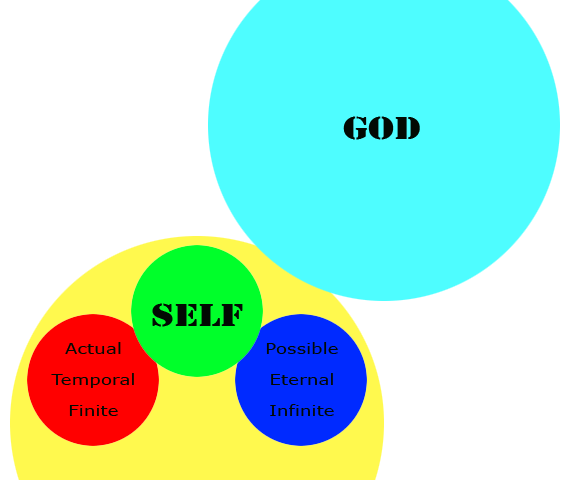
Graphically, this is how I represent my understanding of Dwayne's model:
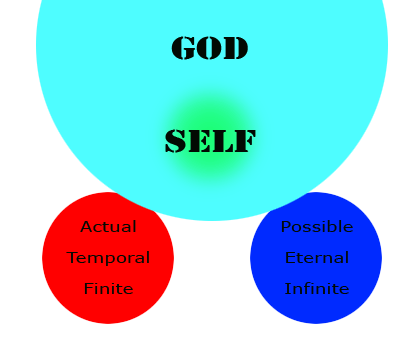
In SK's parlance, God himself becomes the "negative third" in Dwayne's model. I don't believe this is what SK had in mind.
Before God, in grace, we will with all our power to be that which He shows us we are.Post Edited (Corey) : 2/12/2008 6:18:58 AM (GMT-6) | | Back to Top | | |
|
One Love
Registered Member
Date Joined Jan 2003
Total Posts : 13888
| Posted 2/12/2008 7:38 AM (GMT -6) | | Corey:
In SK's parlance, God himself becomes the "negative third" in Dwayne's model. I don't believe this is what SK had in mind.
That is absolutely incorrect about what I believe, Corey. Please, sir, read at least these 4 pages of Chap. 13: "The Spirit in Perichoresis: Strange Loops in Corporate Life." (288-292) The "positive third" is the creaturely self. This is straight up in Sickness Unto Death. (Tyler taught me too, aiiight? ;) )What's also there is that the "positive third" has the ability to relate (or misrelate) to God in their own self-relating. There is an natural "openness" for the self in it's self-relating, to relate to the "Power which constituted it": God.
My original statement...
the "Spirit-bearing" capacity: the ability to relate to God in our own self-relationship via the Holy Spirit.
After Tom wanted clarification, I tried to clarify (obviously, not good enough)...
I mean the Kierkegaardian sense of the human capacity to be a "relation that relates itself to itself" and in that self-relationship, relate to a transcendent GROUND of it's relating to sustain the self-relationship without despair. It is part of our makeup to always have to ability to relate to God in our own self-relationality as creaturely "I"s.
This is all I said. Because of the self-relational nature of our spirit, we have the HUMAN capacity to, in the becoming of our selfhood (which is our self-relating) we are able to relate to the GROUND of our self-relational ability and composition. It is in this manner that humans can have the existential lives infused with eternity by faith in the God-man.
Lemme just do this. Just one part of the 4 pages...
Loder 292. Last part of the "Loops in the Self" section...
If we examine the nature of the patterned relationship it is clearly one of mutual coinherence; opposites are coinherent in and through this relatedness, and the relatedness is coinherent with itself. Furthermore, it is evident that the self cannot be itself without its centered grounding beyond itself, but it must be a participant in that ground such that its life is preserved and its integrity as spirit is sustained by that ground. Thus, the ground also participates in the self in such a way that both ground and self ar sustained as such from the standpoint of the self. In other words, there is a coinherence of the whole patterned activity of the self in and with its ground, and of the ground in and with the self. In essence, the self is spirit when the pattern governing it is perichoretic.
Is this more clear for you, Corey?
In the Spirit of Christ, BE Christ to every "Christ" you see when you look at yourself and other human beings. "Insofar as you've done to the least of these..." Post Edited (Imago Dei) : 2/12/2008 6:51:44 AM (GMT-6) | | Back to Top | | |
|
One Love
Registered Member
Date Joined Jan 2003
Total Posts : 13888
| Posted 2/12/2008 8:03 AM (GMT -6) | | Tom:
And, D, since you and B both condemn #3 as unorthodox, what tell me WHAT Ware means by his third option? You were quick to dismiss my understanding of it. So YOU tell me what Ware's third option (divine-human 'I-thou' relationship) offers that is NOT offered in options 1 and 2.
Ware's position IS #2, you memorialist you! 
He wouldn't have written what he wrote about the Jesus prayer if he DIDN'T assume all the stuff that I showed you. He believes that there's REALLY A STATE where "Christ-in-us" is the one who acts and prays in us...in the way you, Tom, don't like! Look at the quotes for yourself, Tom. It's right there.
WARE is telling you what he means. Look at the quotes.
In the Spirit of Christ, BE Christ to every "Christ" you see when you look at yourself and other human beings. "Insofar as you've done to the least of these..." | | Back to Top | | |
|
PotOnWheel
Registered Member
Date Joined Jul 2001
Total Posts : 9890
| Posted 2/12/2008 8:34 AM (GMT -6) | | Tom: So MY question: What could you MEAN by responding to MY (#3) assertion of synergy with "Tom has my vote"?
B: "Vote" means I agree with your un-acceptance of #1; not an embracing of #3. (but see below)
Tom: Romanticism? I'll take it over 'Science Fiction' anyday! ;o)
B: I find the romantic view much more attractive, btw.
(o) | | Back to Top | | |
| 367 posts in this thread.
Viewing Page : |
| Forum Information | Currently it is Monday, November 09, 2026 9:33 PM (GMT -6)
There are a total of 97,718 posts in 6,040 threads.
In the last 3 days there were 0 new threads and 0 reply posts. View Active Threads
|
Forum powered by dotNetBB v2.42EC SP3
dotNetBB © 2000-2026 |
|
|