 |
| Open Theism Discussion Board > Public Forums > Theological Q&A > The Church Started with Paul? | Forum Quick Jump
|
| 
Hilston
Registered Member
Date Joined Oct 2001
Total Posts : 103
| Posted 4/6/2002 5:06 AM (GMT -6) |   | Hi PotOnWheel,
quote:
As to the majority view, BOTH baptism of us by the Holy Spirit into Christ's death and resurrection AND baptism of us by Christ in the Holy Spirit are the norm.
Transubstantiation was the norm at one point, too. It's interesting that you put the traditions of fallible men above the claims of scripture. You expose the foundational error and weakness of a covenantalist/postmillennialist viewpoint: It ignores Ro 3:4 "Let God be true and every man a liar."
PoW writes:quote:
Your view gives the strong appearance that you have SPLIT these two involvements.
You still haven't explained your so-called "split." I've explained the inextricable unity of the Godhead in the work of salvation. So please, either prove your assertion, or retract it.
PoW writes:quote:
How can they be disentangled? The [S]on and the Spirit are the "rirght and left hands of the Father." So, obviously your view is skewed.
It is only "obvious" based on your erroneous presuppositions. You egregiously limit the work of the Holy Spirit to a water rite, as if there is some kind of voodoo magic mojo benefit in salvation inherent in the ceremony. Prove that from the text. Don't just assert or appeal to the heretical writings of the Early Church Fathers (who were all quasi-Mithraists, by the way. Search and see).
PoW writes:quote:
No matter the logic, and no matter whatever proof-texting; in the face of the sacraments themselves you have created something wierd.
Here's a suggestion. Do a study on the concept of "sacrament." Read the ante-Nicene writers on the subject, then compare the concept to the dominant Mithraic religion of the time. You'll find that the notion of "sacrament" is absent from scripture, yet pervasive in the Mithraic religion. Frankly, I will stick to the biblical text, regardless of what any ad populum argument asserts.
PoW writes:quote:
You did not mention any witness (outside of a VERY skewed reading ot the NT) as to the early Church's practices.
It only seems skewed to those who have been indoctrinated by the heresies of the early "Church" Mithraists. Do you realize that the majority of the ante-Nicene writers were transubstantiationists? How do you pick and choose when to agree with them and when to disagree? You hold to a doctrine that is as arbitrary as it is erroneous, and it appears you're not prepared to defend it. What's even more interesting, is that when I demonstrate from *scripture* the cogency of my theology, I'm accused of proof-texting (!!!).
PoW writes:quote:
I won't begin to comment on how poor your proof-texting is in the paragraph you offered (below):
See what I mean? I get this type of response most often from those who cannot provide an adequate defense of their own view, let alone an adequate critique of mine.
PoW writes:quote:
THIS IS TOO FAR GONE.
Another mere assertion (sounds more like "the easy way out"). See, I have that opinion of much of covenantal/post-millennial theology, yet I'm willing to make the effort to expose your errors on the basis of scripture. Unfortunately, too many covenantalists/post-millennialists are not willing (or are unable) to do the same. It is remarkable to me how often I get appeals to tradition and the writings of fallible/errant men and creeds and confessions and councils, yet the proof from the infallible/inerrant scripture is embarrassingly absent. Who should be the judge of what "is too far gone?" You may say I stray too far from tradition. Fine. I say you stray too far from scripture. You decide which shoes you'd rather occupy. If you choose the latter, you've got some "proof-texting" of your own to do.
Mt 15:3 But he answered and said unto them, Why do ye also transgress the commandment of God by your tradition?
Mt 15:6 And honour not his father or his mother, he shall be free. Thus have ye made the commandment of God of none effect by your tradition.
Mr 7:8 For laying aside the commandment of God, ye hold the tradition of men, as the washing of pots and cups: and many other such like things ye do. 9 And he said unto them, Full well ye reject the commandment of God, that ye may keep your own tradition.
Mr 7:13 Making the word of God of none effect through your tradition, which ye have delivered: and many such like things do ye.
Col 2:8 Beware lest any man spoil you through philosophy and vain deceit, after the tradition of men, after the rudiments of the world, and not after Christ.
2Th 3:6 Now we command you, brethren, in the name of our Lord Jesus Christ, that ye withdraw yourselves from every brother that walketh disorderly, and not after the tradition which he received of us.
1Pe 1:18 Forasmuch as ye know that ye were not redeemed with corruptible things, as silver and gold, from your vain conversation received by tradition from your fathers;
Your previous posts showed promise. I am quite disappointed by your most recent post.
In any case, efcharisto polu',
James Hilston
hilston1@aol.com
www.tgfonline.org
Edited by - Hilston on 04/06/2002 10:13:53 AM | | Back to Top | | |
 |
PotOnWheel
Registered Member

Date Joined Jul 2001
Total Posts : 9890
| Posted 4/6/2002 5:34 AM (GMT -6) | | Hilston, really, THANKS for responding. But since you were so very evasive to my first two questions, you don't seem interested. And it would be way to long to engage you in all those assumptive overstatements, like where you say that Paul shunned ceremony. Rediculous.
I'm done. There are other things needing attention.,
==============
Quickly, from this last post of yours. (After which, PLEASE don't start saying more things about me behind my back, as you do whan you say "It's interesting that you put the traditions of fallible men above the claims of scripture." SHAME ON YOU!)
H: Transubstantiation was the norm at one point, too
P: RED HERRING
h: covenantalist/postmillennialist
p: guessed wrong. Bzzzzzz.
h: You still haven't explained your so-called "split."
p: Question, Doesn't the Holy Spirit, in your view, "baptize us into Christ?
h: You egregiously limit the work of the Holy Spirit to a water rite, as if there is some kind of voodoo magic mojo benefit in salvation inherent in the ceremony.
p: Wrong guess again. I do not "limit the work of the Holy Spirit to a water rite." But perhaps you'd like to explain why the UNSCRIPTURAL AVERSION TO MATTER AS A SACRAMENT?
h: Early Church Fathers (who were all quasi-Mithraists, by the way.
p: Ya. Right! (Proove that!) (Convenient for you.)
h: Do a study on the concept of "sacrament." Read the ante-Nicene writers on the subject,
P: I have. But they ARE in line with Scripture.
P: But your quasi-Gnostic view ( ?--I don't know if it is or not...but you started calling names...)
H: Do you realize that the majority of the ante-Nicene writers were transubstantiationists?
P: That was not even a possibility; as the conceptural and philosophical framework that made that made "transubstantiation" possible as a goofy-overworked idea hadn't been invented yet.
P: YOU need to know what they REALLY thought. I really bet that you woule be pleased! Don't make such sweeping conclusions, Hilston.
(Actually, you make sweeping conclusions a lot. I don't know how easy it would be to drop that habit)
Their view of the Eucharist is NOT transubstantiation!
NOW, are YOU one of the Acts-Nine that shun the Eucharist? We've read about those on CVM!
h: Your previous posts showed promise. I am quite disappointed by your most recent post.
PotOnWheel: Hilston, I don't ahve time for a discussion in which you didn't answer questions, and made sweeping statments.
TELL YOU WHAT. LETS DROP THIS UNPLEASANT DISCUSSION, AND MEET ANOTHER DAY UNDER FAIRER CONDITIONS.
BYE!
| | Back to Top | | |
|
PotOnWheel
Registered Member
Date Joined Jul 2001
Total Posts : 9890
| Posted 4/6/2002 2:31 PM (GMT -6) | | | Sorry about how I left that, Hilston. but I'm done. | | Back to Top | | |
|
Hilston
Registered Member
Date Joined Oct 2001
Total Posts : 103
| Posted 4/6/2002 7:32 PM (GMT -6) | | Hi PotOnWheel,
I'm curious that you thought I evaded your questions -- perhaps I missed them? To which questions, specifically, do you refer? I'll do my best to address them directly. Anyone who has had discussions with me in the past can testify that I do NOT evade questions. The person who invited me here (Goriller) has monitored my behavior on several forums. He can vouch for me. I welcome questions of all sorts.
PoW writes:quote:
And it would be way too long to engage you in all those assumptive overstatements, like where you say that Paul shunned ceremony. Rediculous.
If you're inclined, perhaps we can approach this more deductively then: What is your view of the Mystery? (Eph 3:3-9). What was it that was held in silence from the beginning of the world? (Col 1:26,27).
PoW writes:quote:
Quickly, from this last post of yours. (After which, PLEASE don't start saying more things about me behind my back, as you do whan you say "It's interesting that you put the traditions of fallible men above the claims of scripture." SHAME ON YOU!)
I said nothing behind your back. There is no such thing in a public forum. Shame on YOU for having an over-active and paranoid imagination.
Hilston wrote: Transubstantiation was the norm at one point, too.
PoW writes:quote:
RED HERRING
The fact that you view this as a red herring demonstrates how disconnected you are from the point: You make an ad populum argument, PoW. Appealing to the claims of fallible men is like shooting yourself in the foot. Can't you make your argument from the Word of God? Is the Bible insufficient to independently prove your theology?
Hilston wrote: covenantalist/postmillennialist
PoW writes:quote:
guessed wrong. Bzzzzzz.
Let me be more careful then: Espousing covenantalist/post-millenialist tenets.
PoW writes:quote:
Question, Doesn't the Holy Spirit, in your view, "baptize us into Christ?
Absolutely. That is the point of Eph 4:5. Contrast the One Baptism with the many baptisms of Israel (Heb 6:2).
PoW writes:quote:
... perhaps you'd like to explain why the UNSCRIPTURAL AVERSION TO MATTER AS A SACRAMENT?
I gave you a scriptural explanation above. I'll elaborate further if you like:
One Baptism. For the Body of Christ, there is one and only one baptism (Eph 4:5), namely, that of the Spirit without water. For Israel, there were many baptisms, i.e., ceremonial washings (Heb 6:2). In the broad sense, the significance of baptism may be described as an event intended to experientially identify two things in some respect. For the Body of Christ, the identification is accomplished by the Spirit as a non-ceremonial work. For elect Israel, it was the same identification between the Spirit and the believer, but ceremonially celebrated and expressed symbolically in the water rite.
Compare the following:
A. Kingdom of Israel: Many baptisms
Heb 6:2 Note: "nipto" (washings) and "baptizo" used synonymously in Mr 7:3,4
- Baptism of Israel in to Moses 1Co 10:2 (Note: not a "wet" baptism)
- Many, diverse baptisms Heb 9:10
- Non-hygienic ceremonial baptisms:
- Identification into the priesthood Ex 30:17ff 40:12 Lev 8:6
- Continual hand/foot baptisms of priests Ex 30:18-21 40:30-32
- Day of atonement baptisms Lev. 16:4, 24, 26, 29
- Baptisms of dwellings Lev 14:48-53
- Dietary baptisms Lev 11:23-28 17:23-28 22:6
- Rabbinical baptisms (not biblically sanctioned, but recognized in scripture)
- Before meals Mk 7:2-6
- Utensil, table baptisms Mk 7:4,8
- Messianic baptism Mt 3:13-16 20:22,23 28:19,20
- Millennial baptisms:
- Divinely clean water of the millennial kingdom Eze 47:1-12
- Mosaic ceremonies are fulfilled in practice unless otherwise stated by prophets. Eze 40-46 47:1-12. According to Col 2:11-17, the Mosaic ceremonies are a shadow of the Millennial ceremonies.
- Inner baptism: regeneration Ps 51:1,2,6,7,10 19:12 73:13 119:9,25 (Equivalent to the "inner circumcision" De 30:6 Eze 36:26-27 11:19 44:7,9 Jer 32:39 9:2
- Charismatic baptisms Supernatural empowerments, physical and intellectual, administered via the many spirits, i.e., angels. Joel 2:28-32 Nu 24:7
B. The Body of Christ and the One baptism
- The One Baptism: There is only one baptism for the Body of Christ, viz., the inner baptism. The inner baptism applies to all of God's elect, regardless of household. However, note that the only baptism of Israel's kingdom that is not intrinsically Jewish is the inner baptism (regeneration, circumcision of the heart).
- Water-less baptism: Ro 6:1-11 ("joined together", not "planted together") 1Co 12:13 Gal 3:27 Col 2:11,12 Tit 3:5 1Co 1:17
- Paul honored elect Israel: Paul had a dual ministry, both to the Body of Christ, and to the kingdom of Israel. This is why Paul viewed himself as being born prematurely (1Co 15:8). He baptized certain Kingdom saints (i.e., not Body saints) according to 1Co 1. Paul also offered sacrifices in the temple (Ac 21), had Timothy, a Body saint, circumcised (Ac 16:3), kept Mosaic vows (Ac 18:18), and observed the Jewish feasts (Ac 20:16 19:21). While there were still Kingdom saints around, Paul honored the Hope of Israel and exhorted Body saints to do the same and follow his example, lest they cause the weaker brother (i.e., elect Isrealites) to stumble (Ro 14).
h: Early Church Fathers (who were all quasi-Mithraists, by the way.
p: Ya. Right! (Proove that!) (Convenient for you.)
Here we have the anti-biblical concept of the eucharist as a re-enacted sacrifice described by Cyprian, c. 250 A.D.:quote:
"He then speaks of those Gentiles, namely us, who in every place offer sacrifices to Him, i.e., the bread of the Eucharist, and also the cup of the Eucharist. ... Certainly, only the priest who imitates that which Christ did is the one who truly discharges the office of Christ. He only offers a true and full sacrifice in the church to God the Father when he proceeds to offer it in the manner that he see Christ Himself to have offered it." (Cyprian, c. 250 A.D) [82, pp. 256-7].
Here we have the Mithraic concept of a priestly administration of a the Mithraic communion rite disguised as a Christian "sacrament:"
"Let no man do anything connected with the Church without the bishop. Let that be deemed a proper Eucharist, which is [administered] either by the bishop, or by one to whom he has entrusted it." (Ignatius,ca. 105 A.D.) [58, Vol. 1, Epistle to the Smyrneans, ch. 8]
"Having ended the prayers, we salute one another with a kiss. There is then brought to the president of the brethren bread and a cup of wine mixed with water; and he taking them, gives praise and glory to the Father of the universe, through the name of the Son and of the Holy Ghost, and offers thanks at considerable length for our being counted worthy to receive these things at His hands." (Justin Martyr, c. 160 A.D.) [58, Vol. 1, First Apology, ch. 65]
"In congregations before daybreak, we take from the hand of no one but the presidents the sacrament of the Eucharist - which the Lord both commanded to be eaten at mealtimes and commanded to be taken by all alike ..." (Tertullian, c. 205) [82, p. 255].
Hilston wrote: Do a study on the concept of "sacrament." Read the ante-Nicene writers on the subject, ...
PoW writes:quote:
I have. But they ARE in line with Scripture.
Which scriptures teach required "sacraments"? Both the word and the concept are absent from scripture. Please cite chapter:verse.
Hilston wrote: Do you realize that the majority of the ante-Nicene writers were transubstantiationists?
PoW writes:quote:
That was not even a possibility; as the conceptural and philosophical framework that made that made "transubstantiation" possible as a goofy-overworked idea hadn't been invented yet.
Here we have the transubstantiation taught by Justin Martyr in A.D. 160 and Irenaeus in A.D. 180 :quote:
"For not as common bread and common drink do we receive these; but in like manner as Jesus Christ our Savior, having been made flesh by the Word of God, had both flesh and blood for our salvation, so likewise have we been taught that the food which is blessed by the prayer of His word, and from which our blood and flesh by transmutation are nourished, is the flesh and blood of that Jesus who was made flesh." (Justin Martyr, c. 160 A.D.) [58, Vol. 1, First Apology, ch. 66]
"But our opinion is in accordance with the Eucharist, and the Eucharist in turn establishes our opinion. For we offer to Him His own, announcing consistently the fellowship and union of the flesh and Spirit. For as the bread, which is produced from the earth, when it receives the invocation of God, is no longer common bread, but the Eucharist, consisting of two realities, earthly and heavenly; so also our bodies, when they receive the Eucharist, are no longer corruptible, having the hope of the resurrection to eternity." (Irenaeus, c. 180 A.D.) [58, Vol. 1, Book 4, ch. 18]
The most remarkable thing to me is the lengths to which covie-post-mill' types (or those who espouse covie-post-mill' views) will go to defend these apostates.
PoW writes:quote:
YOU need to know what they REALLY thought.
There's precisely where you err. I do NOT need to know what apostates thought, unless I'm wont to refute those who follow in their apostasy.
PoW writes:quote:
Their view of the Eucharist is NOT transubstantiation!
If you're going to defend them, you need to know what they REALLY thought.
PoW writes:quote:
NOW, are YOU one of the Acts-Nine that shun the Eucharist?
We enjoy a biblical eucharist when our church gathers to study the scriptures. Tonight we had pizza, chips, pie, nachos, coffee, Cherry Coke and various other carbonated beverages. Do a lexical/usage study on "bread" and "cup" and you'll find that the former typically means "food" in a general sense, and the latter means "drink" in a general sense, and both connote eating and drinking one's fill (hardly possible with the cracker nibble/juice sip provided in most "eucharist" observances).
If you wish to drop this entirely, I understand and I have no hard feelings. Thank you for your willingness to participate up to this point. But if you wish to continue, I assure you that anything you ask, I'm willing to answer. Blessings on your head, PoW. I wish you the best in your studies and pursuit of the truth.
Efcharisto polu'
James Hilston
hilston1@aol.com
www.tgfonline.org
Edited by - Hilston on 04/07/2002 01:21:34 AM | | Back to Top | | |
|
(o)
Registered Member
Date Joined Jan 2002
Total Posts : 9
| Posted 4/7/2002 3:42 PM (GMT -6) | | TO THE WIDER CVM COMMUNITY................

Clovis-Baptism-MSill...
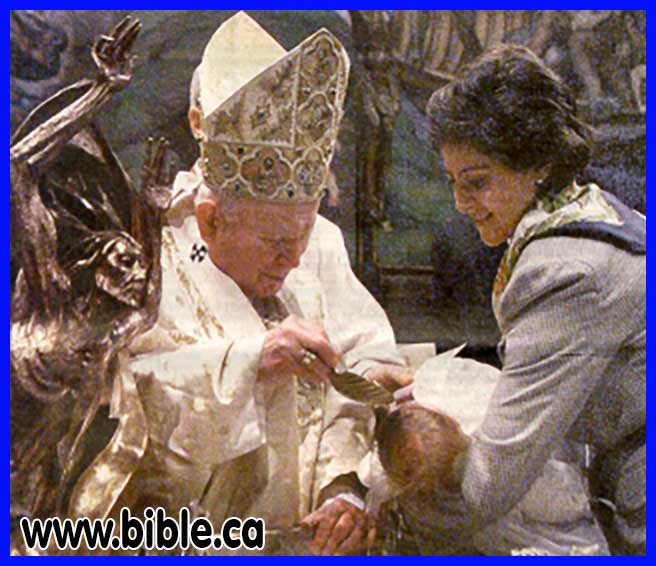
NOTICE THAT THE BAPTISMAL FONT IS BIG ENOUGH TO DROWN IN. THAT IS INTENTIONAL.

The green vegetation defines the course of the wadi (valley) where water surfaces from springs. The wadi connects to the Jordan River in the distance.
Bethany Beyond the Jordan
"These things were done in Betania beyong the Jordan, where John was baptising." John 1:28
Remains of several churches attest to early belief that this area on the east bank of the Jordan River was the area where John baptised Jesus. Extensive wells and water channels from early Byzantine building sites are still in evidence.



I LIKE THAT ONE!
| | Back to Top | | |
|
Hilston
Registered Member
Date Joined Oct 2001
Total Posts : 103
| Posted 4/7/2002 6:16 PM (GMT -6) | | Greetings (o),
Question: What point are you making in your post, and how does it pertain to this thread or ensuing discussion?
Domo,
James Hilston
hilston1@aol.com
www.tgfonline.org | | Back to Top | | |
|
PotOnWheel
Registered Member
Date Joined Jul 2001
Total Posts : 9890
| Posted 4/10/2002 12:43 PM (GMT -6) | | Commenting on the title of this thread, "The Church Started with Paul?", I'd make a few remarks:
1) PAUL certainly was THE APOSTLE of the Gospel, as the others abandoned the Gospel that was delivered to Paul. Further, the Gospel which Paul preached, in the lands of the Gentiles, and brought to Jerusalem twice, was finally rejected by those in Jerusalem -- some of them even inciting the Zealots to persecute some Jewish believers who shared table with Gentiles.
While the Church did not begin with Paul. Again, it must be clearly and forcefully said, that he was THE APOSTLE of the Gospel. He was the Jeremiah who carried the Word after the "temple" was no longer authorative.
2) Mark and Luke were written by the Pauline camp. Luke traveled with Paul, and "signed" his "name" in a verse in Acts. Mark was designed to attempt to persuade key leaders in Jerusalem to recognize that Gospel preached by Paul as THE Gospel. Luke, after the fall of Jerusalem, was intended for Gentiles, and for Jewish believers--but no longer the leadership. Luke's Gospel was also in direct conflict with Josephus historical writings, each community could endanger the safety of the other as being recognized as THE inheritor of traditional Jewish religion -- and with it sole Roman protection.
3) Even Peter, once he came around, used Pauline terms and concepts to write about the Gospel in his Epistles.
4) Luke used The Epistle of Romans as his outline to write Acts. He drew prolifically from Paul's letters while writing both Luke and Acts.
5) If one had a time machine, the last thing one would do would be to go back to the Church in Jerusalem and argue that they should follow anything except the Gospel preached by Paul!
Said.
Edited by - PotOnWheel on 04/10/2002 5:50:09 PM | | Back to Top | | |
|
Matthew Timothy Short
Huh?

Date Joined Apr 2002
Total Posts : 635
| Posted 4/11/2002 4:12 PM (GMT -6) | | Hey Bob,
Where did you ‘Go’ or rather I?
In God’s Love,
Tim
Mic 6:8 He hath shewed thee, O man, what [is] good; and what doth the LORD require of thee, but to do justly, and to love mercy, and to walk humbly with thy God?
| | Back to Top | | |
|
Hilston
Registered Member
Date Joined Oct 2001
Total Posts : 103
| Posted 4/11/2002 4:39 PM (GMT -6) | | PostOnWheel writes:quote:
1) PAUL certainly was THE APOSTLE of the Gospel, as the others abandoned the Gospel that was delivered to Paul.
Which Gospel? The circumcision Gospel or the Uncircumcision Gospel? (Gal 2:7).
PostOnWheel writes:quote:
Further, the Gospel which Paul preached, in the lands of the Gentiles, and brought to Jerusalem twice, was finally rejected by those in Jerusalem -- some of them even inciting the Zealots to persecute some Jewish believers who shared table with Gentiles.
Paul did not preach the Mystery (uncircumcision) Gospel in Jerusalem. He preach the Kingdom (circumcision) Gospel in Jerusalem. That is why we see Paul making sacrifices in the Temple, keeping vows and obeying the Mosaic ordinances (Act 21).
PostOnWheel writes:quote:
While the Church did not begin with Paul.
Depends on which "church" we're talking about. The Kingdom Church had been around since Abraham's day. The Body of Christ began with the conversion of Saul of Tarsus (Acts 9).
PostOnWheel writes:quote:
2) Mark and Luke were written by the Pauline camp. Luke traveled with Paul, and "signed" his "name" in a verse in Acts. Mark was designed to attempt to persuade key leaders in Jerusalem to recognize that Gospel preached by Paul as THE Gospel.
Please cite your references.
PostOnWheel writes:quote:
Luke, after the fall of Jerusalem, was intended for Gentiles, and for Jewish believers--but no longer the leadership.
Please cite references.
PostOnWheel writes:quote:
Luke's Gospel was also in direct conflict with Josephus historical writings, each community could endanger the safety of the other as being recognized as THE inheritor of traditional Jewish religion -- and with it sole Roman protection.
What is your point here?
PostOnWheel writes:quote:
3) Even Peter, once he came around, used Pauline terms and concepts to write about the Gospel in his Epistles.
For example?
PostOnWheel writes:quote:
4) Luke used The Epistle of Romans as his outline to write Acts. He drew prolifically from Paul's letters while writing both Luke and Acts.
What is this thesis based on? Do you have references that develop this concept?
PostOnWheel writes:quote:
5) If one had a time machine, the last thing one would do would be to go back to the Church in Jerusalem and argue that they should follow anything except the Gospel preached by Paul!
Paul didn't preach the same message to all men. To some Gentiles (kingdom Gentiles), he preached and honored food ordinances in accordance with Noahic Law (Acts 15). To the Elect Jews, he preached and honored the Kingdom Gospel with all its attending Mosaic ordinances (Acts 21). To some, he preached and identified with the Mystery, the Body of Christ, the uncircumicision Gospel, that which was hidden, held in silence, from the foundation of the world (Eph 3:3-9 Col 1:26,27). The saints in Jerusalem followed Moses, just as Jesus taught them (Mt. 5:18 28:19,20 23:1-3). Paul would not have preached the non-Mosaic gospel (Gal 4:8-11 Col 2:8-23) of the Body of Christ to the saints in Jerusalem.
Efcharisto polu',
James Hilston
hilston1@aol.com
www.tgfonline.org
Edited by - hilston on 04/11/2002 10:09:29 PM | | Back to Top | | |
|
(o)
Registered Member
Date Joined Jan 2002
Total Posts : 9
| Posted 4/11/2002 6:29 PM (GMT -6) | | quote:
1) PAUL certainly was THE APOSTLE of the Gospel, as the others abandoned the Gospel that was delivered to Paul. Further, the Gospel which Paul preached, in the lands of the Gentiles, and brought to Jerusalem twice, was finally rejected by those in Jerusalem -- some of them even inciting the Zealots to persecute some Jewish believers who shared table with Gentiles.
While the Church did not begin with Paul. Again, it must be clearly and forcefully said, that he was THE APOSTLE of the Gospel. He was the Jeremiah who carried the Word after the "temple" was no longer authorative.
2) Mark and Luke were written by the Pauline camp. Luke traveled with Paul, and "signed" his "name" in a verse in Acts. Mark was designed to attempt to persuade key leaders in Jerusalem to recognize that Gospel preached by Paul as THE Gospel. Luke, after the fall of Jerusalem, was intended for Gentiles, and for Jewish believers--but no longer the leadership. Luke's Gospel was also in direct conflict with Josephus historical writings, each community could endanger the safety of the other as being recognized as THE inheritor of traditional Jewish religion -- and with it sole Roman protection.
3) Even Peter, once he came around, used Pauline terms and concepts to write about the Gospel in his Epistles.
4) Luke used The Epistle of Romans as his outline to write Acts. He drew prolifically from Paul's letters while writing both Luke and Acts.
5) If one had a time machine, the last thing one would do would be to go back to the Church in Jerusalem and argue that they should follow anything except the Gospel preached by Paul!
Easy: Luke 6 -- the whole chapter. | | Back to Top | | |
|
Hilston
Registered Member
Date Joined Oct 2001
Total Posts : 103
| Posted 4/11/2002 6:56 PM (GMT -6) | | Hey (o),
Why so cryptic? If you're going to contribute to a discussion, how about making substantive statements rather than posting photos and references with little or no explanation regarding their pertinence.
(o) writes:quote:
Easy: Luke 6 -- the whole chapter.
What's easy? What question are you answering? What does Luke 6 have to do with this topic? What do your photos have to do with this topic? Please explain. I'm eager to understand your point(s).
Efcharisto polu',
James Hilston
hilston1@aol.com
www.tgfonline.org | | Back to Top | | |
|
PotOnWheel
Registered Member
Date Joined Jul 2001
Total Posts : 9890
| Posted 4/11/2002 8:02 PM (GMT -6) | | P.N.T. writes:
As we know from Galatians 2, it was only due to Paul's' vigorous intervention that the principle of one gospel for Jews and Gentiles alike (i.e., one that would not require Gentiles to become Jews) was accepted by the leadership of the early Christian church headquartered in Jerusalem. Acts recognizes this historical reality implicitly by first introducing Paul (ch. 9) and then presenting Peter as endorsing Paul's position. Subsequently, Peter finds himself preaching this very message to the Gentiles (chs. 10-12) | | Back to Top | | |
|
Matthew Timothy Short
Huh?
Date Joined Apr 2002
Total Posts : 635
| Posted 4/12/2002 12:48 AM (GMT -6) | | Luk 6:43-46For a good tree bringeth not forth corrupt fruit; neither doth a corrupt tree bring forth good fruit. For every tree is known by his own fruit. For of thorns men do not gather figs, nor of a bramble bush gather they grapes. A good man out of the good treasure of his heart bringeth forth that which is good; and an evil man out of the evil treasure of his heart bringeth forth that which is evil: for of the abundance of the heart his mouth speaketh. And why call ye me, Lord, Lord, and do not the things which I say?
| | Back to Top | | |
|
Hilston
Registered Member
Date Joined Oct 2001
Total Posts : 103
| Posted 4/12/2002 4:05 AM (GMT -6) | | Hi PotOnWheel,
You quoted PNT: quote:
As we know from Galatians 2, it was only due to Paul's' vigorous intervention that the principle of one gospel for Jews and Gentiles alike (i.e., one that would not require Gentiles to become Jews) was accepted by the leadership of the early Christian church headquartered in Jerusalem.
Galatians 2 teaches us that Paul publicly rebuked Peter for imposing food ordinances upon Gentiles. In Acts 15, we see Petter and Paul publicly agreeing (with the Holy Spirit) to require Gentiles to observe food ordinances. Not that the Galatian epistle was written PRIOR (A.D. 49) to the events depicted in Acts 15 (A.D. 50). So which of the following would you choose:
(1) The PNT is wrong
(2) Paul was a dissembler
(3) The Bible is false
(4) Some other explanation (Please supply details)
PoW further quotes:quote:
Acts recognizes this historical reality implicitly by first introducing Paul (ch. 9) and then presenting Peter as endorsing Paul's position. Subsequently, Peter finds himself preaching this very message to the Gentiles (chs. 10-12)
Apparently you agree with the PNT? Do you realize that Peter is not endorsing Paul's position at all? Paul's position is nowhere explicitly taught in Acts (but is found in his epistles). What you find in Acts is Paul preaching Peter's message: Paul's confirmations and accommodations to Israel's gospel and the affirmation of the attending Gentile roles in Israel's kingdom. Paul had a dual ministry: One to Elect Messianic Israel and the Elect Messianic Gentiles, one to the Body of Christ. We mostly find the former in Paul's activity and preaching in Acts.
'Antio,
James Hilston
hilston1@aol.com
www.tgfonline.org | | Back to Top | | |
|
PotOnWheel
Registered Member
Date Joined Jul 2001
Total Posts : 9890
| Posted 4/12/2002 11:31 AM (GMT -6) | | James, if you reduce Acts 15 down to "observe food ordinances" then you have some cleaning up to do before you are even at square one. You are missing the point.
And what Peter preached in that later situation was after he repented.
......
Tim, compare that section of Luke to Paul, and compare it to things in Jeremiah.
quote:
Luk 6:43-46For a good tree bringeth not forth corrupt fruit; neither doth a corrupt tree bring forth good fruit. For every tree is known by his own fruit. For of thorns men do not gather figs, nor of a bramble bush gather they grapes. A good man out of the good treasure of his heart bringeth forth that which is good; and an evil man out of the evil treasure of his heart bringeth forth that which is evil: for of the abundance of the heart his mouth speaketh. And why call ye me, Lord, Lord, and do not the things which I say?
Judgement. An emphasis on the heart.
Tim. ALL covenants in that time and part of the world had two portions. A list of "blessings" (the motivation for enterning the covenant) and "curses" (the penalty for breaking covenant.) What you will see when you look at the whole of Luke 6 is this pattern of blessings and curses. This is Christ stating contractually, in the "legaleeze" of the day the NEW COVENANT.
PotOnWheel
Edited by - PotOnWheel on 04/12/2002 4:38:39 PM | | Back to Top | | |
|
Hilston
Registered Member
Date Joined Oct 2001
Total Posts : 103
| Posted 4/12/2002 12:03 PM (GMT -6) | | Hi PotOnWheel,
Thanks for your reply. You writes:quote:
... if you reduce Acts 15 down to "observe food ordinances" then you have some cleaning up to do before you are even at square one.
What do you mean? It's undeniable that the Holy Spirit agreed that symbolic non-Mosaic food restrictions be placed upon the regenerated Gentiles, as well as a prohibition against fornication. What needs to be "cleaned up" before we "are even at square one?"
PoW writes:quote:
You are missing the point.
Perhaps I've missed it. What point is there other than the mandated behavioral prohibitions?
PoW writes:quote:
And what Peter preached in that later situation was after he repented.
Are you saying that Peter repented of imposing Mosaic food restrictions upon the Antiochian saints (described in Gal 2) and later imposed other food restrictions upon saved Gentiles (in Acts 15)? How does this all pan out in your view?
Domo arigato,
James Hilston
hilston1@aol.com
www.tgfonline.org | | Back to Top | | |
|
PotOnWheel
Registered Member
Date Joined Jul 2001
Total Posts : 9890
| Posted 4/12/2002 6:09 PM (GMT -6) | | Hi, bro.
When I wrote "clean up...square one..." I left this open to taking a bad turn.
Thanks for not going down that road.
The "clean up" I mean is the temporary laying aside of your personal tradition of looking at passages from the framework of a mid-Acts and Dispensational framework. You can pick it up again, later. But perhaps you will indulge by looking twice: once with and once without.
OK?
I'll take the burden of the "without." Here it is.
More, or a LARGER ISSUE is at play than just your "It's undeniable that the Holy Spirit agreed that symbolic non-Mosaic food restrictions be placed upon the regenerated Gentiles..." The "as well as a prohibition against fornication" provides a clue. But backing up, let me say that the food restrictions WERE NOT ALL THAT "SYMBOLIC."
Let me jump to a quote from Tarazi. (A friend of mine had him as OT Prof in Sem. He's in his 60s, is a powerful Middle Eastern gentleman, and is fluent in seven languages1)
quote:
(p.242-243, on Acts 15:1-21)
Faced with the clear verdict of scripture, James in this story endorses Pauls gospel. The restrictions imposed on a believing Gentile—pollutions with idols, harlotry (unchastity), that which is strangled, blood (Acts 15:19-20, 29)—do not represent grudging or partial acceptance; they are all found in Paul's own letters. The first item mentioned in both lists concerns idols, and the noun eidolothyton (sacrifices to idols, v.29) is one used by Paul himself. 7 Actually, if one understands porneia (harlotry, unchastity) as referring to harlotry with other deities, as it does frequently in scripture, then all four restrictions are bound to this sin. This seems to be the intention since, in the first list, harlotry appears between references to idol worship. In that case, all restrictions are bound to the basic teaching of the Torah about the oneness of God. Such an interpretation is borne out by Luke's heading of "the conversion (epistrophen) of the Gentiles55 (v.3), for that is how Paul himself describes the conversion of the Gentiles: 'For they themselves report concerning us what a welcome we had among you, and how you turned (epestrepsate) to God from idols, to serve a living and true God, and to wait for his Son from heaven, whom he raised from the dead, Jesus who delivers us from the wrath to come5 (IThess 1:9-10).
He writes: "...all four restrictions are bound to this sin. This seems to be the intention..." and "found in Paul's own letters."
That, my kind board-mate is what I was refering to. This was not some "symbolic" food rules.
Thanks for asking.
Edited by - PotOnWheel on 04/12/2002 11:10:56 PM | | Back to Top | | |
|
PotOnWheel
Registered Member
Date Joined Jul 2001
Total Posts : 9890
| Posted 4/13/2002 5:43 AM (GMT -6) | | Thank you too, Tim.
Viewing the Gospel of Luke as being written AFTER the fall of Jerusalem--after 70 A.D.--and written using the literary divices of its day and genre (which was much older) sure is interesting.
PoW | | Back to Top | | |
|
Hilston
Registered Member
Date Joined Oct 2001
Total Posts : 103
| Posted 4/13/2002 5:54 AM (GMT -6) | | Hi PotOnWheel,
You write:quote:
The "clean up" I mean is the temporary laying aside of your personal tradition of looking at passages from the framework of a mid-Acts and Dispensational framework. You can pick it up again, later. But perhaps you will indulge by looking twice: once with and once without. ...
Your suggestion is a good one, and honestly, it is an exercise I engage in continually. Look at it from my side for a second: I hold to a view of scripture that is contrary to that of the vast majority of believers. I take very seriously the question, "What if I'm wrong?" So I frequently ask myself, "OK, let's say he/she is right, and that my whole framework is a human construct, let's see if this is better explained by his/her view." The question that I find equally poignant is this: "What if I'm right?" The implications are huge, which is another reason why I don't approach this issue in a cursory fashion. If I'm right, then the vast majority of Christendom has been duped by human tradition, erroneous human interpretations, etc. At your request, I will give full consideration to your position.
PoW writes:quote:
More, or a LARGER ISSUE is at play than just your "It's undeniable that the Holy Spirit agreed that symbolic non-Mosaic food restrictions be placed upon the regenerated Gentiles..." The "as well as a prohibition against fornication" provides a clue. But backing up, let me say that the food restrictions WERE NOT ALL THAT "SYMBOLIC."
Are you suggesting that molecular composition of the food in question had instrinsic immoral attributes that were to be avoided? If not, then they were EXCLUSIVELY symbolicm, right? I'm surprised, actually. I didn't think there would be any dispute on that point.
PoW writes:quote:
(p.242-243, on Acts 15:1-21) Faced with the clear verdict of scripture, James in this story endorses Pauls gospel.
Paul's gospel is not found in Acts 15. Please point me to where you see Paul's gospel being taught.
PoW writes:quote:
The restrictions imposed on a believing Gentile—pollutions with idols, harlotry (unchastity), that which is strangled, blood (Acts 15:19-20, 29)—do not represent grudging or partial acceptance; they are all found in Paul's own letters.
Of course, but not because the message taught in Acts 15 is the same as what Paul taught in his letter. The discussion of similar topics, in this case, idolatry/harlotry, is to be expected in the writings of any contemporary of Paul concerned about the immoral climate in which they found themselves. That is to say, idolatry and religious harlotry were pervasive among the pagan cultures in which they wrote. This similarity does not suffice to equate James's teachings with Paul's.
PoW writes:quote:
The first item mentioned in both lists concerns idols, and the noun eidolothyton (sacrifices to idols, v.29) is one used by Paul himself. Actually, if one understands porneia (harlotry, unchastity) as referring to harlotry with other deities, as it does frequently in scripture, then all four restrictions are bound to this sin.
Of course, but sin is not the issue in 1Co 8:8, which explicitly proves that such prohibitions were symbolic ("But meat commendeth us not to God: for neither, if we eat, are we the better; neither, if we eat not, are we the worse"). Thus Paul states that this kind of meat was not intrinsically immoral, or even that the gods/demons to which it was sacrificed was of any intrinsic concern to the believer (that by ingesting the meat, there was a moral consequence). Paul was more concerned with offending the weaker brother, that is, the elect Jew who still could not get past the association of the meat with idolatry.
PoW writes:quote:
This seems to be the intention since, in the first list, harlotry appears between references to idol worship. In that case, all restrictions are bound to the basic teaching of the Torah about the oneness of God.
These laws precede Torah, which is evident in Torah itself. For details on these Noachian laws, see my paper on two types of proselytes: http://www.tgfonline.org/TGF/topical/proselytes.htm
PoW writes:quote:
Such an interpretation is borne out by Luke's heading of "the conversion (epistrophen) of the Gentiles (v.3), for that is how Paul himself describes the conversion of the Gentiles: 'For they themselves report concerning us what a welcome we had among you, and how you turned (epestrepsate) to God from idols, to serve a living and true God, and to wait for his Son from heaven, whom he raised from the dead, Jesus who delivers us from the wrath to come5 (IThess 1:9-10).
Again, as I noticed in the other thread, Tarazi takes similar words used in a similar cultural context, and on that basis attempts to conflate two distinct messages. This is non sequitur. It would be the equivalent of a historian 2,000 years hence claiming that Democrats and Libertarians taught the same message because they both used the phrase "you cannot legislate morality." You have to have more than linguistic similarities. The actual content of the message is at issue here.
Above you wrote:quote:
... And what Peter preached in that later situation was after he repented.
I'm still curious: Are you saying that Peter repented of imposing Mosaic food restrictions upon the Antiochian saints (described in Gal 2) and later imposed other food restrictions upon saved Gentiles (in Acts 15)? How does this all pan out in your view?
I appreciate your willingness to discuss these questions. I look forward to your reply. Thanks for your kindness and candor.
'Antio,
James Hilston
hilston1@aol.com
www.tgfonline.org | | Back to Top | | |
|
PotOnWheel
Registered Member
Date Joined Jul 2001
Total Posts : 9890
| Posted 4/13/2002 7:00 AM (GMT -6) | | Hilston said: "I appreciate your willingness to discuss these questions. I look forward to your reply. Thanks for your kindness and candor."
That's too kind, H. I get worked up. | | Back to Top | | |
|
PotOnWheel
Registered Member
Date Joined Jul 2001
Total Posts : 9890
| Posted 4/13/2002 7:03 AM (GMT -6) | | OK, borther, you have permission to use me as that second rod of iron (yoruself as the first) which is necessary for either of us to be sharpened. Fair enough--and I enjoy YOUR candor too.
quote:
Look at it from my side for a second: I hold to a view of scripture that is contrary to that of the vast majority of believers. I take very seriously the question, "What if I'm wrong?" So I frequently ask myself, "OK, let's say he/she is right, and that my whole framework is a human construct, let's see if this is better explained by his/her view." The question that I find equally poignant is this: "What if I'm right?"
| | Back to Top | | |
|
PotOnWheel
Registered Member
Date Joined Jul 2001
Total Posts : 9890
| Posted 4/13/2002 7:15 AM (GMT -6) | | H.: Paul's gospel is not found in Acts 15. Please point me to where you see Paul's gospel being taught.
Tarazi (p.241): "...the speach Luke puts on Peter's lips is fundamentally Pauline."
PoW: Tarazi points out that Peter, who denied Christ three times, took three times before accepting that the Gospel was for the Gentiles (Cornelias) too. Then Peter--bodily (may I be so personally cute as to say Peter's actions in ditching the Gentile Christians was a denial of Christ too. Theologically true, I think.) separated himself from them(Gal. 2:11-14). | | Back to Top | | |
|
PotOnWheel
Registered Member
Date Joined Jul 2001
Total Posts : 9890
| Posted 4/13/2002 7:37 AM (GMT -6) | | H.: Paul's gospel is not found in Acts 15. Please point me to where you see Paul's gospel being taught.
PoW: Acts 15: 7-12
quote:
Acts 15
7And when there had been much dispute, Peter rose up and said to them: "Men and brethren, you know that a good while ago God chose among us, that by my mouth the Gentiles should hear the word of the gospel and believe. 8So God, who knows the heart, acknowledged them by giving them the Holy Spirit, just as He did to us, 9and made no distinction between us and them, purifying their hearts by faith. 10Now therefore, why do you test God by putting a yoke on the neck of the disciples which neither our fathers nor we were able to bear? 11But we believe that through the grace of the Lord Jesus Christ we shall be saved in the same manner as they."
12Then all the multitude kept silent and listened to Barnabas and Paul declaring how many miracles and wonders God had worked through them among the Gentiles.
I'm afraid to ask; but if you believe in TWO different Gospels, then you might not agree with me when I say, that, when Paul says that THE (There is only one Gospel of Jesus Christ, and Paul brought it to the Gentiles. Peter had no difficulty preaching it in Acts 2.) Gospel was for the Gentile's too, he is "preaching" the Gospel in Jerusalem in Acts 15. But for me, I'd say that that is so (even though James and company had heard the gospel too). | | Back to Top | | |
|
PotOnWheel
Registered Member
Date Joined Jul 2001
Total Posts : 9890
| Posted 4/13/2002 7:48 AM (GMT -6) | | quote:
quote:
--------------------------------------------------------------------------------
The restrictions imposed on a believing Gentile—pollutions with idols, harlotry (unchastity), that which is strangled, blood (Acts 15:19-20, 29)—do not represent grudging or partial acceptance; they are all found in Paul's own letters.
--------------------------------------------------
Of course, but not because the message taught in Acts 15 is the same as what Paul taught in his letter. The discussion of similar topics, in this case, idolatry/harlotry, is to be expected in the writings of any contemporary of Paul concerned about the immoral climate in which they found themselves. That is to say, idolatry and religious harlotry were pervasive among the pagan cultures in which they wrote. This similarity does not suffice to equate James's teachings with Paul's.
Tarazi's point was that NOTHING the Jerusalem council "imposed" was an actual imposition. "The restrictions . . . do not represent grudging or partial acceptance." So, ligic says that Paul got everything that he was looking for. And to Paul (Tarazi says elsewhere), the part about the charity that he would collect for Jerusalem was going to "seal" the contract -- symbolize the oneness. THAT was backed out of by Jerusalem, later, though. (Tarazi mentions Timothy's martyrdom--though I'm not sure what that means.)
Bottom line: Paul's Gospel was approved as the Gospel of Jesus Christ. The Church (the people of God) was recognized as existing beyond the Jews. | | Back to Top | | |
| 155 posts in this thread.
Viewing Page : 1 2 3 4 5 6 7 |
| Forum Information | Currently it is Monday, November 09, 2026 3:15 PM (GMT -6)
There are a total of 97,718 posts in 6,040 threads.
In the last 3 days there were 0 new threads and 0 reply posts. View Active Threads
|
Forum powered by dotNetBB v2.42EC SP3
dotNetBB © 2000-2026 |
|
|