 |
 | 
ISF
Registered Member
Date Joined Dec 2004
Total Posts : 23
| Posted 12/17/2004 8:33 AM (GMT -6) |   | Sahid,
what do you mean by "predictable"?
If God is omniscient, then there is no such creature that could exist where God is ignorant of how they would freely act. This is consistant with the standard definition of omnipotence, where God can do (make) anything logically possible - Hence it is a logical impossibility for God to create a creature as you envision. Most likely, because God would have to deny His own Nature in order to create it.
peace,
jd | | Back to Top | | |
|
JET
Registered Member
Date Joined Jun 2002
Total Posts : 397
| Posted 12/17/2004 8:33 AM (GMT -6) | | Hey Sahid, I think this is a great question, particularly for someone (like William Lane Craig) who wants to:
(1) afffirm the existence of LFW; and
(2) deny that God is "timeless";
(3) but who also wants to affirm classical foreknowledge.
The only way I can see to do this is to deny that God has the power to create a being with "say so" that can be exercised in an unpredictable manner, right?
Then again, when you think about it, it is a pretty amazing thing, ya know? That God could create out of nothing something else that also has the power to create out of nothing (so to speak; that is create their own choices). (Of course, that is precisely what is necessary if God wants to create something capable of love.)
Peace,
JET | | Back to Top | | |
|
Sisters of Cain
Registered Member
Date Joined Mar 2004
Total Posts : 431
| Posted 12/17/2004 9:05 AM (GMT -6) | | quote:
Originally posted by JET
Then again, when you think about it, it is a pretty amazing thing, ya know? That God could create out of nothing something else that also has the power to create out of nothing (so to speak; that is create their own choices). (Of course, that is precisely what is necessary if God wants to create something capable of love.)
God is a creator.
We are made in His image.
Therefore, we are creators as well.
Creators of other people and creators of our own choices.
psssst! JET and Sahid: http://www.christusvictorministries.org/gbfront/forum/topic.asp?TOPIC_ID=3900 | | Back to Top | | |
|
Holiday
Registered Member
Date Joined Nov 2003
Total Posts : 22
| Posted 12/18/2004 1:58 PM (GMT -6) | | JET
Does Craig deny that God is timeless? I though he posited that once God created He bound himself to the creation, thus subjecting Himself to temporality??... I could be off. A chance to learn I guess.
Holiday | | Back to Top | | |
|
ISF
Registered Member
Date Joined Dec 2004
Total Posts : 23
| Posted 12/19/2004 1:05 PM (GMT -6) | | Holiday,
youre right, Craig argued that God is essentially timeless (sans creation) but that upon creating, God is temporal.
if anyone is interested in reading about this, it is in Time and Eternity. Pretty compelling arguments for this view, i think.
peace,
jd | | Back to Top | | |
|
ISF
Registered Member
Date Joined Dec 2004
Total Posts : 23
| Posted 12/19/2004 1:14 PM (GMT -6) | | JET,
quote:
The only way I can see to do this is to deny that God has the power to create a being with "say so" that can be exercised in an unpredictable manner, right?
it has nothing to do with "predictability". God does not merely have good prediction ability, which i must admit sounds like an anthropomorphism to me.
So the predictability/unpredictability aspect is a strawman.
to say otherwise, sounds an awful lot like the "can God make a rock so big that He cant lift it?"
The answer to the above is "no", since God cannot make something impossible to make. In the same way, God cannot make a being with which He does not *know* how they will freely act - since it denies God's knowledge of all true propositions. (even though you OV people love to assert that God can be ignorant of some true statements about the future - and that is the biggest mystery of all).
peace,
jd | | Back to Top | | |
|
anewbeginning
Registered Member
Date Joined Jan 2002
Total Posts : 88
| Posted 12/19/2004 2:21 PM (GMT -6) | | quote:
Originally posted by ISF
The answer to the above is "no", since God cannot make something impossible to make. In the same way, God cannot make a being with which He does not *know* how they will freely act - since it denies God's knowledge of all true propositions. (even though you OV people love to assert that God can be ignorant of some true statements about the future - and that is the biggest mystery of all).
Hi ISF:
Starkman once posed an interesting riddle. It went something like this:
Suppose God bestowed on yourself all His abilty. Given all this power, predicting (or *knowing) my future actions should be a snap, no?
Now, all I would like you to do is to acurately tell me what I will do 10 seconds from now. You won't be able to.
Oops, I guess your above quote has been falsified. | | Back to Top | | |
|
ISF
Registered Member
Date Joined Dec 2004
Total Posts : 23
| Posted 12/19/2004 8:05 PM (GMT -6) | | anew,
quote:
Starkman once posed an interesting riddle. It went something like this:
Suppose God bestowed on yourself all His abilty. Given all this power, predicting (or *knowing) my future actions should be a snap, no?
Now, all I would like you to do is to acurately tell me what I will do 10 seconds from now. You won't be able to.
Oops, I guess your above quote has been falsified.
Is it? i cant for the life of me see how. though, it is getting late.
I suppose if God gave me omniscience i would know what you will do 10 seconds from now. why wouldnt i be able to again? | | Back to Top | | |
|
Alan Rhoda
Registered Member

Date Joined May 2002
Total Posts : 680
| Posted 12/19/2004 8:46 PM (GMT -6) | | Good question, Sahid.
JET, it seems clear to me that Craig would say that God cannot create a world that is (to some extent) epistemically open for Himself. For Craig, this is guaranteed by God's middle knowledge of all counterfactuals of freedom, which, in turn, Craig wants to claim, follows from divine omniscience (God knows all and only truths) and the principle of bivalence (all propositions are either true or false, and if false, then it's denial is true).
Now Craig's mistaken. It does not follow from bivalence that either "If placed in conditions C, Peter would freely deny Christ" or that "If placed in conditions C, Peter would not freely deny Christ" must be true. Hence, it does not follow that an omniscient God would have to know one or the other of those propositions from eternity. Both can be false.
So I think Craig's position is untenable. There is to my knowledge no cogent a priori reason for thinking that God cannot create a world that is (to some extent) epistemically open for Himself.
Regards,
Alan | | Back to Top | | |
|
Alan Rhoda
Registered Member
Date Joined May 2002
Total Posts : 680
| Posted 12/19/2004 9:02 PM (GMT -6) | | quote:
Originally posted by ISF
God cannot make a being with which He does not *know* how they will freely act - since it denies God's knowledge of all true propositions. (even though you OV people love to assert that God can be ignorant of some true statements about the future - and that is the biggest mystery of all).
Your position, ISF, assumes that there are in fact true propositions about how God's creatures will freely act (when their choices are free in a libertarian sense). This is a controversial claim. Craig has defended it, to be sure, but his arguments are, I would submit, unconvincing.
Regarding your claim that OVers love to assert that God can be ignorant of some true statements about the future, this is false. While there are some OVers (e.g., Hasker) who do make that claim, they are a minority among open theists. The majority view, which goes back to Aristotle, is that propositions stating of a future contingent that it "will" happen or that it "will not" happen are neither true nor false. Another common view, defended by Boyd and by many on this discussion board, is that such propositions are false and that what is true instead is that the future contingent "might and might not" happen. If either of these latter two positions is correct, then it is Craig's view (rather than the open view) that compromises God's omniscience because it attributes to God beliefs that some propositions are true when they aren't.
By the way, welcome to the discussion board.
Alan | | Back to Top | | |
|
anewbeginning
Registered Member
Date Joined Jan 2002
Total Posts : 88
| Posted 12/20/2004 1:25 AM (GMT -6) | | quote:
Originally posted by ISF
Is it? i cant for the life of me see how. though, it is getting late.
I suppose if God gave me omniscience i would know what you will do 10 seconds from now. why wouldnt i be able to again?
Hi ISF:
Whatever your prediction of my future actions is, I need only do otherwise. | | Back to Top | | |
|
ISF
Registered Member
Date Joined Dec 2004
Total Posts : 23
| Posted 12/20/2004 7:47 AM (GMT -6) | | alan,
quote:
Your position, ISF, assumes that there are in fact true propositions about how God's creatures will freely act (when their choices are free in a libertarian sense). This is a controversial claim. Craig has defended it, to be sure, but his arguments are, I would submit, unconvincing.
To be sure, many others have argued this claim.
however, this is the part that is confusing to me, i admit. There are only two possible states of affairs that could obtain, with any free choice an agent makes. Peter freely denies Christ is one. Peter freely does not deny Christ is the other.
This corresponds exactly with the principle of bivalence. The statement "Peter freely denies Christ" is either true or false.
Now if this is true, then there is a future-tense statement that corresponds with this reality. "it will be the case that 'Peter freely denies Christ' is true", could be one.
but according to you, (assuming this is a free decision and not determined) such a statement is not either true of false. Since if it is false, then "it will not the case that 'Peter freely denies Christ' is true" <==> "it will be the case that 'Peter freely denies Christ' is false".
So are you saying that the principle of bivalence fails for such future-tense propositions? is not THIS the controversial claim?
quote:
is that propositions stating of a future contingent that it "will" happen or that it "will not" happen are neither true nor false.
so, what IS the truth value of such propositions then?
quote:
Another common view, defended by Boyd and by many on this discussion board, is that such propositions are false and that what is true instead is that the future contingent "might and might not" happen
ive already argued quite a bit about this with JET, to me this seems to say that God does hold false beliefs about the future. God believes that Adam and Eve will not sin, but they do sin, and God regrets making humankind.
So here, you could argue that God believed "Adam and Eve might and might not sin" - but then why does God regret making humankind? He HAD to have known that this was a possibility (since He apparently believed they "might" sin).
Futher, this whole scheme is an endorsement for theological fatalism - that if God knows something for certain, then there is no possibility that Creatures could do otherwise. (propositions about their choice are necessary).
but if God can be certain of free choices, then why wouldnt He know them?
Finally, as Dr. Craig points out, you only need to show that just one future contingent is true, and therefore not incompatible with foreknowledge. And since in the case of Peter, it seems open theists have to concede this to be a "special case" and therefore deterministically caused - Yet you all reject determinism - then it is entirely possible that Jesus here had knowledge of a future contingent proposition before it happenned and Peter was free.
peace,
jd | | Back to Top | | |
|
ISF
Registered Member
Date Joined Dec 2004
Total Posts : 23
| Posted 12/20/2004 7:51 AM (GMT -6) | | Sahid,
quote:
Is 5:4. People unpredictable (at least to a small degree) to God.
only if you believe this is not anthropomorphic.
peace,
jd | | Back to Top | | |
|
ISF
Registered Member
Date Joined Dec 2004
Total Posts : 23
| Posted 12/20/2004 7:55 AM (GMT -6) | | Sahid,
quote:
No, the answer is "yes". What, God can do everything but limit himself? Wasn't there some guy named Jesus who proved that idea wrong?
Not even Jesus could do something logically impossible. Obviously, Jesus did things that were NATURALLY impossible (could not happen by any natural explanation) but thats not a big deal for the God-Man.
This is why the definition of omnipotence is that God can do anything logically possible. This seems to be what we mean by God being All-Powerful anyway.
So the theoretical rock is the problem in the riddle - There just is no rock that could exist where God could not lift it.
peace. | | Back to Top | | |
|
ISF
Registered Member
Date Joined Dec 2004
Total Posts : 23
| Posted 12/20/2004 8:01 AM (GMT -6) | | anew,
quote:
Hi ISF:
Whatever your prediction of my future actions is, I need only do otherwise.
Hi to you as well.
That is an interesting puzzle, (i get it now.. hehehe). my intuition, though, is that the issue here is not with the omniscient person's knowledge of your choice, but with your basing your choice on their knowledge.
Isnt this something like Newcomb's Paradox?
peace,
jd | | Back to Top | | |
|
Alan Rhoda
Registered Member
Date Joined May 2002
Total Posts : 680
| Posted 12/20/2004 10:34 AM (GMT -6) | | ISF: There are only two possible states of affairs that could obtain, with any free choice an agent makes. Peter freely denies Christ is one. Peter freely does not deny Christ is the other. ... This corresponds exactly with the principle of bivalence. The statement "Peter freely denies Christ" is either true or false.
Alan: I would agree with you that if Peter exists at time T then at that time Peter is either presently denying Christ or not denying Christ. But the determinateness of present reality does not by itself imply the antecedent determinateness of future reality. Antecedently, we have three possible states of affairs, not two. It may be (1) necessary that Peter deny Christ, (2) necessary that Peter not deny Christ, or (3) contingent that Peter deny Christ. 'Necessary' and 'contingent' here do not refer to mere logical necessity and contingency, but to the causal necessity and contingency of Peter's future denial in relation to the present.
ISF: According to you, (assuming this is a free decision and not determined) such a statement is not either true of false. Since if it is false, then "it will not the case that 'Peter freely denies Christ' is true" <==> "it will be the case that 'Peter freely denies Christ' is false". So are you saying that the principle of bivalence fails for such future-tense propositions?
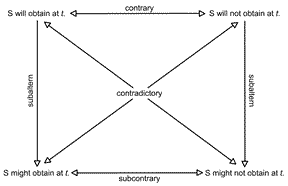
Alan: I affirm bivalence. What I deny is that "will" and "will not" are logical contradictories. The contradictory of "will" is not "will not" but "might not". The contradictory of "will not" is not "will" but "might". "Will" and "will not" are contraries. They can both be false and are both false when both "might" and "might not" are true. This may be depicted as follows:
quote:
quote:
Another common view, defended by Boyd and by many on this discussion board, is that such propositions are false and that what is true instead is that the future contingent "might and might not" happen
I've already argued quite a bit about this with JET, to me this seems to say that God does hold false beliefs about the future. God believes that Adam and Eve will not sin, but they do sin, and God regrets making humankind. So here, you could argue that God believed "Adam and Eve might and might not sin" - but then why does God regret making humankind? He HAD to have known that this was a possibility (since He apparently believed they "might" sin).
Alan: First, if God believes that Adam and Eve "will not" sin, then it is false that they "might" sin. It is not a genuine causal possibility for them. They do not have libertarian free will in that regard. If, on the other hand, they do have libertarian free will in that regard, then God knows that they "might and might not" sin, and he knows it is false that they "will" sin. There is no imputation of false beliefs to God here. If Adam and Eve do sin at time T, then the present-tense statement "Adam are Eve are sinning" is true at T, but that does not imply that the future-tense statement "Adam and Eve will sin" was true prior to T. The only reason one would think that it did imply that is if one thought that "Adam and Eve will sin at T" says nothing more than that "Adam and Eve do sin at T", which is to say that the tense of the former communicates no information that the tenseless statement does not. If that is so, then tensed statements are reducible to tenseless statements without loss of meaning and the B-theory of time is correct. Since you and I both agree that it is not, we must, if we are to be consistent, hold that "Adam and Eve will sin at T" is not made true prior to T simply by the fact that "Adam and Eve do sin at T".
Second, I agree that God knew it was a possibility that Adam and Eve "might" sin, and that God is said later on to "regret" having made humans (Gen. 6). I fail, however, to see how this entails any inconsistency in my position or implies that God holds or held false beliefs.
ISF: Futher, this whole scheme is an endorsement for theological fatalism - that if God knows something for certain, then there is no possibility that Creatures could do otherwise. (propositions about their choice are necessary).
Alan: Fatalism holds that whatever does happen must have happened. In other words, it says that there are no true "might and might not" propositions. In short, fatalism collapses the modal distinction between causal necessity and causal possibility--it say that the only things that can happen are those that must happen. So possibility <--> necessity. Since I hold that there are true "might and might not" propositions, my position is not fatalistic.
Here's another way to look at it. The fatalist holds that "will" and "will not" are contradictories. He also holds that nothing can happen other than what "will" happen. So he also holds that "will"="must" and that, therefore, "will" and "might not" are contradictories. If you make the relevant changes on the square of oppositions above you will see that this has the effect of collapsing the distinction between "will"="must" and "might". The only things that are possible are things that are necessary.
Now, there are two ways to respond to the fatalist. The first approach, Craig's, is to accept that "will" and "will not" are contradictories, but deny that "will" and "might not" are contradictories. This has the effect of distinguishing between "will" and "must".
The other approach, which I take, is to accept that "will" and "might not" are contradictories, but deny that "will" and "will not" are contradictories. This has the effect of distinguishing between causal necessity and causal contingency.
Either way, fatalism is avoided. The issue, then, is which approach is more semantically and metaphysically adequate. Here I contend that the second approach wins hands down.
ISF: Finally, as Dr. Craig points out, you only need to show that just one future contingent is true, and therefore not incompatible with foreknowledge. And since in the case of Peter, it seems open theists have to concede this to be a "special case" and therefore deterministically caused - Yet you all reject determinism - then it is entirely possible that Jesus here had knowledge of a future contingent proposition before it happenned and Peter was free.
Alan: First, there are true statements about future contingents, but these are "might and might not" propositions, not "will" or "will not" propositions. Second, how does the supposition that Peter's denying Christ was only compatibilistically free at the time of Jesus's prediction imply that it is possible that Jesus knew that Peter "would freely" (in a libertarian sense) deny Christ? If he is compatibilistically free in that circumstance then he cannot also be libertarianly free in that circumstance, so what you suggest is not possible.
Regards,
Alan | | Back to Top | | |
|
ISF
Registered Member
Date Joined Dec 2004
Total Posts : 23
| Posted 12/20/2004 12:27 PM (GMT -6) | | alan,
quote:
But the determinateness of present reality does not by itself imply the antecedent determinateness of future reality. Antecedently, we have three possible states of affairs, not two...
how about 4? (since i did say with any free decision, i was not speaking about necessary modality and dividing your contingent state of affairs in two.. but fine) why can it not be "necessarily denies", "necessarily does not deny", "contingently denies", "contingently does not deny"? i dont understand why OV theists insist that we cannot speak about the way in which free agents will in fact choose. We do know that ultimately, people with libertarian free will, will choose one way or the other.
So why, then, i wonder, are we not allowed to talk about propositions concerning how libertarian agents ultimately choose? i think it might be because these are the kind of propositions that the OV denies God knowledge of.
i admit i havent studied the open scheme in this direction very well, so i dont have any good philosophical reasons to deny the "might and might not" scheme (except those presented above - because i still have concern that this scheme has God holding false beliefs). obviously, there are some theological issues here (as to how God can be provident concerning a future He has very little absolute knowledge of, plus who the elect in Christ are, the problem of evil, etc) as well, but its going to be some time before i am equipped to give a better answer in this direction.
quote:
Either way, fatalism is avoided. The issue, then, is which approach is more semantically and metaphysically adequate. Here I contend that the second approach wins hands down.
why is that? i think we all do have an intuition about future tense statements concerning contingencies - that in the same way that humans can hold true beliefs about the future, so also God can.
the reason why i am saying that the OV endorses what is often called "theological fatalism" is because every single person here has at some point argued that if God knows with certainty that a free agent will choose some action then that agent is no longer free in their choice. (this is, after all why OVT denies God such foreknowledge about contingent choices, isnt it?) i have to say it again, though - there is no reason to think this is true. God does not know what MUST happen, but only what WILL happen. (Ockhamist solution?).
But consider for a second that God does have knowledge of some future contingent choice. In what way, exactly, does God's knowledge control the choice of the agent? Even in the case of Peter, you argued that this must be a compatibilist situation. but why? are you making the astounding theological claim that God caused Peter to deny Christ, thus implicating God in sin?
further, humans often have true beliefs about the contingent future, and yet in those situations (where a humans true knowledge of the contingent future is a proper subset of God's foreknowledge) it seems illogical to claim that the person's belief in some way causes the person to act as they do.
finally, if both options are consistant, and one gives God the exhaustive knowledge of the future with which He can be wholly provident, and the other does not - then why wouldnt we choose the molinist solution?
After all, if we are talking about an Anselmian concept of God, then foreknowledge (indeed middle-knowledge) is a great-making property. And the intuition is that we should always maximize our theology to reflect God's maximal greatness.
thanks for the welcome,
peace. | | Back to Top | | |
|
ISF
Registered Member
Date Joined Dec 2004
Total Posts : 23
| Posted 12/20/2004 12:37 PM (GMT -6) | | Sahid,
quote:
I never said that Jesus did the logically impossible. I said that Jesus proves that God can limit himself. There is nothing illogical about limiting oneself.
But God cannot be not-God since God is necessary. Therefore, God is both Omniscient and Omnipotent in every possible world. This means that there is no possible world where a rock like the one we are speaking (heavier than God can lift) exists and "God is Omnipotent" is false.
peace. | | Back to Top | | |
|
Alan Rhoda
Registered Member
Date Joined May 2002
Total Posts : 680
| Posted 12/20/2004 3:03 PM (GMT -6) | | ISF: How about 4? ... Why can it not be "necessarily denies", "necessarily does not deny", "contingently denies", "contingently does not deny"?
Alan: There's no need for 4 b/c the last two are redundant. If it is contingent that he does not deny, then it is also contingent that he denies, and vice-versa.
ISF: i dont understand why OV theists insist that we cannot speak about the way in which free agents will in fact choose. We do know that ultimately, people with libertarian free will, will choose one way or the other.
Alan: No one's saying that we can speak about the way in which free agent will choose. What we're saying is that such statements are not true, strictly speaking, unless the agent is not free in a libertarian sense with respect to that choice. Certainly, agent S is free in a libertarian sense with respect to doing action A at time T, then it is true now that S WILL(either do A at T or not do A at T), but that is not the same as its being true now that S (either will do A at T or will not do A at T). The former disjunction must be true b/c at T matters will be settled one way or the other. But the second disjunction is false because it is not now true that S will do A at T, nor is it now true that S will not do A at T.
ISF: i think we all do have an intuition about future tense statements concerning contingencies - that in the same way that humans can hold true beliefs about the future, so also God can.
Alan: Certainly humans can hold true beliefs about the future, as can God. But there is more than one kind of future tense statement. "Might and might not" statements are future-tense just as much as "will" and "will not". In fact, we can think in terms of a continuous spectrum of future tenses of the form: S will (with probability p) obtain, where p ranges from 0 to 1. What advocates of the open future view want to say is not that we can't meaningfully talk about future contingencies or hold true beliefs about them; rather, what they want to say is that a statement that something "will" happen is true in an unqualified sense iff it definitely will happen (i.e., the present objective probability of its occurring equals one). If the probability is less than one, say 0.5, then what is strictly true is that it will (with probability 0.5) happen.
ISF: the reason why i am saying that the OV endorses what is often called "theological fatalism" is because every single person here has at some point argued that if God knows with certainty that a free agent will choose some action then that agent is no longer free in their choice.
Alan: Yes, we do hold that "if God knows with certainty that a free agent will choose some action then that agent is no longer free in their choice", but that is not theological fatalism; it's simply incompatibilism wrt the future's being settled and libertarian freedom. Fatalism results only if you add to incompatibilism the thesis that God knows what actions every agent will choose. This open theists deny. Hence, they are not fatalists.
So don't confuse open theists with fatalists. Just because we reject the Ockhamist solution to fatalism doesn't mean that we endorse fatalism. Open theism repudiates fatalism by denying its assumption that "will" and "will not" are contradictories. You may not think that the best way to respond to fatalism, but a response to fatalism it is.
ISF: In what way, exactly, does God's knowledge control the choice of the agent?
Alan: God's knowledge doesn't at all control the choices of creaturely agents. But his knowledge does reflect reality perfectly, so if God knows that I "will" do something, then it follows, I submit, that I am not free in that regard. God's knowledge causes nothing. Rather, it is only because I am not free in that regard that God's knows that I will do it. If, on the other hand, I am free to do A or not-A, then God does not know either that I will do A or that I will not do A.
ISF: In the case of Peter, you argued that this must be a compatibilist situation. but why? are you making the astounding theological claim that God caused Peter to deny Christ, thus implicating God in sin?
Alan: That a choice is compatibilistically free does not imply that God caused it to happen. Peter's compatibilistic freedom was the result of earlier libertarianly free choices on his part that had solidified his character to a point where Jesus could confidently predict how he would react in those circumstances. It's like Pharoah. He hardened his own heart to a point where God decided to make an object lesson of him by hardening him in the very condition that Pharoah himself had already chosen. Ought doesn't imply can; it implies "can or could have". Our libertarian choices eventually shape our character to a point where our libertarian freedom becomes responsibly chosen compatibilistic freedom.
ISF: further, humans often have true beliefs about the contingent future, and yet in those situations (where a humans true knowledge of the contingent future is a proper subset of God's foreknowledge) it seems illogical to claim that the person's belief in some way causes the person to act as they do.
Alan: Human knowledge is fallible. God's is not. So the fact that a human "knows" something does not imply that an omniscient God also knows it. To suggest otherwise is to equivocate on the term "knowledge". Our "knowledge" is not a proper subset of God's.
ISF: finally, if both options are consistent, and one gives God the exhaustive knowledge of the future with which He can be wholly provident, and the other does not - then why wouldn't we choose the molinist solution?
Alan: It hinges on your antecedent (IF both options are consistent). I don't think Molinism is coherent. It supposes that certain propositions are eternally true that seem to me to be clearly false. But IF (per impossible, IMO) Molinism were coherent then I suppose I would be inclined toward Molinism on philosophical grounds, though I think I would still be inclined towards open theism on Biblical grounds.
ISF: After all, if we are talking about an Anselmian concept of God, then foreknowledge (indeed middle-knowledge) is a great-making property. And the intuition is that we should always maximize our theology to reflect God's maximal greatness.
Alan: Foreknowledge and middle-knowledge are great-making properties iff they reflect God's accurate knowledge of all truths (i.e., iff they are included in the property of omniscience). Both Molinists and open theists affirm that God is omniscient (i.e., that God knows all and only truths). So the real issue is not whether God is omniscient (we agree on that), but on what omnscience entails. We argree on the fact on omniscience but disagree on its content (i.e., which things are true).
Regards,
Alan | | Back to Top | | |
|
ISF
Registered Member
Date Joined Dec 2004
Total Posts : 23
| Posted 12/20/2004 7:15 PM (GMT -6) | | alan,
quote:
There's no need for 4 b/c the last two are redundant. If it is contingent that he does not deny, then it is also contingent that he denies, and vice-versa.
thats very interesting, because it seems to me that "Peter will deny Christ, but could do otherwise" and "Peter will not deny Christ, but could do otherwise" are both meaningful statements that absolutely could be true or false. They express a state of affairs that is not identical. So it looks like 4 are needed here.
quote:
No one's saying that we can speak about the way in which free agent will choose. What we're saying is that such statements are not true, strictly speaking, unless the agent is not free in a libertarian sense with respect to that choice.
isnt this just funny semantics? arent you the one who was trying to tell me that you prefer the OV because of its metaphysical and semantical superiority? if future tense statements which are true cannot be called true simply because they could have failed to be true is so strange and seemingly illogical - but then again, foreknowledge/omniscience is an interesting and at times strange thing to think about. nevertheless, it looks like every other view here other than your own (that ascribes to God knowledge of what He obviously is knowledgable of) wins here in terms of adequate semantics.
quote:
what they want to say is that a statement that something "will" happen is true in an unqualified sense iff it definitely will happen (i.e., the present objective probability of its occurring equals one). If the probability is less than one, say 0.5, then what is strictly true is that it will (with probability 0.5) happen.
but what will actually happen is not probabilistic. (what is probabilistic is which state of affairs could obtain). Consider a coin flip. Say you predict beforehand "It will turn up heads". consider that when you flip the coin, it does turn up heads. now obviously there was a .5 probability that it could come up heads and a .5 probability that it could come up tails. yet the actual state of affairs, the coin turning up heads, is not probabilistic. And in fact, you would be reasonable in stating that your prediction (and statement) was true. notice you did not predict "it might or might not turn up heads" which may reflect some truth about which state of affairs could obtain (or might obtain) - but it says absolutely nothing about the actual state of reality which will in fact obtain - you merely predicted "it will turn up heads".
now, even though for you such knowledge is simply a wild guess based on nothing, really, it is not inaccurate here to say that your statement was true, because it was the case that the coin turned up heads. but now imagine that you did have innate knowledge because you have a perfect nature like God does and knew that the statement "the coin will turn up heads" was true. Do you think in such a case that the coin no longer has a .5 probability of turning up heads and now simply because of your knowledge of what will in fact obtain it now has a probability (metaphysical not epistemic!) of 1? of course not.
but this is what your philosophy is saying concerning creaturely freedom. Gods knowledge doesnt limit which states of affairs COULD (or MIGHT) obtain, He just knows what WILL obtain.
quote:
So don't confuse open theists with fatalists. Just because we reject the Ockhamist solution to fatalism doesn't mean that we endorse fatalism.
no, i know that you arent theological fatalists - but i contend that your view is reactionary concerning the claim of theological fatalists. that you agree with theological fatalists, that if God has knowledge of an agent's future contingent choices, then that agent is not free (libertarian sense). So since you accept their view, but also contend that determinism is false and libertarianism is true in some cases - you deny God knowledge of such propositions.
but i think in light of molinism and ockhamism such a move to openness is wreckless (since it denies God foreknowledge of contingencies).
quote:
Human knowledge is fallible. God's is not. So the fact that a human "knows" something does not imply that an omniscient God also knows it. To suggest otherwise is to equivocate on the term "knowledge". Our "knowledge" is not a proper subset of God's.
i am not saying that a human's knowledge is exactly equivalent to God's, obviously. but what i am saying is that if a human knows a true proposition, then God also knows an equivalent proposition which reflects that reality. (this is, after all the definition of omniscience - that God knows only and all true propositions. true is true). There is no equivocation here at all, we have knowledge and God has perfect knowledge. It is probably better to look at this in the other direction, that a human happens to know a true proposition that God knows - but nonetheless. So then, my friend, the set of those true propositions that we know (discard the false propositions that we hold) is indeed a proper subset of God's knowledge (on a conceptualist model of God's knowledge).
quote:
So the real issue is not whether God is omniscient (we agree on that), but on what omnscience entails. We argree on the fact on omniscience but disagree on its content (i.e., which things are true).
exactly, unless your view holds God knowing false beliefs (which i am not convinced of yet).
foreknowledge and middle-knowledge on their own are great-making properties, i think. so then, in the case of middle-knowledge, if it is even possible (and it is) that some CCFs are true from eternity (1 Cor 2:8?) then we should ascribe to God knowledge of all true CCFs.
peace,
God bless your week. | | Back to Top | | |
| Forum Information | Currently it is Monday, November 09, 2026 11:54 AM (GMT -6)
There are a total of 97,718 posts in 6,040 threads.
In the last 3 days there were 0 new threads and 0 reply posts. View Active Threads
|
Forum powered by dotNetBB v2.42EC SP3
dotNetBB © 2000-2026 |
|
|