 |
| 
SpiritusNaturae
simul iustus et peccator

Date Joined Oct 2004
Total Posts : 3
| Posted 6/5/2005 2:40 PM (GMT -6) |   |
 Someone help a brother out?
I, at one time, claimed OVT without hesitation but now find myself with questions that I'm finding difficult to get answers for. They may not be earth shattering but they are enough to cause me a bit of queasiness.
For instance, is the debate/argument over OVT's validity philosophical or theological in nature? Can we find anyone in the early history of Christianity who claimed an Openness-esque idea or understanding of God? John chapter 6 verses 37, 44-45, 64-65 give me a bit of gas as well in regards to OVT.
Any and all help is appreciated...
"...but in your hearts regard Christ the Lord as holy, always being prepared to make a defense to anyone who asks you for a reason for the hope that is in you;" 1 Peter 3:15 ESV Post Edited (SpiritusNaturae) : 6/5/2005 2:50:20 PM (GMT-5) | | Back to Top | | |
 |
Grahaminator
Registered Member

Date Joined Jan 2005
Total Posts : 70
| Posted 6/5/2005 4:38 PM (GMT -6) | | SpiritusNaturae,
It seems clear to me that the Open View debate is both theological and philosophical. Although I should tell you that I am not an open theist, and that I would recommend abandoning the OV. I would be interested in reading the OV responses to your question.
Matt
Man is the feeblest reed in existence, but he is a thinking reed. There is no need that the universe be armed for his destruction; a noxious vapour, a drop of water is enough to cause his death. But though the universe were to destroy him, man would be more noble than his destroyer. -Pascal | | Back to Top | | |
|
Violin for God
Luke, I am your father. --Nooooooooo!!!!!

Date Joined Dec 2004
Total Posts : 690
| Posted 6/6/2005 12:23 AM (GMT -6) | | |
Yo Bro!
"John chapter 6 verses 37, 44-45, 64-65 give me a bit of gas as well in regards to OVT."
Well, I’ll give this a try (definitely can’t say I’ll have all my ducks lined up, but this is a good question).
"All that the Father gives Me will come to Me, and the one who comes to Me I will certainly not cast out.” John 6:37
It seems that, in general, people break it down to either all people have the freedom to choose Christ or nobody has the freedom to choose. This is how I reconcile the passages that appear to suggest free-will vs. passages that appear to suggest a pre-selection: (Perhaps I’m wrong about something, so I’m willing to re-evaluate.)

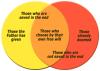
Draw a large circle and draw a line through the circle to make 2 halves (A & B). Draw a smaller circle (#1) in the first half (A), draw another circle (#2) that crosses over between both halves (A&B), and draw a circle (#3) in the second half (B).
A= Total of those saved in the end
B= Those not saved in the end
1= Those the Father has given (no choice) such as David, Solomon, Isaiah, the disciples, and whoever else God may have already called.
2= Those who choose by their own free will. (This is where the majority of all people are.)
3= Those already doomed. Possible reason: they already chose this route on their own (Judas for example)
So in this diagram I’ve made, everyone falls into two groups: saved in the end, not saved in the end. Then there are those who the Father by His power calls (group 1), whether the called realize it or not. That group automatically goes into the “saved in the end”. Then (group 2) there are those who have a choice. I think this is the majority of people. The individuals in that group are free to choose to follow God or reject God. Then (group 3) there is the group that has become hard-hearted and God has decided to let them go in the direction they already wished to go.
So the phrase “all that the Father gives Me” need not mean everyone who will be saved in the end. This means “all” in this group, at least, fit under the (A.1) category.
"No one can come to Me unless the Father who sent Me draws him; and I will raise him up on the last day. It is written in the prophets, 'AND THEY SHALL ALL BE TAUGHT OF GOD.' Everyone who has heard and learned from the Father, comes to Me.” John 6:44-45
Here, one of the main questions is, what type of “draw”? Is it dragging, kicking and screaming, or is it alluring, wooing, with the possibility of the wooer being denied? I found that the word used in this passage, helkuoo, can mean either one. Thus in the first part of this passage shows at least a possibility that the Father woos all people. We also should look at the passage to which Jesus is referring:
“All your children shall be taught by the LORD, and great shall be the prosperity of your children.” Isaiah 54:13
It’s clear that all the descendants of these Israelites would be taught by the LORD. The LORD is doing the acting. The children are doing the receiving. Now Jesus comments on this passage by saying “everyone who has heard (receptive) and learned (active)…” After teaching, I can certainly tell you, I can teach and teach until I’m blue in the face, but it’s the students’ choice if they want to learn. There’s the old proverb: you can lead a horse to water, but you can’t make him drink.
Compare that with this passage:
"And I, if I am lifted up from the earth, will draw all men to Myself." John 12:32
As to what type of drawing, I can guess, but it’s interesting that the previous passage says that the Father does the drawing. Here it is the Son that is doing the drawing. If the Son draws all, then it may follow that the Father also has drawn all.
Now with the last passage:
" ‘But there are some of you who do not believe.’ For Jesus knew from the beginning who they were who did not believe, and who it was that would betray Him. And He was saying, ‘For this reason I have said to you, that no one can come to Me unless it has been granted him from the Father.’ " John 6:64-65
I’d say this is a clarification of the previous passage in question (John 6:44-45) Here I’d also look at the tense of the statements: Jesus knew from the beginning who they were who did not believe and who would betray him. Note the distinction between the verbs used. It doesn’t say who would not believe. The “did” is already a past occurrence. The “would” refers to the future. It’s like saying “At that time, I knew you didn’t believe me, but I knew he would betray me.”
“From the beginning” does not necessarily mean “from the beginning of time”. Here’s what I found about this phrase in this passage:
From the very beginning (JB "from the outset"; NEB "all along") has reference either to the beginning of Jesus' ministry or to the time of his calling the disciples; it does not refer to the beginning mentioned in John 1:1. The same phrase is used in 16:4 and is translated at the beginning. From the very beginning may be rendered "from the day that he began to teach" or "all the time starting with the day he began to teach."
(from the UBS Handbook Series. Copyright (c) 1961-1997, by United Bible Societies)
Knew from the beginning eedei (NT:1492) ex (NT:1537) archees (NT:746). In the New Testament we have ex (NT:1537) archees (NT:746) only here and John 16:4, but ap' (NT:575) archees (NT:746) in apparently the same sense as here in John 15:27; 1 John 2:7,24; 3:11 and see Luke 1:2; 1 John 1:1. From the first Jesus distinguished between real trust in him and mere lip service (John 2:24; 8:31), two senses of pisteuoo (NT:4100).
(from Robertson's Word Pictures in the New Testament, Electronic Database. Copyright (c) 1997 by Biblesoft)
Well, I hope this helps. I wasn’t expecting the diagram to not show up. Oh well. Let me know what y’all think. Darn, this took another 2 hours to write!
(B) Those not saved in the end |
(A) Total of those saved in the end
|
(1) Those the Father has given (no choice) such as David, Solomon, Isaiah, the disciples, and whoever else God may have already called. |
(2) Those who choose by their own free will. (This is where the majority of all people are.) |
(3) Those already doomed. Possible reason: they already chose this route on their own (Judas for example) |  Post Edited By Moderator (Forum Administrator) : 6/8/2005 9:46:44 AM (GMT-5)
Image Attachment :
Venn.gif 13KB (image/gif)This image has been viewed 173 time(s). | | | |
| | Back to Top | | |
|
Starkman
Registered Member

Date Joined Oct 2001
Total Posts : 1747
| Posted 6/6/2005 7:12 AM (GMT -6) | | Hello Spiritus,
Start with your own life. Do you or do you not have the choice to choose in many, many instances? Do you really think those choices are predestined, predetermined or settled from eternity past so that you could never change the choices you will make in the future?
Plain, ol' life pretty well sets the record straight as I see it. I've used these examples before in my posts:
1. If God showed up at your door and told you that He was going to tell you EVERTHING you will do in the next five minutes (I mean EVERYTHING, since God knows would have to know all of or the Open View is true), would you be able to do everything He tells you, or would you be able to change it? I am thoroughly convinced that you could change it. Indeed, you couldn't do everything He told you.
2. You're sitting in God's Grand Theater watching your future on film (it's all been preserved on DVD, mind you, because celluloid is old stuff anymore!). You speed the DVD ahead in order to see what's coming down the pike. (Remember: EVERYTHING you will ever say, do, feel...every every itch you'll scratch, every blink you'll blink, every thought you'll think...EVERYTHING is known, because God either predestines it or because He simply knows it...if, that is, the Open View is not true.) Question: After watching the show, do you think that you would get up and go live it all EXACTLY as you saw it? No way. Impossible. You couldn't even if you tried to.
We humans are created in a way that makes it impossible for God to ever be able to say, "There! There it is. I now know everything...EVERYTHING that Spiritus will do in all the future." That time does not exist. There is simply is no time when it can be said that it's all known, because YOU prove daily that you can change it. We can't resort to saying that God has simple knowledge only of the future—that He doesn't predestine it, but only knows it—because the entire future is settled; it cannot be changed. There is thus no freedom and, as I pointed out, were God to show you your future, you COULD change it. It just doesn't work out experientially. (These examples are, admittedly, existential and not philosophical or theological. Nevertheless, they are as valid.)
Hope this helps in your quest,
Starkman
My teacher used to say that whenever he read Scripture, he would always ask the question, "What does this have to say about the character of God?" Working off his thinking, as I read Scripture, I have come to ask, "What does this have to say about the heart and passion of God's desire for relationship for us? | | Back to Top | | |
|
Nathan Straub
Registered Member
Date Joined May 2005
Total Posts : 50
| Posted 6/7/2005 2:31 PM (GMT -6) | | Starkman, I've already shown the impossibility of your "God's Grand Theatre" analogy here and the following page.
If God exhaustively knows the future, and showed the next year of your life to you, IF after viewing the film it was possible for you to affect those events based on that knowledge, then the film would have to include both your watching the film and how it affected your future choices. Then, because you saw on the film how watching your future would affect your future choices, the film would have to also include how watching the affect on your future of your choices based on watching the film would affect your future choices. And so on.
Your scenario is impossible because it includes an infinite regress. This shows the impossibility of COMMUNICATING exhaustive information to finite creatures, and also why God in His wisdom knows every detail of the future, including the exhausting causal chains, and yet only chooses to reveal to us a small part of it.
In your scenario, free will is possibly nullified by my knowledge of what I'm going to freely do, but not in the act itself, and especially not when that act is not influenced by such knowledge. | | Back to Top | | |
|
Tom
Registered Member

Date Joined Jul 2001
Total Posts : 10353
| Posted 6/7/2005 3:50 PM (GMT -6) | | SpiritusNaturae-
The OV debate ranges over all possible fronts—biblical, exegetical, theological, hermeneutical, philosophical, traditional, existential, and even scientific. It’s a worldview, why wouldn’t it? Some who are open theists came into the debate through the philosophical arguments. Others through the biblical. I’m an example of the latter. For me it was biblical/theological concerns that first won me. Then I suppose the existential fit. More recently the philosophical arguments have shored up my convictions. But whichever doorway you enter through, you have to eventually pass through the rest and make sense of things.
If those verses in John are the only verses that give you gas, then hey, count yourself blessed. As a traditional Arminianist you’d be blowing holes in your underwear. As a determinist you’d need a colostomy. The OV isn’t 100% free of all intelligible objection in the sense of having no possible weaknesses. Good luck in your search for such a full-proof theology. All views have holes. Guess what—we don’t understand all we shall. But some views have more holes than others. Given all eight ‘fronts’ of the debate, I’d say the OV has far fewer holes than the competition. Far fewer. If a few verses in John bother you, consider what you would have to deal with once you embrace one of the competing views.
Having said that, the verses in John would make a nice thread which may prove to treat, even alleviate, your gas. I’m suPPPPPer busy packing to move, so I can’t join such a discussion for the next month or so. Maybe later.
As for the earliest open theists I can think of? Oh, I guess I’d say Abraham. Then I’d throw in Samuel, David, and Jeremiah. Then there’s Paul and Peter. If you just want an early church example, there’s Calcidius (4th Century Christian philosopher). For Calcidius’ views, see J. Den Boeft, Calcidisus on Fate: His Doctrine and Sources (New York: E. J. Brill, 1977) and Calcidius, Timaeus a Calcidio translatus Commentarioque instrucus, ed. J. H. Waszink, 2nd ed., vol 4 of Plato Latinus (Leiden: E. J. Brill, 1975).
Hang on SN. Don’t give up.
Blessings,
Tom | | Back to Top | | |
|
Starkman
Registered Member
Date Joined Oct 2001
Total Posts : 1747
| Posted 6/7/2005 6:24 PM (GMT -6) | | | Hey Nathan,
Nathan: Starkman, I've already shown the impossibility of your "God's Grand Theatre" analogy here and the following page.
Starkman: Ah...no, no, no, my dear Nathan. You have most certainly not shown the impossibility of my analogy! You have only one argument, which is not really an argument. Here let me state back to you what I'm hearing you say: God must keep silent because He cannot communicate the future on film to a human; He has no way to avoid the problem of constant change within the film (infinite regress as you called it). You haven't proved anything here, though, Nathan. You have only made my point. (By the way, the link didn't work. It just gave me a page stating that the page couldn't be found.)
Nathan: If God exhaustively knows the future, and showed the next year of your life to you, IF after viewing the film it was possible for you to affect those events based on that knowledge, then the film would have to include both your watching the film and how it affected your future choices.
Starkman: Yes...IF God knew the future exhaustively. IF. The fact is, however, that since I can affect whatever it is that I am shown, the future is therefore not settled. The film cannot show me what I will do and have me do it exactly as I was shown. That's the whole point! Were it true that God's knowledge of the future were exhaustive, I would absolutely have to do all I saw and could do no differently. That, however, is not possible or our reality.
Nathan: Then, because you saw on the film how watching your future would affect your future choices, the film would have to also include how watching the affect on your future of your choices based on watching the film would affect your future choices. And so on.
Starkman: And here is where the weakness of your argument is most vulnerable, for you forget that the contents of the film itself must be settled. The film cannot change if the future is exhaustive. It will have always been settled, so the film would have always been what it is to be. Whatever actions actions I am to make in the future MUST be in the film, as you mentioned, as settled events. Hence, I can see what I will do. But the fact is that there is simply no time when all is settled; for the minute the future is said to be settled, I can change it (not all, but much of it). In other words, it can never be that God can say, "There! The future is exaustively settled, and I know it all exhaustively. I'll put it on film for all to see."
By the way, my same point is made in the analogy of Jesus coming into your house for a cup of joe, having decided to tell you your future. No matter what He says to you, Nathan, you could change it. There is simply no "time" when it's all locked in. Think about this, because you cannot miss that point. It's no different than the film analogy.
Nathan: Your scenario is impossible because it includes an infinite regress.
Starkman: No, it is possible just because of what you are calling "infinite regress." (By the way, it isn't infinity or regress going on here. There is simply an unknown future.) My scenario, is, in fact, reality. It's how we live, and it's why God cannot produce a film with everything settled in it.
Nathan: This shows the impossibility of COMMUNICATING exhaustive information to finite creatures,
Starkman: You see, God has to keep silent, in your view, because were He to simply show the film, it would have to constantly be changing...which is the very proof of my argument, Nathan. The film cannot be static, because our own reality demonstrates the impossibility of a settled future.
Nathan: and also why God in His wisdom knows every detail of the future, including the exhausting causal chains, and yet only chooses to reveal to us a small part of it.
Starkman: You've deduced two conclusions from one argument "Your scenario is impossible because it includes an infinite regress." Your second conclusion has no basis from this argument; for your argument that God cannot communicate exhaustive knowledge does not prove God has exhaustive knowledge. All you have done at this point, Nathan, is made a claim. You'll have to do more than this to substantiate it.
Nathan: In your scenario, free will is possibly nullified by my knowledge of what I'm going to freely do, but not in the act itself, and especially not when that act is not influenced by such knowledge.
Starkman: I'm afraid I don't follow you here. How is free will possibly nullified (either it is or it isn't, wouldn't you say?) because of your knowledge of what you are going to freely do but not in the act itself? I'm lost. 
Well, I'm on vacation, heading out the door manana (still don't know how to get that tilde over a letter), but I'll try and check the Board while I'm away.
Starkman
My teacher used to say that whenever he read Scripture, he would always ask the question, "What does this have to say about the character of God?" Working off his thinking, as I read Scripture, I have come to ask, "What does this have to say about the heart and passion of God's desire for relationship for us? | | Back to Top | | |
|
ThatDarnCat
Registered Member

Date Joined May 2005
Total Posts : 82
| Posted 6/8/2005 7:53 AM (GMT -6) | |
Nathan: and also why God in His wisdom knows every detail of the future, including the exhausting causal chains, and yet only chooses to reveal to us a small part of it.
If God has not laid out an exhaustive account of the future in scripture (and He hasn't), then either of two cases could be true:
1. He knows the future exhaustively and has only revealed what He's going to do in a few cases listed in scripture (most of which are volitional declarations)
2. He doesn't know the future exhaustively
There's no way you can prove 1. by a few instances of His volitional declarations because then, even I could prove my exhaustive knowlege of the future based on a few volitional declarations that I bring to pass.
Your buddy: "Pistons are gonna beat the Heat and advance to the final"
You: "Good guess!"
God: "Pistons are gonna beat the Heat and advance to the final"
You: "God, you know ALL THE FUTURE!"
Why ascribe to God, what you wouldn't ascribe to your buddy? That's a presupposition you have when you come to scripture.
Post Edited (ThatDarnCat) : 6/8/2005 8:42:19 AM (GMT-5) | | Back to Top | | |
|
Paul M. Blackmore
Registered Member
Date Joined Mar 2005
Total Posts : 53
| Posted 6/9/2005 6:22 AM (GMT -6) | | | There is no need for any one to get gas from the passages mentioned in John chapter 6.
" 37All that the Father giveth me shall come to me; and him that cometh to me I will in no wise cast out."
The Father has always had His "sheep" in this world (those who believed in Him), long before the coming of Christ into the world. Jesus simply points out that those "sheep" which were His Father's already would be given now to the Son. Witness Cornelious for example.
Such persons were "appointed to believe" as soon as they heard the gospel. They already belonged to the Father because they heard about God, were convicted of personal sin, and bowed their souls in faith to God the Father, long before they ever even heard of Christ. They chose to submit their souls to the Father.
The Father now chooses to hand those very souls over to His Son. Jesus said "My Father worketh hiterto, and I work". It's just that simple.
No need to get gas over this.
"44No man can come to me, except the Father which hath sent me draw him: and I will raise him up at the last day."
No big deal here either. God lights every man that cometh in the world. Its true that if He didn't do this, nobody would be saved. God tries to draw everyone in this manner, but not every man will allow Him to.
" 45It is written in the prophets, And they shall be all taught of God. Every man therefore that hath heard, and hath learned of the Father, cometh unto me."
Again, not all the Jews really knew the Father, although they claimed they did. Jesus said, "had ye believed Moses, ye would have believed me". The point being that all that were true sheep of His Father to start with, had no choice but to come to Christ when introduced to Christ, the Father's only begotten Son. They would recognize the Son's voice as their shepherd now, and from now in would pray to their Father in the name of the Son as instructed.
These verses are dealing with the transitition from a world that had not known Christ, to a world that Christ had now entered. This is the solution to the confusion over these passages.
" 64But there are some of you that believe not. For Jesus knew from the beginning who they were that believed not, and who should betray him.
65And he said, Therefore said I unto you, that no man can come unto me, except it were given unto him of my Father."
Again, the Father had hardened the unbelieving Jews in unbelief in order to accomplish His ends at Calvary. He raised up unbelievers (who were unbelievers by choice) to positions of power and influence in the Roman world, the Jewish world, and even inserted one such person into his own chosen group of 12 disciples.
Such hardened souls, were unable to come to Christ, at least untill the crucifixion was accoimplished. God refused to draw them until such time as they had played out the roles that their hearts were only too willing to fulfill.
Psalms 119
96I have seen an end of all perfection: but thy commandment is exceeding broad.
97O how love I thy law! it is my meditation all the day. | | Back to Top | | |
|
Paul M. Blackmore
Registered Member
Date Joined Mar 2005
Total Posts : 53
| Posted 6/13/2005 7:00 AM (GMT -6) | | |
In addition, I am not aware of a single verse or passage in the Holy Scritures, that proves that every minute detail of the future is fully known or fully determined by God.
Please point such out if you feel otherwise.
All that remains unknown to us in this matter, are the specific mechanisms by which God arranges and engineers specific parts of the future, in order to fulfill his prophecies on schedule.
I have many thoughts on this topic based upon what I observe from a careful reading of the Holy scriptures, but I am reluctant to wander into an area that is really the domain of God and not of men.
I will just say that predictability is largely founded upon the invariability of evil. God is invariably good. Satan and his forces are invariably evil.
God is in full control of the timetable by which the unfolding of the "mystery of iniquity" becomes unraveled. The spiritual powers that are given permission to have influence for certain set times and seasons, are completely predictable to God. Men who have chosen to become God rejectors, thereby become comepletely predictable as well.
God manages the future by restraint of what is fully predictable. He needs never to instigate the evil, only to restrain it to a greater or lesser degree.
Regards
Paul M. Blackmore
Psalms 119
96I have seen an end of all perfection: but thy commandment is exceeding broad.
97O how love I thy law! it is my meditation all the day. | | Back to Top | | |
|
Lee Merrill
booted

Date Joined Jun 2001
Total Posts : 723
| Posted 6/18/2005 12:48 PM (GMT -6) | | Hi everyone,
Paul said...
" 37All that the Father giveth me shall come to me; and him that cometh to me I will in no wise cast out." The Father has always had His "sheep" in this world (those who believed in Him), long before the coming of Christ into the world.
John 6:39 And this is the will of him who sent me, that I shall lose none of all that he has given me, but raise them up at the last day.
Now surely this doesn't refer just to people who were fearing God then, who would yet believe in Jesus. The scope here indeed seems to be all believers.
Paul said...
"44No man can come to me, except the Father which hath sent me draw him: and I will raise him up at the last day." No big deal here either. God lights every man that cometh in the world. Its true that if He didn't do this, nobody would be saved. God tries to draw everyone in this manner, but not every man will allow Him to.
This I think won't do, though, if "draw him" and "raise him" apply to the same (singular! indicating an individual) person.
Paul said...
The point being that all that were true sheep of His Father to start with, had no choice but to come to Christ when introduced to Christ, the Father's only begotten Son.
Then they don't have free will in this area of salvation? Well, I agree, but I don't think this is Open View.
Paul said...
od refused to draw them until such time as they had played out the roles that their hearts were only too willing to fulfill.
But Pilate was unwilling, was he not?
Acts 3:13 The God of Abraham, Isaac and Jacob, the God of our fathers, has glorified his servant Jesus. You handed him over to be killed, and you disowned him before Pilate, though he had decided to let him go.
ThatDarnCat said...
Why ascribe to God, what you wouldn't ascribe to your buddy?
Because your buddy can't predict that there will always be Jewish people? And be right?
That involves a lot of (OVT would say free?) human choices...
Isaiah 46:10 I make known the end from the beginning, from ancient times, what is still to come.
He doesn't say "guess," he is not estimating! He declares it, and this is the reason:
Isaiah 46:10 I say: My purpose will stand, and I will do all that I please.
And that's not what your buddy would say, about the future...
Blessings,
Lee
==================================================
"Even now we seem to have dim glimpses into regions
from which we receive no word to bring away" (George MacDonald)Post Edited (Lee Merrill) : 6/18/2005 12:51:10 PM (GMT-5) | | Back to Top | | |
|
Paul M. Blackmore
Registered Member
Date Joined Mar 2005
Total Posts : 53
| Posted 6/18/2005 10:53 PM (GMT -6) | | |
Hello everyone;
Lee Merrill said,
"John 6:39 And this is the will of him who sent me, that I shall lose none of all that he has given me, but raise them up at the last day.
Now surely this doesn't refer just to people who were fearing God then, who would yet believe in Jesus. The scope here indeed seems to be all believers."
I disagree. Just two verses earlier we read " 37All that the Father giveth me shall come to me; and him that cometh to me I will in no wise cast out."
"All that the Father has given me" is clearly not talking about "all believers". Two groups of people are identified in verse 37. Those currently belonging to the Father (which had now been handed over to the Son), and those who would from then on, come to the Father via their faith in Christ.
It is true that "all believers" will hear The voice of Christ calling them out of their graves, but so will "all men", belivers and unbelievers alike. In the previous chapter we read,
"28Marvel not at this: for the hour is coming, in the which all that are in the graves shall hear his voice,
29And shall come forth; they that have done good, unto the resurrection of life; and they that have done evil, unto the resurrection of damnation."
I submit that the point is being made that it is now "Christ" who must be reckoned with as the judge of the living and the dead. People must look now to Christ if they would "come to the Father".
The focus in John 6 is Christ's authority and entitlement to all that was truly the possession of His Father. What was truly the possession of His Father was just as truly now His own possession. Such sheep had no ability to resist this handover of property from Father to Son.
"All that the Father has given me, will come to me"
" 26But ye believe not, because ye are not of my sheep, as I said unto you.
27My sheep hear my voice, and I know them, and they follow me:
28And I give unto them eternal life; and they shall never perish, neither shall any man pluck them out of my hand.
29My Father, which gave them me, is greater than all; and no man is able to pluck them out of my Father's hand.
30I and my Father are one." John 10
This being the grand point of it all. Christ was and is "one with His Father". All who were already for God, would now become followers of Christ, and the Son had His Father's explicit approval and blessing to say such things.
Regards
Paul M. Blackmore
Psalms 119
96I have seen an end of all perfection: but thy commandment is exceeding broad.
97O how love I thy law! it is my meditation all the day. | | Back to Top | | |
|
Paul M. Blackmore
Registered Member
Date Joined Mar 2005
Total Posts : 53
| Posted 6/18/2005 11:38 PM (GMT -6) | |
Lee Merrill said...But Pilate was unwilling, was he not?
Acts 3:13 The God of Abraham, Isaac and Jacob, the God of our fathers, has glorified his servant Jesus. You handed him over to be killed, and you disowned him before Pilate, though he had decided to let him go.
In the game of Chess, pieces of value regularly get "pinned" to the "king" that they are bound to serve and defend. We get to choose whether we want to play on the side of light or darkness. Having chosen the side that we will serve, our lives become destinies that are very much in the hands of the "chessmasters" that we respectively serve. Chess pieces do not have "free-will" but become pieces to be played in the great contest for souls that God wages with Satan.
Those who have chosen to serve the "king of darkness" can raise no just complaint when God manouvers in such a manner as to pin them(harden them momentarily) in a position, that they willingly allowed themslves to be placed into in the first place. After all, thay got to choose the "chessmaster" of their choice did they not?
It is not my place to defend or support "open-theism". I just want people to understand what things I have come to understand that the Bible teaches about the workings of fate, faith, and the universe in general. I do not call myself an "open-theist". I personally refuse the label.
The "open view" is in my opinion, an incomplete, "irreverent at times", look at the interactions between God and men down through the ages. As a movement, it has much to learn about respect for God's right to predetermine certain aspects of the future, and just what the mechanisms are that enable God to accomplish His objectives without fail.
That being said, it is the most Biblically and logically sound approach, to understanding how things really work in this universe of ours. Calvinists need to get off their high horses and begin to help expand this "best view" of how God conducts His business with men.
Blessings in Christ
Paul M. Blackmore
Psalms 119
96I have seen an end of all perfection: but thy commandment is exceeding broad.
97O how love I thy law! it is my meditation all the day. | | Back to Top | | |
|
Lee Merrill
booted
Date Joined Jun 2001
Total Posts : 723
| Posted 6/19/2005 2:59 PM (GMT -6) | | Hi Paul,
Paul said...
"All that the Father has given me" is clearly not talking about "all believers". Two groups of people are identified in verse 37. Those currently belonging to the Father (which had now been handed over to the Son), and those who would from then on, come to the Father via their faith in Christ.
But in verse 37, the tense is present tense, not past tense: "All the Father [present tense] gives me will come," not "All the Father has given me will come." And commentators do seem to take this as referring to all believers:
"... but the whole body of the elect are here meant" (Gill)
"Observe, what is given Him by the Father is expressed in the singular number and neuter gender—literally, 'everything'; while those who come to Him are put in the masculine gender and singular number—'every one.' The whole mass, so to speak, is gifted by the Father to the Son as a unity, which the Son evolves, one by one, in the execution of His trust. So #Joh 17:2, "that He should give eternal life to all that which Thou hast given Him" [BENGEL]." (Jamieson, Fausset, Brown)
"Collective use of the neuter singular, classic idiom, seen also in #6:39; 17:2,24; 1Jo 5:4." (Robertson's NT Word Pictures)
And 1 John 5:4 is "For whoever is born of God overcomes the world."
Which must mean all believers.
Paul said...
30I and my Father are one." John 10
This being the grand point of it all. Christ was and is "one with His Father". All who were already for God, would now become followers of Christ, and the Son had His Father's explicit approval and blessing to say such things.
I agree, yet I don't think that is what is being said in John 6...
Various folks said...
Lee: But Pilate was unwilling, was he not?
Paul: Having chosen the side that we will serve, our lives become destinies that are very much in the hands of the "chessmasters" that we respectively serve.
Then how are people converted? Once they choose to serve the devil? God actually takes chess pieces from the devil, though they cannot deliver themselves (I agree!), God can, and only he can, without our help, as in rasing the dead (Eph. 2:5), being born (Jn. 3; 1 Pt. 1:23; ...), or in Creation (2 Cor. 4:6), all passive analogies.
Paul said...
Calvinists need to get off their high horses and begin to help expand this "best view" of how God conducts His business with men.
Well, I think the Open View is not the best view, if we cannot say of our buddy, what we can read of God here:
Isaiah 46:10 I say: My purpose will stand, and I will do all that I please.
Now we cannot say this about the future, ourselves, and if God is estimating, and may be wrong, he cannot say this either. Only, he did!
Blessings,
Lee
==================================================
"Even now we seem to have dim glimpses into regions
from which we receive no word to bring away" (George MacDonald)Post Edited (Lee Merrill) : 6/20/2005 10:07:45 PM (GMT-5) | | Back to Top | | |
|
Paul M. Blackmore
Registered Member
Date Joined Mar 2005
Total Posts : 53
| Posted 6/20/2005 5:01 AM (GMT -6) | |
Lee Merrill said...
Hi Paul,
Paul said...
"All that the Father has given me" is clearly not talking about "all believers". Two groups of people are identified in verse 37. Those currently belonging to the Father (which had now been handed over to the Son), and those who would from then on, come to the Father via their faith in Christ. But in verse 37, the tense is present tense, not past tense: "All the Father [present tense] gives me will come," not "All the Father has given men will come."
So by your reckoning, the group mentioned in verse 39 must be yet another group. The past tense is used to describe them.
"John 6:39 And this is the will of him who sent me, that I shall lose none of all that he has given me, but raise them up at the last day.
Your point has no merit. The transfer of ownership of the Father's sheep to the Son, was a work in process during the ministry of Christ. It continued on for a time even after Christ was crucified.
It is equally correct to speak of this "gifting" if you will, as a thing happening in the present tense, or as a thing deeded prior to the actual transfer.
John 8: 30As he spake these words, many believed on him."
The transfer of ownership was indeed a work in process.
Your appeal to Bible commentators carries little weight with me.
Your continued efforts to point out the foolish "meowwwsings" of "that darn cat", show just how weak your position really is.
Surely you do not conclude that we are all part of some grand puppet show because of such things do you? I have given the explanation of the troublesome verses pointed out in John 6. My explanation stands.
Regards
Paul M. Blackmore
Psalms 119
96I have seen an end of all perfection: but thy commandment is exceeding broad.
97O how love I thy law! it is my meditation all the day. Post Edited (Paul M. Blackmore) : 6/20/2005 5:29:48 AM (GMT-5) | | Back to Top | | |
|
Acolyte
Registered Member
Date Joined Jun 2005
Total Posts : 42
| Posted 6/20/2005 5:41 PM (GMT -6) | | | And now for something totally different.
John 6 v. 37 has two clauses that are unpacked in v. 39 and v. 40. The crucial distinction here is between the general and the particular, or what amounts to the same thing, nature and person.
Christ is the source of life for all, not Moses or anyone else. This is the theme of the chapter.
Christ takes up all of human nature en toto in the incarnation and therefore loses nothing that the Father gives him. This is why v. 39 is neuter. All are raised up.
Everyone gets eternal existence and is therefore saved from annihilation, which is why Christ is the savior of all men, but especially of those who believe. 1 Tim 4:10, 2 pet 2:1. How people spend their eternal existence is up to the personal use of their natural freedom.
All come to Christ since all are raised up, but some come with faith and hence are not cast out. The critical distinction is between person and nature.
Acolyte
| | Back to Top | | |
|
Lee Merrill
booted
Date Joined Jun 2001
Total Posts : 723
| Posted 6/21/2005 8:23 PM (GMT -6) | | Hi everyone,
Various folks said...
Lee: But in verse 37, the tense is present tense, not past tense: "All the Father [present tense] gives me will come," not "All the Father has given me will come."
Paul: So by your reckoning, the group mentioned in verse 39 must be yet another group. The past tense is used to describe them.
But "gives me" could indicate a continuation of the process that chose the previous people, in verse 39. Actually! I hold that "given me" did not occur within time, at all, and refers to all people God chooses, or has ever chosen, or ever will choose.
Paul said...
The transfer of ownership of the Father's sheep to the Son, was a work in process during the ministry of Christ. It continued on for a time even after Christ was crucified.
But then how is it that "all mine are [present tense] yours, and all yours are mine," in John 17:10?
Paul said...
John 8: 30As he spake these words, many believed on him." The transfer of ownership was indeed a work in process.
But these, Jesus said belonged to the devil, after they were said to have believed, so I would say this indicates believing about Jesus, that he was the Messiah, but was not actually saving faith.
Paul said...
Surely you do not conclude that we are all part of some grand puppet show because of such things do you?
No, I believe Jesus sets people free, then they can really choose!
1 Corinthians 9:1 Am I not free?
Acolyte said...
Everyone gets eternal existence and is therefore saved from annihilation, which is why Christ is the savior of all men, but especially of those who believe.
But those who are sent to the lake of fire are said to not be saved:
Philippians 1:28 This is a sign to them that they will be destroyed, but that you will be saved-- and that by God.
Acolyte said...
How people spend their eternal existence is up to the personal use of their natural freedom.
But Peter might disagree here?
1 Peter 2:7-8 Now to you who believe, this stone is precious. But to those who do not believe, "The stone the builders rejected has become the capstone," and, "A stone that causes men to stumble and a rock that makes them fall." They stumble because they disobey the message-- which is also what they were destined for.
Blessings,
Lee
==================================================
"Even now we seem to have dim glimpses into regions
from which we receive no word to bring away" (George MacDonald) | | Back to Top | | |
|
Acolyte
Registered Member
Date Joined Jun 2005
Total Posts : 42
| Posted 6/21/2005 8:40 PM (GMT -6) | | Lee,
I take the Bible to be true, but I don’t think this implies that I have to take the bible literally. I think Philp means sign in terms of warning and I don’t think warnings render things inevitable. Moreover, those who go to the lake of fire are said to be under Christ’s jurisdiction, because he holds the keys and hence authority over them. Even those who are lost are saved in terms of redemption even if they refuse on a personal level to co-operate with God’s love. They are redeemed in terms of their nature even if they are not in terms of their person. Hell is hell because people are unprepared and improperly oriented to the Light that is God and this is why Hell is not an absence of God. Christ looses nothing, not even those who deny him. 2 Pet 2:1 If we balk at the idea that they are saved at the level of nature, then we have to balk at the incarnation in which God takes upon himself humanity in its entirety and not just an instance of it.
I agree with Peter that Jesus became elevated and was the foundation for the rescuing of humanity. The Bible doesn’t give us an explication of “cause” here. Is this efficient causation? Final causation? Is this cause in the sense contributing cause? I am not OV, but we have to be wary of reading specific notions of causation into the biblical text. Historically, cause just meant “explanation” or “reason.” It seems to me that the stone is one and the same and what differentiates the persons is how they are oriented to it not how the stone is oriented to them. They are set to a destination because of their unbelief, not irrespective of it. This end is not made inevitable logically prior to or apart from their unbelief, which is why they are responsible, or so I would argue. They stumble because they disobey. | | Back to Top | | |
|
Paul M. Blackmore
Registered Member
Date Joined Mar 2005
Total Posts : 53
| Posted 6/21/2005 10:02 PM (GMT -6) | |
Lee Merrill said...
Paul said...
The transfer of ownership of the Father's sheep to the Son, was a work in process during the ministry of Christ. It continued on for a time even after Christ was crucified. But then how is it that "all mine are [present tense] yours, and all yours are mine," in John 17:10?
You continue to obsfucate, whining about tenses.
The Father is one with the Son. Verse 17 reads " 22....... that they may be one, even as we are one:"
From this perspective, what belonged to the Father, belongs to the Son. What belongs to the Father, belongs to the Son. What will belong to the Father, will belong to the Son as well.
Again, your objection fails.
Furthermore, a broader view of the passage you quoted from reveals the following.
Jesus said...
I have manifested thy name unto the men which thou gavest me out of the world: thine they were, and thou gavest them me; and they have kept thy word. Now they have known that all things whatsoever thou hast given me are of thee. For I have given unto them the words which thou gavest me; and they have received them, and have known surely that I came out from thee, and they have believed that thou didst send me. I pray for them: I pray not for the world, but for them which thou hast given me; for they are thine. And all mine are thine, and thine are mine; and I am glorified in them.
"Thine they were, and Thou gavest them me."
Well maybe the Father did give such as belonged to Him in the first place, to the Son after all. 
The oneness of the Son with the Father still does not negate the Biblical fact, that souls were in truth, deeded from Father to Son. ( tenses notwithstanding) 
1st Corinthians 15:
"27For he hath put all things under his feet. But when he saith all things are put under him, it is manifest that he is excepted, which did put all things under him.
28And when all things shall be subdued unto him, then shall the Son also himself be subject unto him that put all things under him, that God may be all in all."
Blessings in Christ
Paul M. Blackmore
Psalms 119
96I have seen an end of all perfection: but thy commandment is exceeding broad.
97O how love I thy law! it is my meditation all the day. | | Back to Top | | |
|
Lee Merrill
booted
Date Joined Jun 2001
Total Posts : 723
| Posted 6/23/2005 8:40 PM (GMT -6) | | Hi everyone,
Acolyte said...
I think Philp means sign in terms of warning and I don’t think warnings render things inevitable.
But "not being frightened in any way" implies a sure result, does it not? Thus I think the next clause indicates a sure destruction, as well.
Acolyte said...
Historically, cause just meant “explanation” or “reason.”
But a reason can be a final cause, it generally is.
Acolyte said...
They are set to a destination because of their unbelief, not irrespective of it.
Well, what is the message they were destined to disobey, is it not the gospel?
1 Peter 2:2-3 Like newborn babies, crave pure spiritual milk, so that by it you may grow up in your salvation, now that you have tasted that the Lord is good.
So then they were destined to disobey the gospel, and thus their unbelief also was what they were destined for, causing them, subsequently, to stumble, and thus the decision of salvation is not in their hands.
Various folks said...
Lee: But then how is it that "all mine are [present tense] yours, and all yours are mine," in John 17:10?
Paul: From this perspective, what belonged to the Father, belongs to the Son. What belongs to the Father, belongs to the Son. What will belong to the Father, will belong to the Son as well.
I agree! So then people could not possibly make a transition, from first belonging to the Father, but not really belonging to the Son, to then belonging both to the Father and the Son.
Paul said...
The oneness of the Son with the Father still does not negate the Biblical fact, that souls were in truth, deeded from Father to Son.
Yes, I agree, one verse does not erase the other one, and I think that the view that the primary reference here is to a gift that did not occur in time at all, resolves this better than saying that people were given to Jesus, at various times during and after his ministry, and that they did not really belong to Jesus before they were given, which we have said is impossible.
"And when all things shall be subdued unto him, then shall the Son also himself be subject unto him that put all things under him, that God may be all in all."
Yes, but this does not indicate the time of when the people Jesus prayed for, were given to Jesus...
Blessings,
Lee
==================================================
"Even now we seem to have dim glimpses into regions
from which we receive no word to bring away" (George MacDonald) | | Back to Top | | |
|
Paul M. Blackmore
Registered Member
Date Joined Mar 2005
Total Posts : 53
| Posted 6/24/2005 6:06 AM (GMT -6) | | |
Dear brother Merrill:
I decline to follow you down the road of "timelessness". The use of such an exit renders your "tense" arguments null and void, and precludes any further discussion with you in matters involving a "before and after" of any sort.
I see you using a similar exit when pinned down with the problem of Calvin's teaching on "getting new life before the exercise of saving faith".
Similarly, the burden of fact contained in the following passage would no doubt cause you to play the "timeless" or "anthropomorphic" card as well.
I've had a bellyfull of such obsfucatorical nonsense from Calvinists on other boards, and I refuse to entertain any more of it. ( for the moment anyway )
Here now is the promised quote. Take your exit from this passage using whatever excuse you like. It matters not to me.
Genesis 22:12And he said, Lay not thine hand upon the lad, neither do thou any thing unto him: for now I know that thou fearest God, seeing thou hast not withheld thy son, thine only son from me.
God searches hearts the heart of man with good reason. He did not forget what He wrote in those hearts from time immemorial as you would have us believe.
Rather, we are living in a real-life, real-time, interactive drama with God in heaven, where real hope and real possibilities for good really exist.
I leave you to your unbiblical beliefs bequeathed to so many of the simple, by that "mischievious pointy-bearded beheader" known to the world as John Calvin. 
Regards
Paul M. Blackmore
Psalms 119
96I have seen an end of all perfection: but thy commandment is exceeding broad.
97O how love I thy law! it is my meditation all the day. | | Back to Top | | |
|
Lee Merrill
booted
Date Joined Jun 2001
Total Posts : 723
| Posted 6/25/2005 9:04 PM (GMT -6) | | Hi everyone,
Paul said...
Genesis 22:12 And he said, Lay not thine hand upon the lad, neither do thou any thing unto him: for now I know that thou fearest God, seeing thou hast not withheld thy son, thine only son from me.
... we are living in a real-life, real-time, interactive drama with God in heaven, where real hope and real possibilities for good really exist.
Well, the Septuagint translates this in a way that can mean "now I have known," as in Young's translation:
"... for now I have known that thou art fearing God, and hast not withheld thy son, thine only one, from Me.’
Acolyte said...
I agree that it implies a sure result, but the result is “sure” because the antecedent conditions were fulfilled by the agents. I don’t see what is problematic about that.
But then it's sure, and at least from now on they have no choice, I'm not sure the OVT or free-will folks would be happy with that. But there are other verses that show that people do not have freedom to choose salvation, that God's choice is behind their choice:
LA 3:37 Who can speak and have it happen if the Lord has not decreed it?
MT 28:18 Then Jesus came to them and said, "All authority in heaven and on earth has been given to me."
This does imply that unbelievers then, must not have real authority.
Acolyte said...
It is true that a reason can be a final cause but why would final causation be antithetical to free will?
I agree that a final cause does not prohibit free will.
Acolyte said...
The passage doesn’t say that they were destined and then disbelieved. The passage in Peter says that they disbelieved and because of that they were destined to destruction.
Destined to disobey, though, destined to stumble, that is what Peter says! So then what were they destined to disobey, if not the gospel?
Blessings,
Lee
==================================================
"Even now we seem to have dim glimpses into regions
from which we receive no word to bring away" (George MacDonald) | | Back to Top | | |
| 48 posts in this thread.
Viewing Page : 1 2 |
| Forum Information | Currently it is Monday, November 09, 2026 5:35 PM (GMT -6)
There are a total of 97,718 posts in 6,040 threads.
In the last 3 days there were 0 new threads and 0 reply posts. View Active Threads
|
Forum powered by dotNetBB v2.42EC SP3
dotNetBB © 2000-2026 |
|
|